

Buyers who search for an industrial tablet distributor, vendor or supplier are asking one question under three different words: who should I buy from? CF-Device is a manufacturer, so we are not neutral, but the honest answer is that it depends on two things — how many units you need and how much of the product you need changed. For a small order of a standard unit a distributor is often the better source. Once the order grows or the requirement stops being standard, the manufacturer is the only party who can actually deliver it.
TL;DR
- “Distributor”, “vendor” and “supplier” are loose labels — judge a source by what it can change, not what it calls itself
- Under about 20 units of a standard model, a distributor with regional stock and local warranty is often the right call
- Custom I/O, a pre-installed software image or a new board can only come from a manufacturer that owns the production line and firmware
- A custom or contract build is decided in the agreement — design ownership, patch delivery and change notification matter more than unit price
- CF-Device builds the VCM range and TANK V2 in-house (SMT, assembly, Android 11.0 / Linux 5.10 firmware), ISO 9001:2015 certified, shipping 140,000+ units a year to 33 countries
What Is the Difference Between a Distributor, Vendor, Supplier and Manufacturer?
Catalogues use these words interchangeably, which is why they tell you very little. The useful way to separate them is by what each can do for you after the order is placed.
| Label | What it usually means | Holds stock | Can change the product |
|---|---|---|---|
| Distributor | Authorised regional seller of a maker’s catalogue | Yes | No, but handles local warranty |
| Reseller / trading company | Buys finished units and resells them | Sometimes | No |
| Vendor / supplier | Any of the above — the word carries no information | Varies | Ask |
| Manufacturer | Owns the design, tooling and firmware | Builds to order | Yes, including the OS |
| Contract / ODM manufacturer | Builds a product to your requirement | Builds to order | Yes, to your spec |
The two vague rows are where buyers get caught. A company calling itself an industrial tablet supplier may be any row above it. The quickest way to find out is to ask for something non-standard, such as a fourth CAN channel, and see who answers with a lead time and who says they must check with the factory. The full set of checks is in rugged tablet manufacturers: how to tell a real maker from a reseller.
Which Source Fits Which Order?
CF-Device sends buyers to a distributor when that is genuinely the better route, because a mismatched order costs the buyer more than it earns us. The pattern is consistent enough to write down:
| Your situation | Best source | Why |
|---|---|---|
| A handful of standard units, local service matters | Distributor | Regional stock and a nearby warranty contact |
| Standard catalogue unit, lowest price, no support needed | Reseller | Cheapest route, with no recourse if the board changes |
| A fleet standardising on one platform | Manufacturer direct | Same unit available in year four, with notice of any change |
| Extra CAN or RS485 port, or a pre-installed software image | Manufacturer direct | Only the party that owns firmware and the board can do it |
| New board, new housing, your own form factor | Contract / ODM manufacturer | Engineering and tooling sit with the maker |
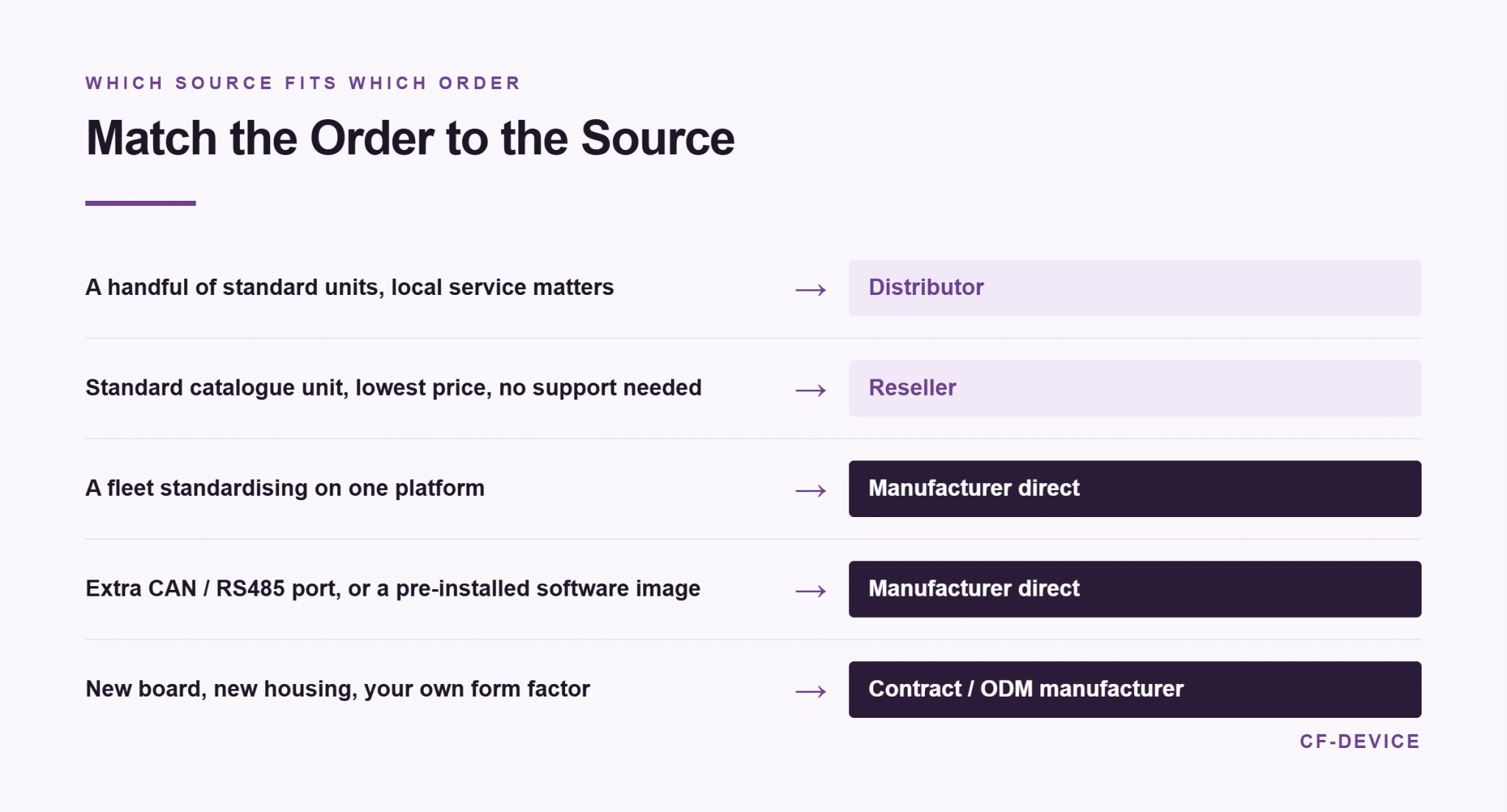
The crossover is not a precise number, but below roughly 20 units a distributor holding stock can compete on both price and speed. Beyond that, or the moment the requirement is not on a datasheet, buying direct becomes clearly better. Most “OEM” enquiries turn out to need only the lower customisation levels, which is covered in the five levels of industrial tablet OEM and ODM.
What Does a Custom or Contract Tablet Build Actually Involve?
Buyers searching for a custom tablet manufacturer or contract tablet manufacturers often picture a long, expensive project. Most are shorter than expected, because the real requirement is smaller than the first brief. The sequence CF-Device works through is:
- Describe the problem, not the spec — a terminal that survives cold storage, a screen that fits one cab. The lowest customisation level that solves it usually wins
- Scope to the lowest level — branding, software image, I/O change, board revision or new housing, in rising order of cost and time
- Sample and validate on the real machine — before any volume is committed
- Agree the terms — the checklist below
- Produce and deliver — with the same unit still orderable later
- Support over the service life — patches, spares and repair
Timing depends heavily on the level. In CF-Device’s experience a software image plus one extra CAN channel is roughly an eight-week, moderate-MOQ project, while a new housing means tooling and re-certification and runs closer to six months at higher volume. Which of those you need is usually decided at step two, which is why it is worth getting right.
What Should a Contract Manufacturing Agreement Cover?
The unit price is the least important line in the agreement. These are the points that decide whether the deployment is still viable in year three:
- Who owns what — the design, the firmware, and the right to modify either
- How patches arrive — a manufacturer that builds its own OS and OTA pipeline can issue a fix; one that does not can only forward your report
- Change notification — written notice before any board, component or firmware revision, so the same model number never quietly means different hardware
- Lifecycle and last-time-buy notice — how long the model is built and how much warning you get before it stops
- Test documentation — which standards and methods the unit was tested against, and whose company name is on the report
- Warranty and repair route — where a failed unit goes and how long it takes to come back
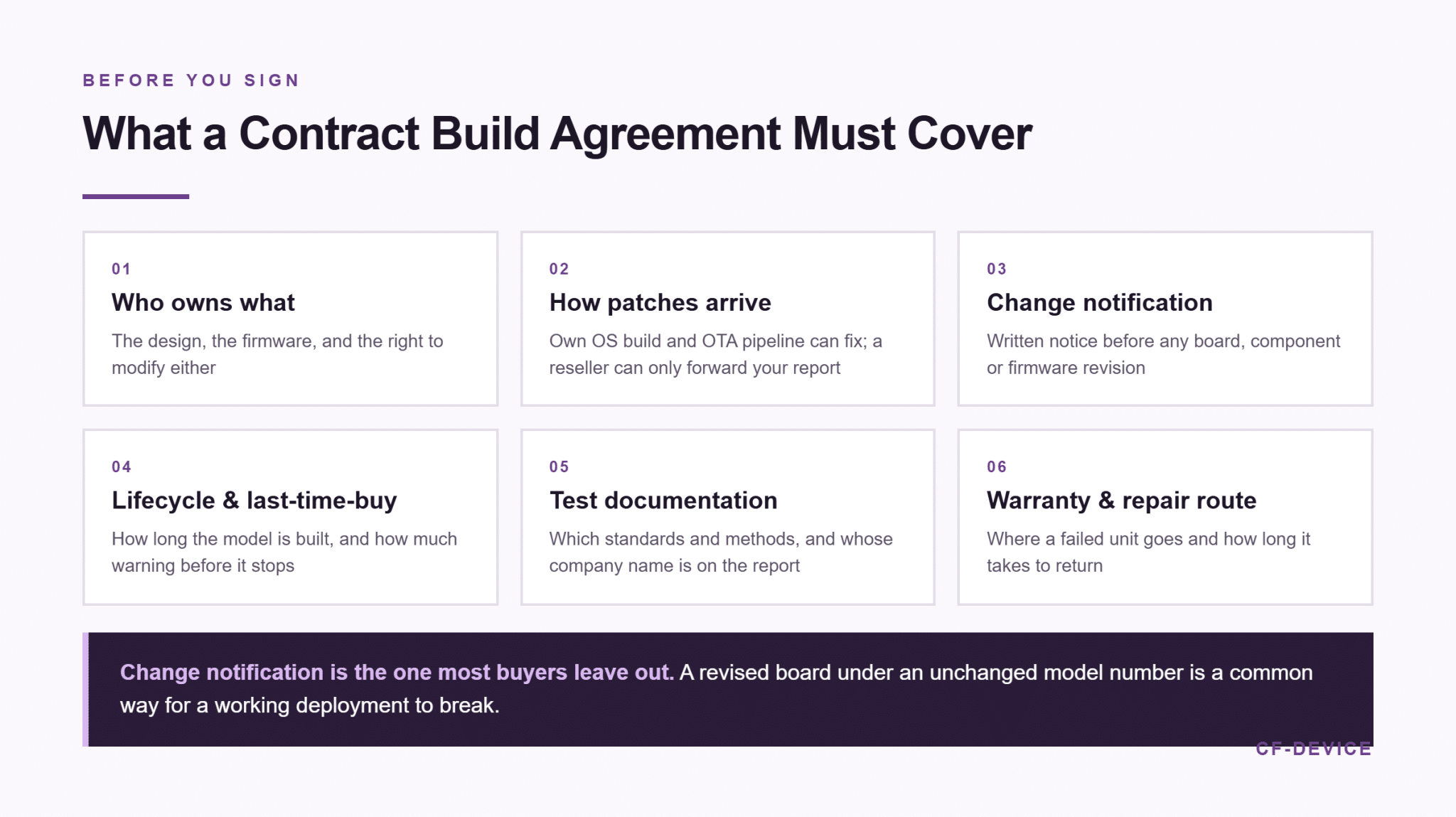
Change notification is the one most buyers leave out and most regret. A revised board with a different CAN controller under an unchanged model number is a common way for a working deployment to break, and it only happens when the supplier does not control the design. The same logic, applied across the five supplier tiers, is set out in industrial PC manufacturers: five kinds of supplier.
Does It Matter Whether a Tablet Manufacturer Is Based in the USA?
Buyers who search for tablet manufacturers in the USA are usually trying to solve service and delivery, not nationality. Country of manufacture is not what decides reliability; ownership of the design and the production line is. A Shenzhen factory that owns its tooling and firmware can commit to a lifecycle, and a trading company anywhere cannot.
What a US-based source does offer is proximity. CF-Device, based in Shenzhen with R&D centres in Beijing and Shenzhen, handles warranty through RMA with regional logistics rather than a local service centre. For a buyer who needs a repair turned around in days, a regional distributor can be faster, and we say so. For a buyer who needs the product itself to be different, a distributor cannot help whatever its location.
What Does the Move From Distributor to Direct Usually Look Like?
A common pattern is a pilot bought through a distributor and a rollout bought direct. The pilot proves the unit works on the real machine, and it often reveals the one thing a standard unit lacks — an extra interface or a pre-loaded application. That finding is what justifies moving to the manufacturer. Because CF-Device’s VCM models share one platform, mounting standard and 5–36V DC power specification, moving from a standard unit to a customised one later does not mean requalifying the installation. The hardware framework behind that is in our rugged vehicle tablet hardware buyer’s guide.
Frequently Asked Questions
Is an industrial tablet vendor the same as a supplier?
In practice yes — both are vague terms covering any seller from a trading company to a manufacturer. Ask what the company can change about the product; that answer tells you what it actually is.
Can a distributor customise an industrial tablet?
Generally not beyond what the manufacturer already offers. Changing an interface, the firmware or the housing needs the party that owns the board and the software.
What is the difference between OEM and contract manufacturing?
OEM usually means an existing product built to your branding and configuration. Contract or ODM work means the manufacturer designs or builds to your requirement. Most enquiries described as one are the other, so state which you mean before asking for a quote.
What does CF-Device customise?
All five levels, from branding and software images through I/O configuration and board revisions to new housings, in-house across the VCM range, with Android 11.0 / Linux 5.10 dual-OS builds and an OTA pipeline it maintains itself. Units are rated IP65–IP67, accept 5–36V DC with ignition sense and operate from −30°C to +70°C.
Once a fleet is deployed, keeping the units updated is the next decision, covered in MDM remote device management.
Interested in specs, OEM options, or a quote? Contact our team to discuss a custom or contract build directly with the manufacturer.