

Search “rugged tablet manufacturers” and the results mix three very different kinds of company: actual manufacturers, trading companies reselling other people’s hardware, and regional distributors. All three present themselves the same way on a website. The difference only becomes visible once your requirement becomes specific — a non-standard I/O configuration, a certification report, a five-year supply commitment. CF-Device sits in the first category: in-house SMT and assembly, own firmware, ISO 9001:2015 certified.
TL;DR
- A genuine manufacturer owns the BOM, the tooling, and the firmware — a reseller owns none of them
- Ask for actual test reports, not “IP65 compliant” wording on a datasheet
- Interface customisation is the fastest way to identify who really builds the hardware
- Model lifecycle commitment matters more than unit price on a multi-year fleet deployment
- Firmware ownership determines whether you get security patches in year three
- CF-Device: founded 2018, ISO 9001:2015 (cert. 00121Q310921R0S/4403), 140,000+ units shipped annually to 33 countries
Three Kinds of Company Rank for the Same Search
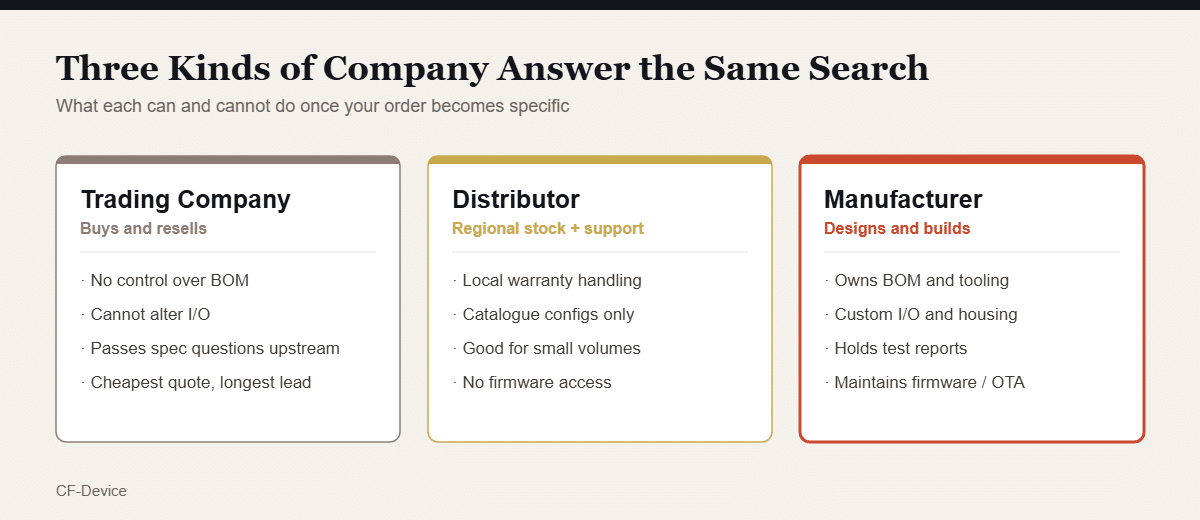
In short: a manufacturer can change the product; a reseller can only change the price.
None of these three is inherently the wrong choice. A distributor is often the right partner for a ten-unit order needing local warranty service. A trading company can be genuinely useful when the requirement is a standard catalogue product at the lowest possible price. The problem is only when a buyer needs manufacturer-level capability — custom interfaces, documented certification, long-term supply — and doesn’t discover until three months in that their supplier can’t provide it. The same tier structure applied to the wider industrial computing category is broken down in industrial PC manufacturers: five kinds of supplier.
Question One: Can They Change the I/O Configuration?
This is the single fastest diagnostic. Ask whether a unit can be built with, say, four CAN channels instead of two, or an additional RS485 port, or camera inputs in a non-standard combination. A manufacturer will answer with a lead time and an MOQ. A reseller will answer with whatever is already in the catalogue, or will say they need to “check with the factory” — which tells you where the actual manufacturer sits in the chain. CF-Device ships four SocketCAN channels as a standard configuration on the VCM V12 PRO and S10-2 PRO, and scopes further interface changes as normal engineering work.
Interface configuration matters more than most buyers initially expect, because it’s what determines whether the terminal can read the machine it’s mounted in at all — the integration layer covered in our CAN bus and J1939 integration guide.
Question Two: Who Holds the Certification Reports?
“IP65 rated” and “MIL-STD-810 compliant” are words anyone can type onto a datasheet. A manufacturer that actually commissioned the testing holds the report — a document with a lab name, a test date, the specific method used, and the sample it was performed on. Ask for it directly. The response is informative either way: a real manufacturer sends the file, a reseller sends a marketing PDF with the same adjectives repeated. CF-Device commissions and documents testing per model against IP65–IP67, MIL-STD-810, and ISO16750, including 48-hour salt-spray exposure.
This matters practically, not just procedurally. IP65 and IP67 are not interchangeable ratings, and a supplier who can’t produce the report often can’t tell you which one their unit actually passed — the distinction is set out in IP65 vs IP67: which rating your deployment needs.
Question Three: How Long Will This Model Exist?
Consumer hardware runs on an annual refresh cycle. Industrial deployments don’t: a fleet standardising on one terminal needs to buy the same unit in year four to replace a damaged one, and needs the spare parts to still exist. Industrial computer manufacturers typically commit to a defined product lifecycle — five years, sometimes ten — precisely because their customers plan on that horizon.
A supplier who can’t state a lifecycle commitment is usually selling from whatever is currently available rather than from a product roadmap they control. The practical consequence lands two years later, when the replacement unit has a different mount, a different connector, and a different OS image than the 80 units already installed.
Question Four: Is Firmware Maintained In-House?
Hardware is the visible half of a rugged terminal. The half that determines whether a deployment stays viable is firmware: security patches, OS updates, and the ability to fix a bug that only appears under your specific workload. A manufacturer maintaining its own OS build and OTA pipeline can issue a fix. A company reselling someone else’s hardware can only forward your bug report and wait. CF-Device maintains its own Android 11.0 / Linux 5.10 dual-OS builds and OTA pipeline, which is why a patch can be issued rather than escalated upstream.
This is also what makes fleet-scale management possible — pushing a configuration change or a patch to 200 installed units without a technician visiting each vehicle depends on the manufacturer having built that capability into the platform, as covered in MDM remote device management.
Question Five: Do They Handle OEM and ODM Work?
An industrial tablet OEM relationship — where the terminal ships under your brand, or with your software pre-installed, or in a modified housing — is only possible with a company that owns the production line. Whether or not you need OEM work today, asking about it reveals the supplier’s actual position: manufacturers quote it as a normal service with an MOQ; resellers treat it as an unusual request. CF-Device treats OEM/ODM configuration as a standard service across five customisation levels, from branding through to new tooling.
| Request | Manufacturer response | Reseller response |
|---|---|---|
| Custom I/O layout | Lead time + MOQ | “Let me check with the factory” |
| Certification report | Sends test document | Sends marketing datasheet |
| Product lifecycle | Stated commitment in years | “Currently in stock” |
| Firmware customisation | Scoped as engineering work | Not available |
| OEM / ODM branding | Standard service | Case-by-case, uncertain |
How can I verify a company actually manufactures rather than resells?
Three requests, all of which a genuine manufacturer handles routinely: a factory video call, a quote for a custom I/O configuration, and the third-party test report behind a claimed IP or MIL-STD rating. A company that deflects on all three is not manufacturing. CF-Device operates R&D centres in Beijing and Shenzhen with technical staff above 50% of headcount and ships 140,000+ units annually to 33 countries — figures that only exist where production is owned rather than brokered.
On the first of those three, here is the answer in advance. This is CF-Device’s own SMT and assembly line in Shenzhen, with VCM series terminals moving through board assembly, sealing and functional test:

A supplier who cannot show you this — live on a call, not as stock footage — is not the party building the hardware.
What Is the Difference Between OEM, White Label and Private Label?
Buyers use these four terms interchangeably when approaching CF-Device, and the quotation they get back differs substantially depending on which one they actually mean. The distinction is not semantic — it decides who owns the firmware, whose name appears on the certification report, and who is responsible when a security patch is needed in year three.
| Term | What it usually means | Who owns the design | Firmware patches come from |
|---|---|---|---|
| OEM | Existing product, your branding and configuration | The manufacturer | The manufacturer |
| ODM | Product designed to your requirement | Negotiated per contract | The manufacturer |
| White label | Generic product, any buyer’s branding applied | The manufacturer | The manufacturer — you cannot patch it yourself |
| Private label | Sold exclusively under your brand, often with exclusivity terms | The manufacturer | The manufacturer, under contract terms |
The trap sits in the right-hand column. White label and private label arrangements look like the simplest route to putting hardware under your own brand, and for a consumer accessory they usually are. For a vehicle terminal with a five-to-ten-year service life, two problems surface later: you cannot issue a firmware or security patch yourself without source access, and the third-party test report behind the IP and MIL-STD claims carries the manufacturer’s company name, not yours — which becomes an awkward conversation during a customer’s supplier audit.
CF-Device’s practice is to state in the quotation which of the four models applies, who holds the certification documentation, and how patches will be delivered over the deployment’s life. A supplier who does not raise these points unprompted has usually not thought past the first shipment. The five levels of customisation available, from branding through to new tooling, are set out in our industrial tablet OEM and ODM guide.
A Procurement Example
A systems integrator building an agricultural guidance product sourced terminals from the lowest-quoting supplier found through a B2B directory. The units worked. Eleven months later, the supplier’s stock changed to a revised board with a different CAN controller — same model number, same photos, different behaviour under the integrator’s software. Because the supplier didn’t control the design, they hadn’t been notified of the change either. The integrator’s engineering rework cost more than the entire original price advantage, and the eventual replacement supplier was chosen on exactly the five questions above rather than on unit price.
Where CF-Device Sits
CF-Device is a manufacturer: in-house SMT and assembly, own firmware and OTA pipeline, certification testing commissioned and documented per model, and OEM/ODM configuration as a standard service rather than an exception. The full specification framework behind the product range is set out in our rugged vehicle tablet hardware buyer’s guide, and the deployment contexts these terminals are built for in our use-case guide.
Common Questions
Is buying direct from a manufacturer always cheaper?
Not always on unit price at low volumes — a distributor holding regional stock can be competitive under about 20 units. Direct becomes clearly better once customisation, certification documentation, or multi-year supply consistency matter.
What MOQ is normal for a custom rugged tablet configuration?
It varies by how deep the change goes — firmware and I/O changes typically carry a lower MOQ than housing or tooling changes, which require new moulds and therefore higher volume to justify.
Are Chinese rugged tablet manufacturers reliable for long-term supply?
The country of manufacture is not the variable that decides this — ownership of the design and the production line is. A Shenzhen factory that owns its tooling and firmware can commit to a lifecycle; a trading company in any country cannot, because it does not control whether the board changes. Judge on the same five questions above regardless of origin: CF-Device is ISO 9001:2015 certified (cert. 00121Q310921R0S/4403), operates R&D centres in Beijing and Shenzhen, and ships 140,000+ units annually into 33 countries — all of which are verifiable rather than asserted.
Does a manufacturer handle warranty service internationally?
Usually through RMA with regional logistics rather than a local service centre — worth clarifying upfront, since this is one area where a regional distributor can genuinely offer faster turnaround.
What does CF-Device actually manufacture in-house?
The VCM series of rugged vehicle-mount tablets (7″, 8″, 10.1″, 12.1″) and TANK V2, a screenless IP65-rated compute unit — with in-house SMT, assembly, dual Android/Linux OS builds, and the MDM platform that manages them.
Vetting the supplier is the second half of the decision. The first half is knowing which of the four device types the job actually calls for, since a maker with the wrong form factor is no more use than a reseller — that choice is set out in the four types of rugged industrial tablet.
The same five checks apply when a fleet is evaluating a switch away from an incumbent brand rather than buying for the first time — the criteria that matter in a replacement decision are set out in our comparison of Zebra rugged tablet alternatives for permanent vehicle mounting.
Interested in specs, OEM options, or a quote? Contact our team to discuss your requirement directly with the manufacturer.