
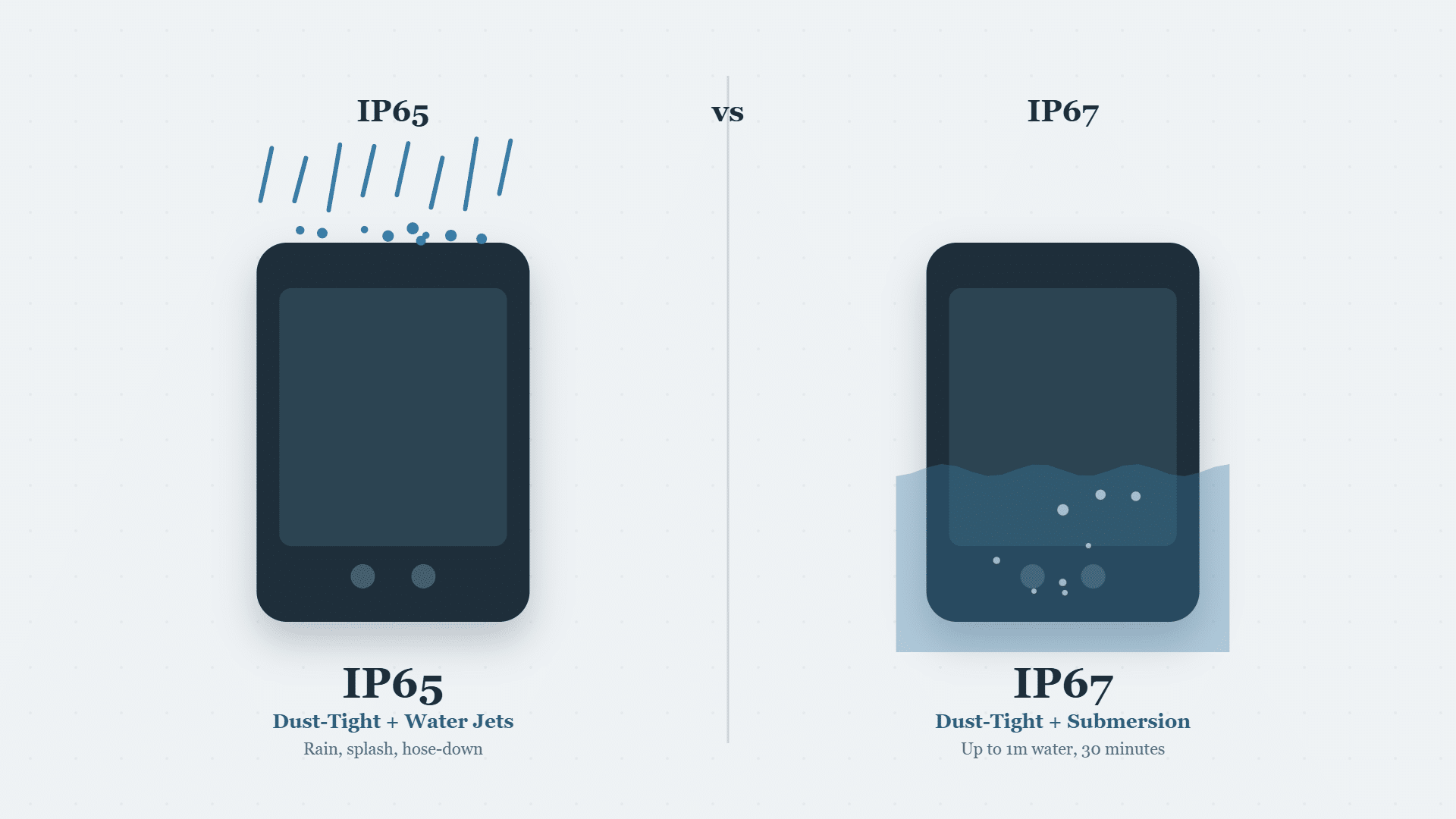
IP65 vs IP67 looks like a one-digit difference, and CF-Device rates its VCM range across both because the choice is a real one: in practice, that digit is the line between “protected from dust and jets of water” and “protected from dust and full submersion,” and picking the wrong one for your environment either overspends or under-protects.
TL;DR
- IP65 protects against dust ingress and water jets from any direction — sufficient for most road vehicle and general fleet use
- IP67 adds protection against temporary full submersion — relevant for mining, off-road, and wash-down environments
- The first digit (dust) is identical between the two; the second digit (water) is where they diverge
- Overspending on IP67 for a road fleet isn’t harmful, just an unnecessary cost if IP65 already covers the actual exposure
- In CF-Device’s range, the VCM V12 PRO, V12-2 and V10-2 are IP67, while the VCM M10 and the S10-2 family are IP65; the rating is listed per model
What Do the IP Rating Numbers Mean?
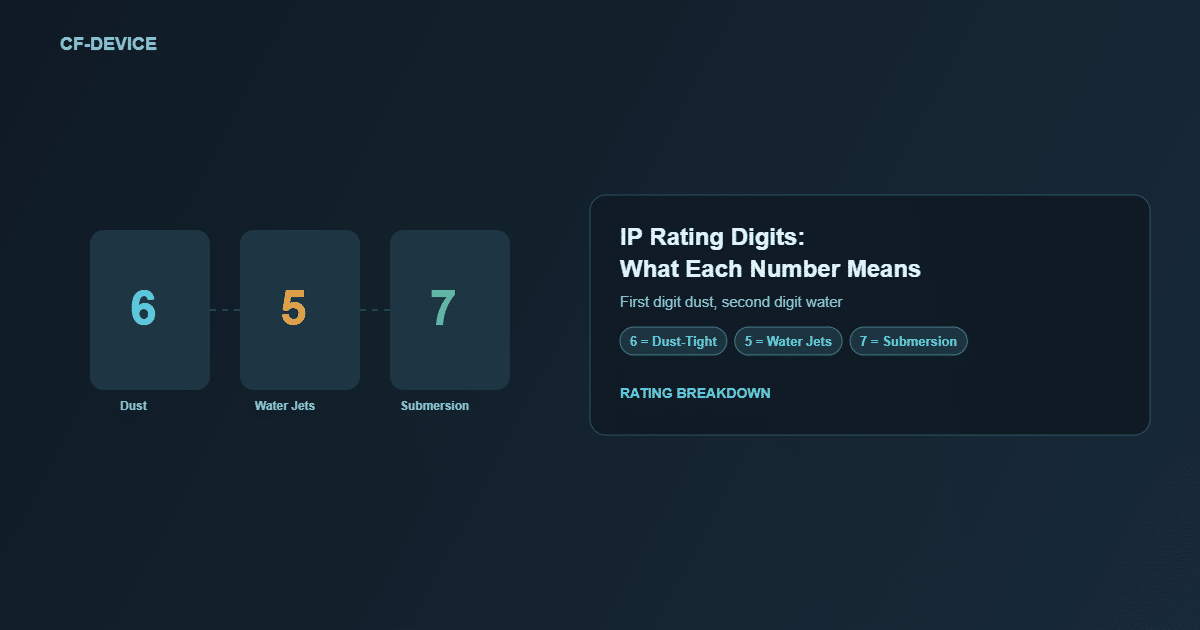
The IP (Ingress Protection) rating’s first digit covers solid particle protection, the second covers liquid. IP65 and IP67 share the same top dust protection (6) — the difference is entirely in the water rating: 5 means protected against low-pressure water jets from any direction; 7 means protected against temporary immersion up to 1 meter for up to 30 minutes.
What Is the Difference Between IP65 and IP67?
| IP65 | IP67 | |
|---|---|---|
| Dust protection | Fully dust-tight | Fully dust-tight (same) |
| Water protection | Low-pressure jets, any direction | Temporary submersion, 1m / 30min |
| Typical use case | Road vehicles, delivery fleets | Mining, off-road, wash-down bays |
| Relative cost | Lower | Higher |
| Risk of over-spec’ing | N/A | Paying for unused protection on road fleets |
IP65 vs IP67: Is IP65 Good Enough for a Vehicle Tablet?
Standard road vehicles, delivery fleets, and general logistics — covered in Logistics & Transportation — typically face rain, wash-down, and road spray, all within the IP65 rating’s water-jet protection. IP67’s added submersion resistance goes largely unused in this environment.
When Do I Actually Need IP67?
Mining sites, off-road agricultural equipment working through flooded fields, and any environment with a real risk of temporary submersion (deep puddles, wash bays with standing water) justify IP67’s added protection — this is covered in more depth in our Mining: Rugged Terminals guide, where dust and moisture exposure both run higher than standard road conditions. Construction sites sit between the two cases, which is why the rating usually needs to be decided per role rather than per site — see tablet for the construction industry: four jobsite roles, four different specs.
Do External Cameras Need the Same IP Rating?
The IP rating discussion isn’t limited to the terminal itself — external cameras feeding AVM 360° surround view are mounted on the exterior of the vehicle and face the same dust/water exposure the main housing does, often in a harsher position (lower, more exposed to splash and debris). A terminal rated IP67 paired with cameras rated only IP65 doesn’t actually deliver IP67-level reliability for the surround-view system as a whole — the weakest-rated component in the chain sets the real-world exposure limit, which is worth confirming component-by-component rather than assuming the headline terminal rating covers every part of the system.
What Does Getting the IP Rating Wrong Cost?
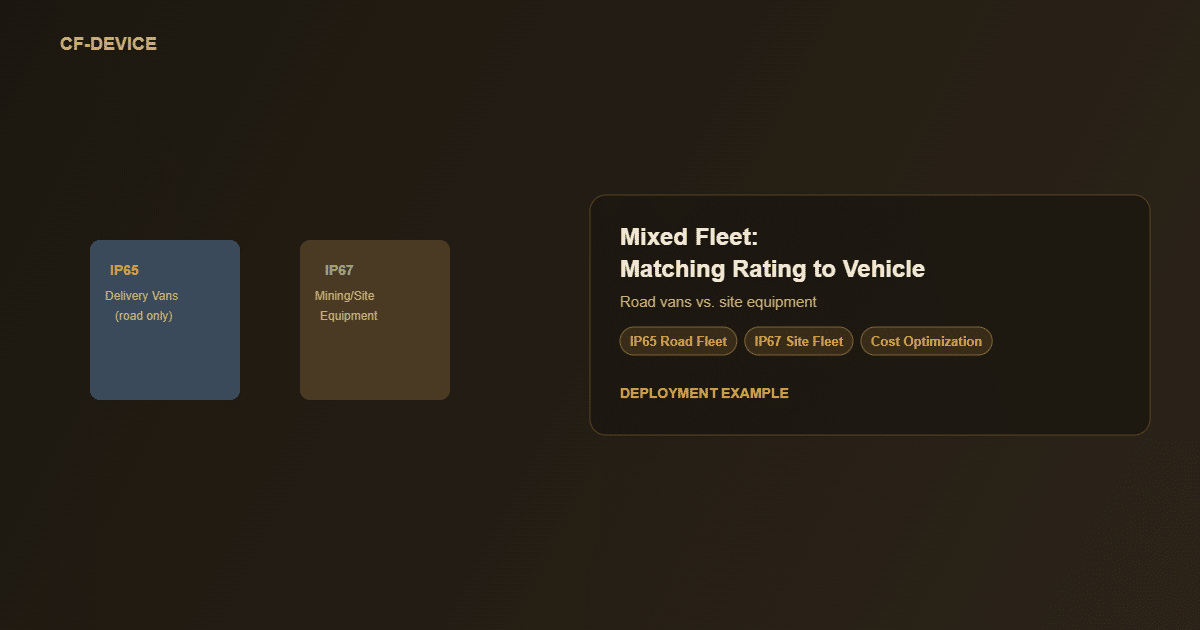
Picture an equipment rental company that standardized on IP67 terminals across its entire fleet — including delivery vans that never left paved roads — reasoning that “higher is always safer.” When reviewing hardware costs a year later, the delivery-van units had never once been exposed to submersion-risk conditions; the IP67 premium on those specific units had bought protection the vehicles never needed, while the mining and construction units in the same fleet used the submersion rating regularly. Splitting the spec by actual deployment condition — IP65 for road vehicles, IP67 for site equipment — would have cut hardware cost on the van fleet without changing durability outcomes.
How Do I Verify an IP Rating Is Genuine?
An IP rating printed on a spec sheet is a manufacturer’s claim, not automatically an independently verified fact. Requesting the actual third-party test report behind the claimed rating — not just the number itself — is a reasonable step before committing to a fleet-wide order, particularly for IP67 claims where the submersion test is easier to overstate than the more visibly checkable dust-tightness test. Who holds that report is also one of the clearest tests of whether you are dealing with the actual builder, as set out in rugged tablet manufacturers: how to tell a real maker from a reseller.
How Do I Match the IP Rating to My Deployment?
The mistake to avoid isn’t choosing IP65 for a mine site or IP67 for a delivery van — it’s not checking which conditions the specific deployment actually faces before defaulting to whichever rating sounds more impressive. Full certification context is covered in IP67 & MIL-STD-810 Explained, and how ingress rating fits alongside OS choice, power, and interfaces in a complete specification is set out in our rugged tablet hardware hub and rugged vehicle tablet hardware buyer’s guide. To check a specific unit, see the IP rating of every VCM model.
Is IP67 the Same as Waterproof?
No, and this is the misunderstanding that produces the most expensive failures CF-Device sees in the field. IP67 certifies survival of temporary immersion — one metre, thirty minutes, in still fresh water, tested once on a new unit. It does not certify:
- Repeated immersion over years — gaskets compress and harden with thermal cycling, so a five-year-old IP67 unit is not the unit that passed the test
- High-pressure washing — that is IP69K, a different test entirely; a pressure washer at close range will drive water past an IP67 seal
- Salt water or chemicals — the test uses fresh water; salt spray and agricultural chemicals attack seals and connectors on a different timescale
- Immersion under pressure — a unit moving through water is subject to more than static one-metre pressure
CF-Device’s practical guidance: treat IP67 as “survives an accident,” not “designed to work submerged.” If a deployment involves routine high-pressure washdown, the question to ask is about IP69K and connector sealing, not about upgrading from IP65 to IP67.
How Does an IP Rating Degrade Over Time?
This is the part almost no datasheet addresses, and it explains many ingress failures that arrive as warranty claims. An IP rating is measured on a new unit in a laboratory. In service, four things erode it:
| Degradation path | What happens | What slows it |
|---|---|---|
| Gasket compression set | Seal hardens and stops rebounding after repeated thermal cycles | Wide-temperature-rated sealing material, not generic rubber |
| Connector wear | Repeated mating cycles wear the seal face on plugs | Fixed installation — a mounted terminal is unplugged rarely |
| Cover left open | A rubber port flap not reseated after a USB stick is used | Harness connectors for the main interfaces instead of flap-covered ports |
| Fastener creep | Housing screws loosen under vibration, opening the seal line | MIL-STD-810 vibration testing on the assembled housing |
The third row is a common cause of field failures, and it is an operational problem rather than a specification one: an IP67 terminal with a port cover left hanging open is an IP20 terminal. This is a large part of why CF-Device’s VCM terminals carry their main interfaces on a sealed harness connector rather than on flap-covered consumer ports — there is less for an operator to leave open.
What Is the Difference Between IP65, IP66 and IP67?
IP66 sits between the other two and is frequently the more useful rating for vehicle work, which is why it is worth knowing rather than skipping. The second digit is not a simple ladder — 6 and 7 test different things:
- IP65 — water jets, 12.5 litres per minute, 6.3 mm nozzle, from 3 metres
- IP66 — powerful water jets, 100 litres per minute, 12.5 mm nozzle, from 3 metres — the relevant test for hose-down cleaning
- IP67 — static immersion, 1 metre, 30 minutes — no jet test at all
The consequence catches buyers out: an IP67 unit is not automatically better than IP66 against a hose, because IP67 never tested against pressurised jets. A device rated IP67 alone may fail a hose-down that an IP66 device survives. Where both matter, the rating to look for is a dual declaration such as IP66/IP67 rather than IP67 on its own. The full certification picture, including how MIL-STD-810 vibration testing interacts with seal integrity, is in IP67 and MIL-STD-810 explained.
Common Questions
Does a higher IP rating always mean a more durable tablet overall?
No — IP rating covers dust/water ingress specifically; shock and vibration resistance is a separate certification (MIL-STD-810), and both matter independently.
Can an IP65 tablet be used temporarily in an IP67 environment without damage?
Occasional light exposure likely won’t cause immediate failure, but sustained deployment in submersion-risk conditions beyond the rated protection will eventually cause ingress failure.
Is IP68 available, and when would it be needed?
IP68 (deeper/longer submersion) exists but is rarely necessary for vehicle-mount terminals — it’s more common in dedicated underwater equipment.
Can a mixed fleet run different IP ratings on different vehicles?
Yes — matching the rating to each vehicle type’s actual exposure (as in the rental fleet example above) is standard practice and avoids overspending across the whole fleet.
Do external cameras need the same IP rating as the main terminal?
Ideally yes, or higher — cameras are often mounted in more exposed positions than the terminal itself, so a mismatched lower-rated camera becomes the actual weak point in the system.
Which CF-Device models are IP67 rated?
The rating is set per model. The VCM V12 PRO, VCM V12-2 and VCM V10-2 are IP67. The VCM V7-2 and V7A-2 are IP65 as standard, with IP67 available as a custom option. The VCM M10, the S10-2 family, V12, V10 PRO, V8 PRO, V7 PRO, S7 and TANK V2 are IP65. Confirm the rating for the specific configuration being quoted.
Does the IP rating cover the connectors as well as the housing?
Only when the connectors are mated and properly seated — an unplugged or uncovered port is outside the rating entirely. This is why CF-Device carries the VCM’s main interfaces on a sealed harness connector rather than on flap-covered ports: it removes a common cause of real-world ingress failure, which is a cover an operator forgot to close.
The IP rating is one of four numbers worth checking before ordering, and it interacts with the type of unit you are specifying — a washdown device and a cab-mounted one are different purchases even at the same rating. The full type-by-type breakdown is in rugged industrial tablet: which of the four types you actually need.
Interested in specs or a quote? Contact our team to discuss the right protection rating for your fleet.