

Rugged hardware for mining vehicles has to meet a different standard from general commercial equipment, because few environments punish hardware like a mine site: constant vibration, heavy dust, extreme temperature swings, and machinery operating around personnel in low-visibility conditions. CF-Device rates its VCM range to IP65–IP67, MIL-STD-810 testing and −30°C to +70°C, with sealing that differs by model (see below).
TL;DR
- IP67 sealing and MIL-STD-810 testing are baseline, not upgrades, for mine-site equipment; specify from the IP67 models
- −30°C to +70°C covers both underground heat and high-altitude cold
- AVM 360° surround view is close to essential around haul trucks and loaders
- Low-signal zones need local data logging with sync on reconnect, not constant connectivity
- Physical buttons and driver fatigue monitoring are increasingly standard on mining specifications
Rugged Hardware for Mining Vehicles: The Core Requirements
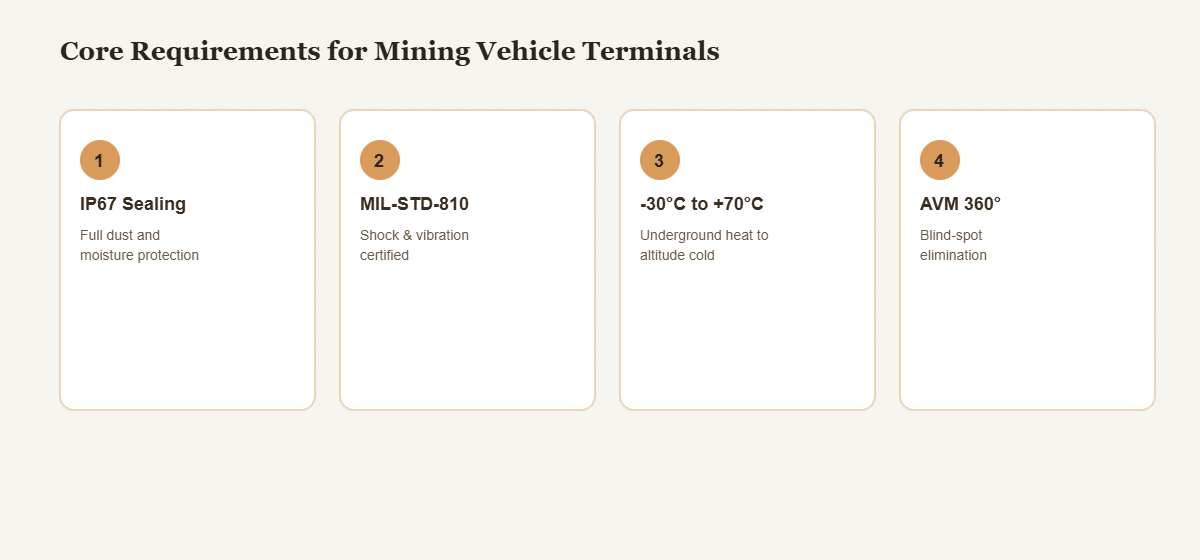
- Ingress protection: IP67 sealing, which is dust-tight and survives temporary immersion, for wet haul roads, washdown and standing water
- Shock and vibration resistance: MIL-STD-810 testing for equipment that runs on unpaved, uneven terrain for entire shifts
- Wide temperature tolerance: operation from −30°C to +70°C covers both underground heat and high-altitude cold
- Blind-spot elimination: AVM 360° surround view is close to essential around haul trucks and loaders where ground personnel and equipment share tight space
Rugged Tablet for Mining, Mining Tablet and Mining Vehicle Terminal
Searches for a rugged tablet for mining, a mining tablet, tablets for use in mining, a mining vehicle terminal and a mining equipment platform all describe the in-cab unit that sits between the machine and the fleet system. For a mine it is a fixed, vehicle-powered terminal, not a handheld: it takes the machine’s supply, reads the machine’s bus and survives the shift. How that terminal class compares with the handheld rugged tablets is covered in the rugged vehicle tablet hardware buyer’s guide.
Communication in Low-Signal Zones
Mining sites often have inconsistent cellular coverage, especially underground or in remote pits. Terminals need robust CAN-bus integration with vehicle systems and, where cellular is unreliable, the ability to log data locally and sync once connectivity returns rather than depending on a live connection to function. Confirm the local-logging behaviour for the VCM model you choose.
Operator Safety Features
Physical buttons for blind operation (so an operator does not need to look at a touchscreen while navigating rough terrain) and driver monitoring (DMS) for fatigue detection during long shifts are increasingly standard requirements on mining equipment specifications, not optional extras. The VCM V8 PRO’s 9-button design is a direct fit for this eyes-free operation need. DMS is listed on the VCM M10; confirm it for other models.
Why Mine Sites Break Consumer-Grade Hardware Faster Than Any Other Industry
The combination of factors at a mine site is rarely found together anywhere else: fine abrasive dust that works into any unsealed seam, sustained vibration from haul roads that are never fully graded, and temperature swings between underground heat and surface cold on the same shift. A terminal rated against only one or two of these stresses in isolation tends to fail at the intersection: a housing that resists dust in a lab test but has not also been vibration-tested can loosen its internal seals over months of haul-road operation, letting dust in through a path the IP rating alone did not anticipate. This is why MIL-STD-810 and IP67 need to be verified together, not treated as interchangeable proof points.
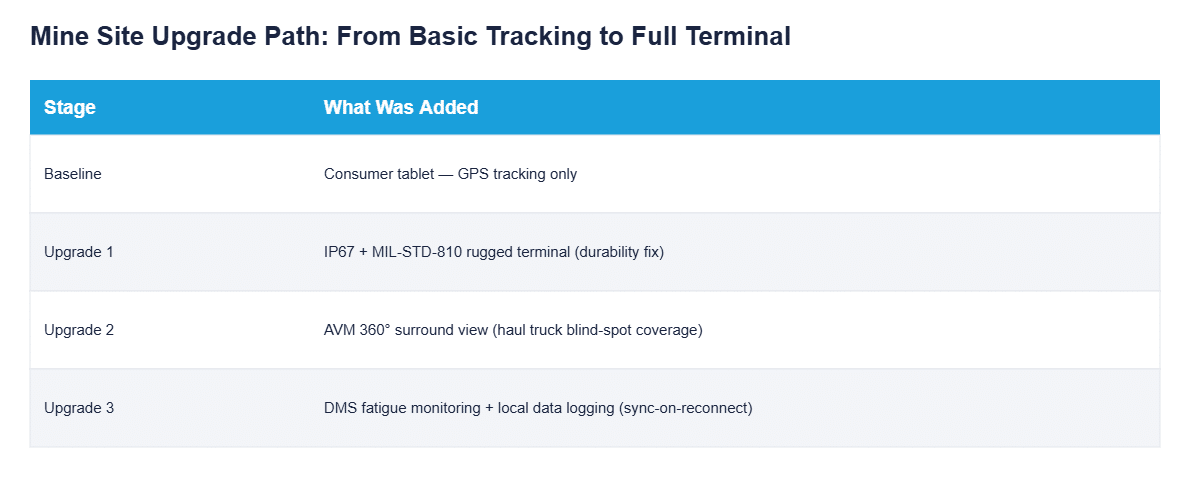
A Deployment Example
Consider an open-pit operation running haul trucks and loaders across multiple benches that first equips its vehicles with consumer-grade tablets for basic GPS tracking. Repeated failures from dust ingress and vibration-related screen damage lead to a terminal upgrade: IP67-rated hardware with MIL-STD-810 testing for the base tracking function, AVM 360° surround view added for haul truck blind-spot coverage around loading zones, and driver fatigue monitoring for operators running extended shifts across remote pit locations. The terminal also switches to local data logging with sync on reconnect, since several active pit areas have inconsistent cellular coverage, the same connectivity-resilience approach covered in our port and yard equipment positioning guide. This is an illustrative scenario rather than a customer case study.
Mining Fleet Management: What the In-Cab Hardware Does
Mining fleet management is mostly software, and this section covers only the hardware half. The terminal in the cab does four jobs for it:
- Reports position and status from each haul truck and loader
- Reads the machine bus over CAN, so engine and fault data reach the platform
- Carries the safety cameras and driver monitoring where they are fitted
- Logs locally in zones with no signal and syncs when the vehicle is back in coverage
Scheduling and dispatch are the platform’s job, not the terminal’s. On sealing, the VCM models differ: the V12 PRO, V12-2 and V10-2 are IP67; the V7-2 and V7A-2 are IP65 as standard and can be customised to IP67; the other VCM models are IP65. For a mine site, specify from the IP67 group. All carry the −30°C to +70°C range. How accurate positioning needs to be on each machine class is set out in GPS for heavy equipment.
The hardware layer behind fleet management is covered in fleet management: one terminal, full operational visibility.
The Bottom Line
Mining fleets that treat the vehicle terminal as commodity hardware tend to replace it every season. Equipment rated to genuine industrial standards, not just marketed as “rugged”, is the difference between a terminal that lasts a shift and one that lasts years. For the certification standards behind this durability, see IP67 & MIL-STD-810 Explained.
Which Mining Guide Should I Read Next?
This guide belongs to the applications hub. Pick the next one by the question you still have open:
| If your question is… | Read |
|---|---|
| What do the certifications actually test? | IP67 and MIL-STD-810 explained |
| How accurate must positioning be? | GPS for heavy equipment |
| What about yards and ports? | Port and yard operations |
| What does driver monitoring detect? | DMS driver monitoring |
| What does surround view add? | AVM 360° surround view |
Common Questions
Is IP65 sufficient for mining, or is IP67 required?
IP65 is already dust-tight and protected against water jets. IP67 adds protection against temporary immersion, which suits wet haul roads, washdown and standing water, so IP67 is the safer baseline for a mine site. The two ratings are compared in IP65 vs IP67.
How do terminals handle data logging when there is no cellular signal underground?
Terminals log positioning, operational and safety event data locally, then sync automatically once the vehicle returns to a coverage zone. This avoids dependence on constant connectivity for basic operation. Confirm the behaviour for your model.
Are physical buttons necessary if the terminal already has a touchscreen?
For blind operation while navigating rough terrain, yes. Physical buttons let operators switch functions by feel without diverting visual attention, which touchscreens cannot replicate.
Why do terminals rated for dust or vibration alone still fail at mine sites?
Because the two stresses compound: vibration can loosen seals that were only tested for dust resistance in isolation, letting particulate in through a path the individual rating did not account for.
Interested in specs or a quote? Contact our team to discuss mining fleet deployment.