

Port and yard equipment positioning is a different problem from fleet tracking: container yards and ports need accuracy that basic vehicle GPS can’t provide, because stacking a container within centimeters of a target position requires a different tier of hardware than knowing which zone a truck is in. CF-Device offers centimetre-level RTK options on selected VCM terminals for exactly this gap.
TL;DR
- Standard fleet GPS tracking (meter-level) is insufficient for container/crane positioning precision
- Centimeter-level RTK GNSS supports the accuracy port and yard operations require
- Wide-input-voltage power design protects against voltage fluctuations common in port electrical systems; the protections listed differ by model
- Positioning data feeds directly into equipment control, not just a dispatch map
- Coordinating dozens of yard vehicles depends on centralized device management, not just accurate positioning alone
Why Ports and Yards Need More Than Standard GPS
Stacking a container within centimeters of a target position requires a different tier of hardware than knowing which zone a truck is in. This is a direct extension of the heavy equipment GPS accuracy tiers question, but with tighter tolerances than most fleet applications — a misplaced container in a dense stack isn’t just an efficiency loss, it can require re-handling an entire stack to correct.
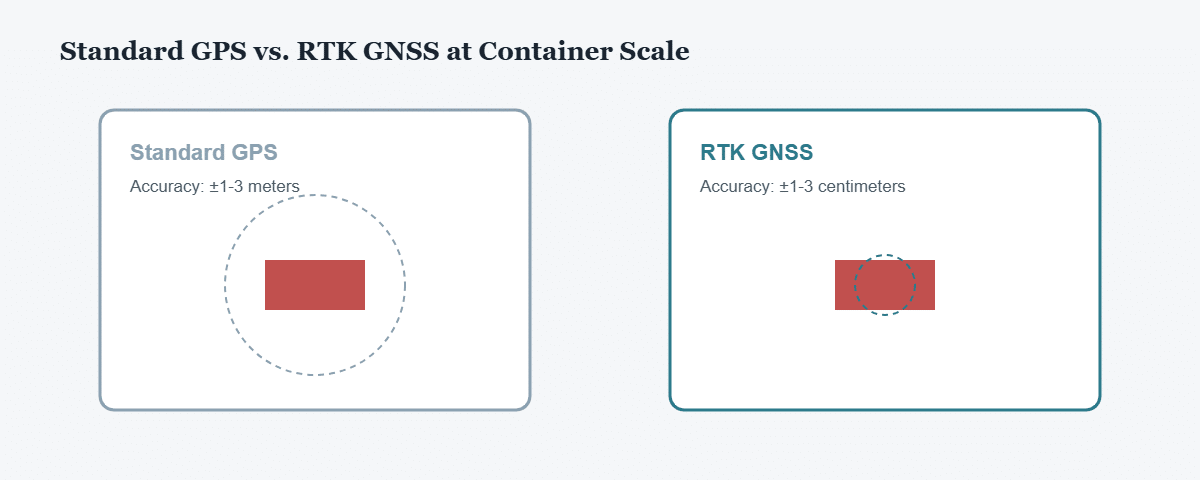
Standard GPS vs. RTK GNSS at Container Scale
| Standard GPS | RTK GNSS | |
|---|---|---|
| Typical accuracy | ±1-3 meters | ±1-3 centimeters |
| Suitable for | General yard truck routing | Container stacking, crane placement |
| Failure mode if misapplied | Container misplacement, re-handling | N/A (over-engineered for basic tracking) |
| Relative cost | Lower | Higher, justified by precision requirement |
A ±1-3 meter error is irrelevant for knowing which yard zone a truck is in. Applied to placing a container in a stack six containers deep, that same error range makes automated or assisted placement unworkable — this is why the two use cases require fundamentally different positioning hardware, not just different software. The tiers themselves, and what each costs, are laid out in GNSS positioning explained: from meter-level GPS to centimeter-level RTK.
Container Yard Positioning: Where RTK Corrections Come From
Container yard positioning at centimetre level depends on correction data as well as on the receiver. An RTK receiver compares its own satellite signal with a nearby reference station and applies the difference, and that correction has to reach the vehicle reliably: over a radio link, over the cellular network, or from a network service. On a fixed port facility the reference station is usually a one-time infrastructure setup rather than a per-vehicle cost, but the way the corrections are delivered is a project decision, not something a terminal datasheet settles. The VCM S10-2 PRO and S10-2 PLUS datasheets list radio communication, which is relevant where corrections arrive by radio; confirm the delivery method for your site before specifying the hardware.
Centimeter-Level Positioning for Port Cranes and Stackers
Gantry crane operations rely on centimeter-level RTK GNSS positioning to place containers accurately without constant manual guidance — the same RTK positioning technology used in precision agriculture applied to a completely different environment: dense, high-value cargo movement where a positioning error has direct cost consequences; the crane side is covered in port and yard operations: gantry cranes. The VCM S10-2 PLUS lists the MXT906B, UM980 and P20E GNSS modules, with the UM982 as an option, and the UM980 and UM982 are the RTK-grade ones, so integrators can match module cost to the accuracy tier each machine actually needs. The VCM S10-2 PRO offers positioning at meter, sub-meter or centimeter level as an option. Reach stacker GPS follows the same logic as crane placement: where the machine stacks containers, specify the RTK tier.
Power Reliability in Port Electrical Environments
Port and yard equipment often runs on electrical systems with more voltage fluctuation than standard road vehicles — cranes and heavy machinery starting and stopping on shared circuits create spikes that damage unprotected electronics over time. Wide-voltage input design with over/under-voltage protection prevents terminal damage from these fluctuations. CF-Device’s datasheets list those protections on the VCM S10-2 PRO and S10-2 PLUS, among other models, so confirm them for the unit you specify. It is a requirement that’s easy to overlook until a terminal fails from a power spike rather than physical wear — a failure mode that looks like a hardware defect but is actually a specification mismatch.
Coordinating Equipment at Fleet Scale
Positioning is one data stream among several — coordinating dozens of yard vehicles and cranes also depends on MDM remote management to keep every terminal updated and monitored without physically visiting each machine, the same operational layer that supports warehouse and forklift/AGV fleets at indoor scale. A port running 30 cranes and 60 yard trucks with inconsistent firmware versions across terminals introduces the same kind of operational risk as inconsistent positioning accuracy — MDM addresses the fleet-management side of the same precision problem.
A Deployment Consideration: Yard Truck GPS Accuracy by Role
Not every port vehicle needs RTK-tier hardware. A practical deployment typically tiers positioning by function: gantry cranes and reach stackers get RTK-capable terminals; general yard trucks and support vehicles run standard GNSS, because yard truck GPS accuracy at meter level is enough to route them between zones. Specifying RTK across the entire fleet adds cost without adding value where centimeter precision doesn’t change the outcome. For the full hardware specification sequence, see the rugged vehicle tablet hardware buyer’s guide.
Common Questions
Is RTK GNSS necessary for all port equipment, or just gantry cranes?
Gantry cranes and precision-stacking operations benefit most; general yard trucks and support vehicles often function adequately with standard meter-level GPS.
How does wide-voltage input specifically help in port environments?
Port electrical systems frequently experience voltage spikes from heavy machinery starting/stopping on shared circuits — wide-voltage input with over/under-voltage protection prevents this from damaging terminal hardware over time. Which protections are listed differs by model, so check the datasheet.
Can the same terminal handle both crane positioning and general communication needs?
Yes, provided it supports the GNSS module tier required (RTK) alongside standard connectivity — this is a hardware specification question, not a software limitation.
Does RTK positioning require a fixed base station at the port?
Typically yes — RTK accuracy depends on correction data from a nearby reference station, which for a fixed port facility is usually a one-time infrastructure setup rather than a per-vehicle cost. How the corrections reach each vehicle (radio, cellular or a network service) is decided per project.
Interested in specs or a quote? Contact our team to discuss port and yard equipment positioning requirements.