

CF-Device’s VCM V10-2 is a 10.1″ rugged vehicle-mount tablet built around dual-SIM, dual-channel 4G connectivity and AVM 360° surround view — solving the two failure modes that disrupt connected fleets most: dropped signal and blind spots. It is also the model buyers search for as the “V10.2 tablet”.
TL;DR
- Dual-SIM, dual-channel 4G with dual-SIM protection — the connection continues if one SIM or carrier drops
- AVM 360° surround view from AHD cameras: two inputs as standard, expandable to four
- Quad-core 64-bit Cortex-A55 at 2.0 GHz, 1 TOPS overall (0.8 TOPS NPU), Android 11.0 or Linux 5.10
- 1280×800 display at 750 cd/m² or brighter, IP67, 9-36V DC, −30°C to +70°C
- Optional handheld intercom microphone, optional RTK GNSS; some options share pins, so read the trade-offs below
Why Dropped Connectivity Is a Bigger Problem Than It Sounds
Dropped connectivity is one of the most disruptive failure modes for a connected fleet — a terminal that loses its network mid-route can’t report location, can’t receive dispatch updates, and can’t stream safety-critical camera feeds. The VCM V10-2 addresses this with a feature new to the lineup when it launched: dual-SIM, dual-channel 4G, the same reliability concern covered in our logistics and transportation fleet guide.
VCM V10-2 Dual-SIM Design: Redundant Connectivity
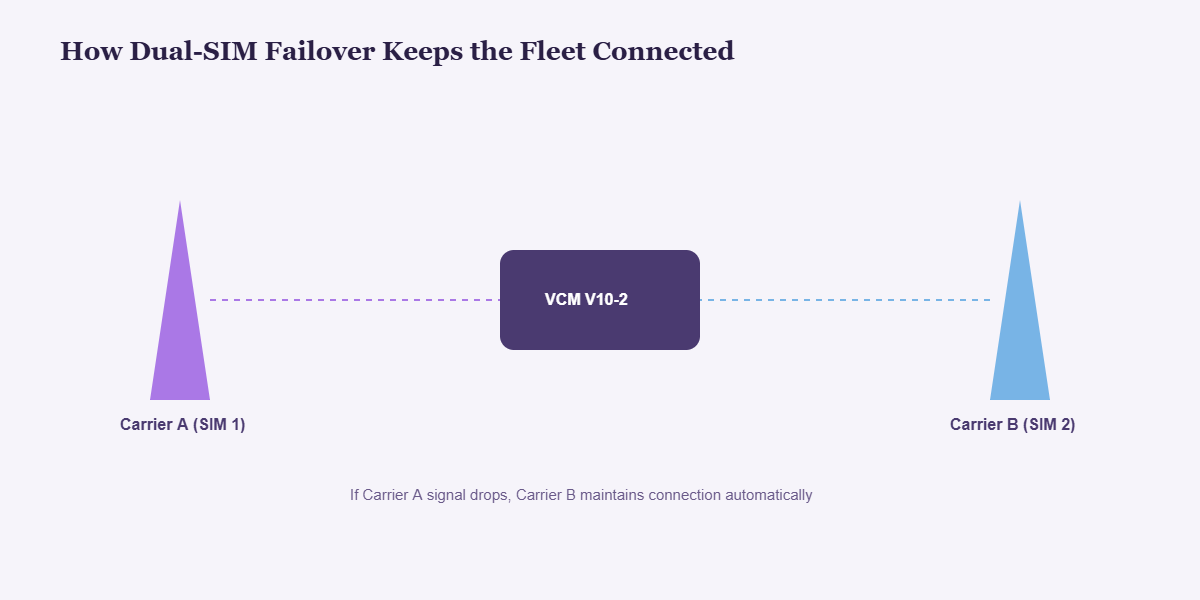
Two independent 4G channels, each with its own SIM, mean that if one carrier drops signal or one SIM’s data plan is interrupted, the second connection keeps the vehicle online. The datasheet describes this as dual-SIM, dual-channel with dual-SIM protection. For fleets operating across regions with inconsistent carrier coverage, a dual-SIM rugged tablet materially reduces connectivity gaps.
AVM 360° on a Mid-Size Terminal
The V10-2 lists CF AVM 360° surround-view stitching, with AHD camera inputs of 720p×2 or 1080p×2 as standard and expansion to four inputs. That brings the perimeter-visibility feature normally associated with larger displays into a 10.1″ form factor — useful for mid-size trucks and machinery where a 12.1″ panel doesn’t fit the cab. A 10.1″ AVM 360 tablet is a practical middle ground.
1 TOPS Computing, Dual OS
A quad-core 64-bit Cortex-A55 at 2.0 GHz with an ARM G52 2EE GPU delivers 1 TOPS of overall computing power (0.8 TOPS from the NPU), running either Android 11.0 or Linux 5.10 depending on the deployment’s software requirements. Memory is 2 GB LPDDR4 expandable to 8 GB, and storage is 16 GB eMMC expandable to 128 GB, with TF card support up to 1 TB. The 10.1″ capacitive display is 1280×800 with five-point touch at 750 cd/m² or brighter. IP67 protection, a 48-hour salt-spray result and 100M Ethernet round out a spec sheet built for continuous field use.
Built-In Voice Communication
An optional handheld intercom microphone lets drivers stay in contact with dispatch from the cab — a practical addition for operations coordinating multiple vehicles in real time. It is not free of cost in pins, however: enabling it takes over OUTPUT1, OUTPUT2, RS232-B and INPUT1, so confirm those four functions are not needed before you specify it.
Camera, CAN and I/O Trade-Offs to Know Before Ordering
Several options on the V10-2 share lines, and the datasheet lists the costs. Expanding the cameras from two to four inputs uses OUTPUT3 and INPUT2. CAN is two channels as standard, with a third available, but the third channel and the RS485 port are mutually exclusive: it is one or the other. CAN speeds are listed at 250K and 500K, and the CAN is classic CAN (no CAN FD). Two RS232 ports and one USB 2.0 port are standard. The output and input counts differ between the product text and the datasheet, so ask CF-Device to confirm the exact number of 12V outputs and digital inputs before you quote. The CAN side is covered in CAN bus and J1939 integration.
ISOBUS VT for Next-Gen Implement Compatibility
The V10-2 is listed as compatible with the new generation of CF ISOBUS VT, letting one terminal run the control interface for compliant implements. ISOBUS support is listed model by model on CF-Device’s datasheets, so confirm it for any other model you compare.
Harness Group C and Physical Fit
The V10-2 measures 248.9 × 167.5 × 29.85 mm and weighs 0.99 kg, mounted on a RAM-101U with four M5×10 screws. It uses harness group C, shared with the VCM S10-2 series and the VCM V7A-2, so a fleet moving between these models does not have to rewire. Power is 9-36V DC (not 5-36V) with ignition detection and over-voltage, under-voltage and reverse-polarity protection listed.
Why Dual-SIM Failover Only Works If the SIMs Are Actually Different
A dual-SIM terminal doesn’t automatically deliver connectivity redundancy — it delivers it only when the two SIMs are provisioned on genuinely independent networks. Two SIMs from the same carrier still share that carrier’s tower outages, regional dead zones, and network congestion, so a fleet manager setting up the VCM V10-2 needs to actively provision each SIM on a different carrier to get the failover protection the hardware is built to provide. This is a procurement decision, not a hardware limitation — the terminal handles the dual-SIM protection, but the redundancy is only as real as the SIM plan behind it.
Who It’s For
Fleets that have experienced connectivity dropouts with single-SIM hardware, or that need AVM 360° surround view on a mid-size (not full 12.1″) display, are the clearest fit for the V10-2’s dual-SIM and camera-input combination. Compare it to the VCM V8 PRO if physical button control matters more than dual-SIM redundancy.
Common Questions
Does dual-SIM mean two separate carrier contracts are required?
Yes, for real redundancy — dual-SIM failover only protects against dropouts if each SIM is on a different carrier or plan; using two SIMs from the same carrier reduces the redundancy benefit.
Can VCM V10-2’s AVM 360° system match the coverage of larger 12.1″ models?
It supports up to four camera inputs, while the VCM V12 PRO, S10-2 PRO and M10 list up to eight AHD inputs — enough for most mid-size vehicle perimeter coverage, though larger equipment with more blind spots may need the higher camera count.
What does the intercom microphone cost in other functions?
Enabling the optional handheld intercom takes over OUTPUT1, OUTPUT2, RS232-B and INPUT1. Whether voice use needs any radio licence depends on your region and project, so confirm it locally.
Will two SIMs from the same carrier still improve reliability?
Some improvement, but not full redundancy — a carrier-wide outage or dead zone affects both SIMs equally, so independent carriers give the strongest protection.
Can I have three CAN channels and RS485 at the same time?
No. The V10-2 has two CAN channels as standard, and the optional third CAN shares its line with RS485, so you can use one or the other.
Dual-SIM connectivity and AVM 360° are two capabilities among many; the full picture of what a rugged vehicle terminal has to do is set out in our complete guide to rugged vehicle tablets and the rugged vehicle tablet hardware buyer’s guide.
Interested in specs or a quote? Contact our team or view the full VCM V10-2 product page.