

CF-Device’s VCM V7A-2 is a 7″ rugged vehicle-mount tablet built around one idea: an anti-glare screen that stays legible in direct sunlight. It sits close to the VCM V7-2 in size, but it is a different, cost-reduced model, and the six differences below matter when you specify one.
TL;DR
- Anti-glare (AG) screen — the model’s headline feature, addressing reflection and washout rather than relying on brightness alone
- Quad-core Cortex-A55 at 2.0 GHz, 0.8 TOPS NPU, Android 11.0 / Linux dual system, 4G/5G, two CAN channels (classic CAN, no CAN FD)
- CF ISOBUS VT and CF AVM 360° support, compact 200 × 134 × 32.52 mm body at 0.685 kg
- IP65 as standard (IP67 on request), −30°C to +70°C, 48-hour salt spray, 5-36V DC input
- Not identical to the V7-2: six reductions, and a different harness group
Why Screen Visibility Is an Underrated Failure Point
Screen visibility under direct sunlight is one of the most underrated failure points in vehicle-mount hardware — a display that washes out at midday is effectively useless for the hours an outdoor vehicle actually operates. The VCM V7A-2 targets this problem with an anti-glare full-screen display design, and “V7A” is the shorthand many buyers use for it.
VCM V7A-2 Anti-Glare Display: Visibility Engineered for Harsh Light
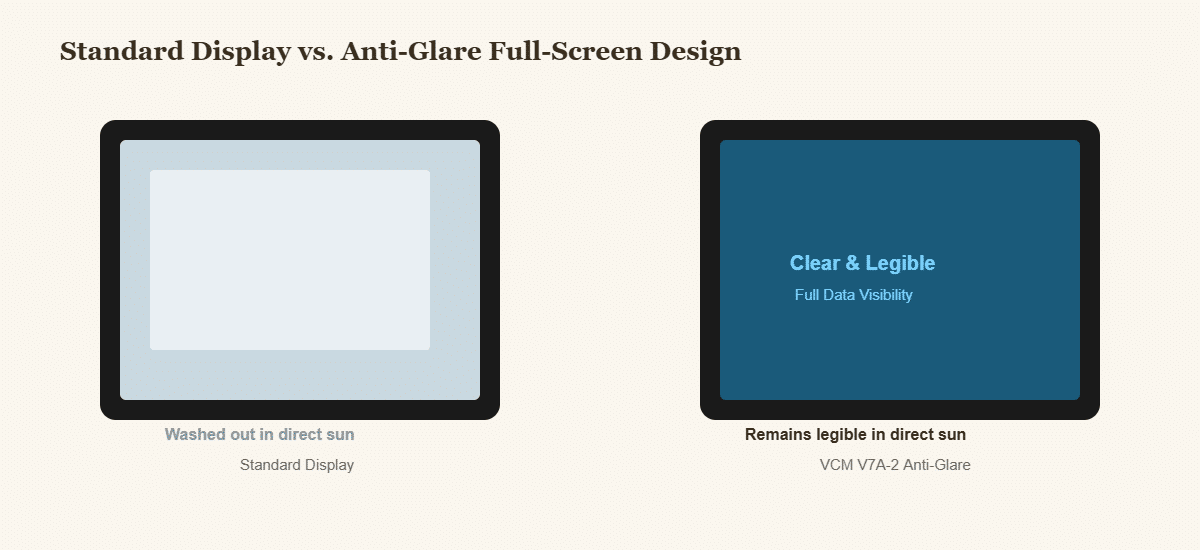
Where standard displays rely on brightness alone to fight glare, the V7A-2’s anti-glare screen reduces reflection and washout, keeping the interface legible in direct sun — a meaningful difference for vehicles that spend entire shifts outdoors in open terrain, the same field-visibility demand covered in our smart agriculture terminal guide. The panel is 7″ at 1024×600, 750 nits, with 5-point capacitive touch.
Six Differences From the VCM V7-2
The V7A-2 shares its body size with the VCM V7-2 (200 × 134 × 32.52 mm) and its Cortex-A55 platform, but it is a reduced-specification variant built around the anti-glare screen. The datasheet lists these differences:
| Item | VCM V7A-2 | VCM V7-2 |
|---|---|---|
| CAN channels | 2, classic CAN, no CAN FD | 3, including CAN FD |
| Ethernet | 100M standard, gigabit optional | Gigabit standard |
| Camera inputs | AHD 720p×2 or 1080p×2 | AHD 720p×4 or 1080p×2 |
| Analog (ADC) inputs | None | 2 |
| GNSS accuracy | Meter or centimeter (no sub-meter) | Meter, sub-meter or centimeter |
| Power protection listed | Over-voltage, under-voltage, reverse polarity | Also over-current |
It also has USB 2.0 rather than the USB 3.0 of the V7-2. If the machine needs CAN FD, three CAN channels, four camera inputs or analog sensing, the V7-2 is the right model; the V7A-2 is for installs where sun legibility is the priority and those extras are not needed.
Core Platform
The V7A-2 has a quad-core Cortex-A55 at 2.0 GHz with an ARM G52 2EE GPU and a 0.8 TOPS NPU. Memory is 2 GB LPDDR4 expandable to 8 GB, storage is 16 GB eMMC expandable to 256 GB, and the unit supports Android 11.0 and Linux (kernel 5.10) as a dual system. Connectivity is 4G/5G, Wi-Fi (2.4G/5G, 802.11 b/g/n/ac) and Bluetooth 4.2. Two RS232 ports, one RS485 port, three 12V outputs and two digital inputs complete the interfaces. The dual-OS design is explained in dual Android/Linux architecture.
ISOBUS VT and Compact Form
ISOBUS VT support (CF ISOBUS VT) lets this terminal run implement control interfaces natively, while the compact 200 × 134 × 32.52 mm, 0.685 kg body keeps installation flexible across small agricultural machines and specialty vehicles. It mounts on a RAM-101U bracket with four M5×10 screws.
Rated for Harsh Environments
The V7A-2 is IP65 as standard, with IP67 available as a custom order, so confirm the sealing level when quoting. It operates from −30°C to +70°C, was salt-spray tested for 48 hours, and its third-party vibration (7.0 Grms) and shock (50 g) results are listed. See our IP65 vs IP67 rating guide for how sealing compares across the lineup.
Harness Group C: What It Fits and What It Does Not
The V7A-2 uses harness group C, shared with the VCM S10-2 series and the VCM V10-2. A fleet that already runs those models can reuse their wiring. It is not shared with the V7-2, which is a different harness group even though the two bodies are the same size and look alike; plugging the wrong harness into either risks damaging the hardware. Check which model is in the vehicle before you order a replacement or a cable.
Why Anti-Glare Matters More at Certain Times of Day
The practical impact of anti-glare treatment isn’t constant throughout a shift — it concentrates at low sun angles (early morning and late afternoon) and at midday overhead sun, the two conditions where reflection off a standard glossy display is most severe. An operator running implement controls or navigation through these windows on a standard screen often ends up shading the display with a hand or tilting the terminal to find a readable angle — small workarounds that add up to real distraction and lost time across a full season. Anti-glare treatment removes the need for that workaround, rather than just making the display marginally brighter.
Who It’s For
Fleets operating in consistently sunny, high-glare conditions — open-field agriculture, construction in open terrain, coastal operations — where display legibility has been a recurring complaint with standard tablets will see the clearest benefit from the V7A-2’s anti-glare design, particularly where the vehicle already uses the C-group harness. Compare it to the VCM V7 PRO if glare isn’t a primary concern.
Common Questions
Does the anti-glare screen reduce brightness compared to standard displays?
The V7A-2 lists 750 nits. The anti-glare treatment addresses reflection and washout rather than the rated brightness figure.
Is VCM V7A-2 the same hardware as VCM V7-2 aside from the screen?
No. It shares the body size and the Cortex-A55 platform, but it has two CAN channels without CAN FD, 100M Ethernet as standard, two camera inputs per resolution option, no analog inputs and no sub-meter GNSS option, and it uses a different harness group. See the comparison table above.
Which environments benefit most from the anti-glare design?
Open-field agriculture, construction in open terrain, and coastal operations with consistently high sun exposure see the clearest benefit — indoor or low-glare deployments won’t notice a meaningful difference.
Does glare cause more than just visibility annoyance for operators?
Yes — operators working around glare with hand-shading or screen-tilting adds distraction and lost time across a shift; anti-glare treatment removes the need for that workaround.
Is the V7A-2 IP67?
It is IP65 as standard. IP67 is available as a custom order, so state the sealing level you need when you request a quote.
Anti-glare treatment addresses one environment. The full set of environmental decisions behind a terminal specification is set out in our complete guide to rugged vehicle tablets and the rugged vehicle tablet hardware buyer’s guide.
Interested in specs or a quote? Contact our team to discuss VCM V7A-2 availability. A separate datasheet PDF is not yet published for this model, so our technical support will send the specification on request.