

A rugged industrial tablet is a computer built to a stated environmental specification — sealed to an IP rating, tested to MIL-STD-810 for shock and vibration, powered from a vehicle or machine supply rather than a wall adapter, and rated across a temperature range that includes freezing and direct sun. CF-Device has shipped roughly 140,000 of them a year into 33 countries, and the single most common purchasing mistake we see is not choosing the wrong brand. It’s choosing the wrong type.
The category is sold under several names — rugged tablet computer, tablet PC rugged, mobile rugged computers, industrial grade tablet — and all of them cover at least four physically different products that are not substitutes for one another.
TL;DR
- “Rugged” is an unregulated marketing word — judge the four numbers instead: IP rating, MIL-STD-810 test method, operating temperature range, and DC input voltage
- Four distinct types exist: vehicle-mount, handheld, washdown-sealed, and screenless — picking by brand before picking by type is the usual error
- CF-Device’s VCM range is rated IP65–IP67, tested to MIL-STD-810, runs on 5–36V DC, and operates from −30°C to +70°C
- Environment decides the spec, not the other way round: cold store, washdown, direct sun and continuous vibration each force a different requirement
- A waterproof rugged tablet (IP67) and a dust-tight one (IP65) are different purchases — the wrong one fails in months
I. What Actually Makes a Tablet “Industrial”
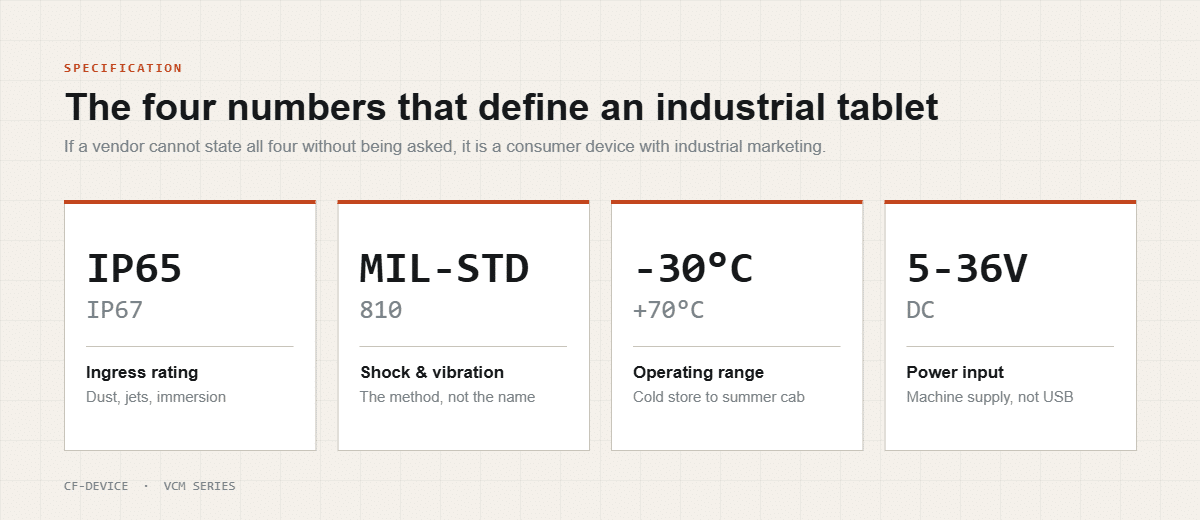
CF-Device publishes four numbers for every unit it builds, and those four are the whole definition. An industrial grade tablet states an ingress rating (IP65 or IP67), the shock and vibration standard it was tested against (MIL-STD-810), a numeric operating temperature range, and a DC input voltage range. A consumer tablet in a thick case states none of them. Everything else — processor, RAM, screen resolution — is the part both product classes have in common, which is why comparing on those specs alone tells you nothing about whether the unit survives the job.
In short: if a vendor can’t give you all four numbers without being asked, you are looking at a consumer device with industrial marketing.
II. The Four Types of Rugged Industrial Tablet
CF-Device builds three of these four types, and says so plainly about the fourth, because sending a buyer to the wrong category costs them more than losing the order costs us.
| Type | Power | Typical use | Chosen when |
|---|---|---|---|
| Vehicle-mount (VMC) | 5–36V DC from the machine | Excavators, forklifts, trucks, tractors | The operator stays with the machine |
| Handheld | Internal battery, shift-length | Inspection, delivery, meter reading | The worker walks the site |
| Washdown / fully sealed | DC or battery, IP67 sealed | Food processing, marine, chemical | The device gets hosed down |
| Screenless vehicle computer | 5–36V DC, drives external display | Buses, custom dash installs, kiosks | The cab has no room for a panel |
CF-Device’s line covers the vehicle-mount type (the VCM series, 7″ to 12.1″), the washdown type (IP67-rated VCM variants), and the screenless type (TANK V2). We do not build handhelds, and a fleet that genuinely needs one is better served by a specialist in that form factor than by mounting a VMC on a shoulder strap.
III. Vehicle-Mount: The Default for Machine Operators
The vehicle-mount type is where most of CF-Device’s volume goes, because most industrial tablet users are sitting in a cab rather than walking. The defining trait is not toughness but power: the unit runs off the machine’s electrical system through a wide-voltage input with ignition sense, so it wakes with the engine, shuts down cleanly after it, and never has a dead battery at shift change. Add CAN bus and the tablet stops being a screen and starts being an instrument — reading engine hours, fault codes and implement status directly from the machine. Which screen size fits which cab is a separate decision, worked through in how to choose the right tablet screen size for your vehicle.
IV. Is a Waterproof Rugged Tablet the Same as a Dust-Tight One?
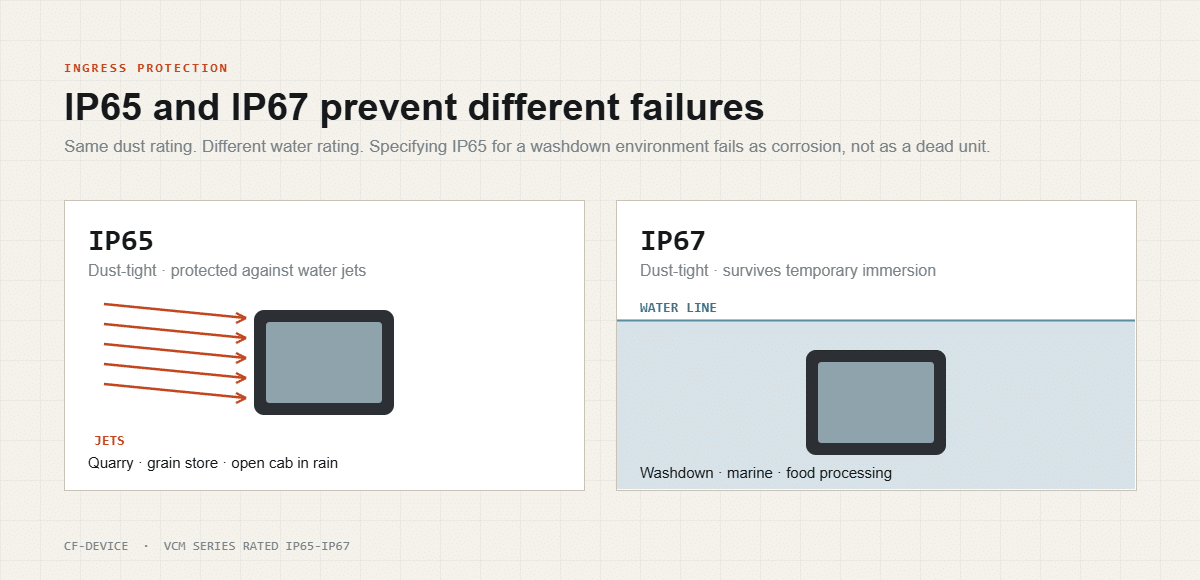
No, and CF-Device treats them as separate product decisions because the failure they prevent is different. IP65 means dust-tight and protected against water jets — correct for a dusty quarry, a grain store, or an open cab in rain. IP67 means dust-tight and survives temporary immersion — the rating you need if the device will be hosed down at the end of a shift, or if it might go in standing water. A waterproof rugged tablet is specifically the IP67 case; specifying IP65 for a washdown environment is one of the most expensive substitutions in this category, because the failure appears months later as corrosion rather than immediately as a dead unit. The two ratings are compared in detail in IP65 vs IP67: which protection rating your rugged tablet needs.
V. Choosing by Environment, Not by Spec Sheet
CF-Device’s specification process starts from the environment and works backwards, because a spec sheet read in isolation invites buying more rating than the job needs in one column and less than it needs in another.
| Environment | The spec it forces | Commonly missed |
|---|---|---|
| Cold store / winter yard | −30°C operating, DC power | Batteries stop charging below 0°C |
| Direct sun, open field | 750 cd/m² or brighter, anti-glare | 500 cd/m² is unreadable at midday |
| Washdown / marine | IP67, sealed connectors | IP65 corrodes over months |
| Continuous vibration | MIL-STD-810 vibration method | Kills more units than drops do |
| Gloved operation | Glove-mode touch or physical buttons | Capacitive touch fails with gloves |
| 24V / 48V machine supply | 5–36V DC with ignition sense | USB-C charging circuits fail on spikes |
The vibration row is the one buyers under-weight most consistently. What the test regime behind MIL-STD-810 actually subjects a unit to is set out in IP67 and MIL-STD-810 explained.
VI. Rugged Tablets for Field Work: The Mounting Question
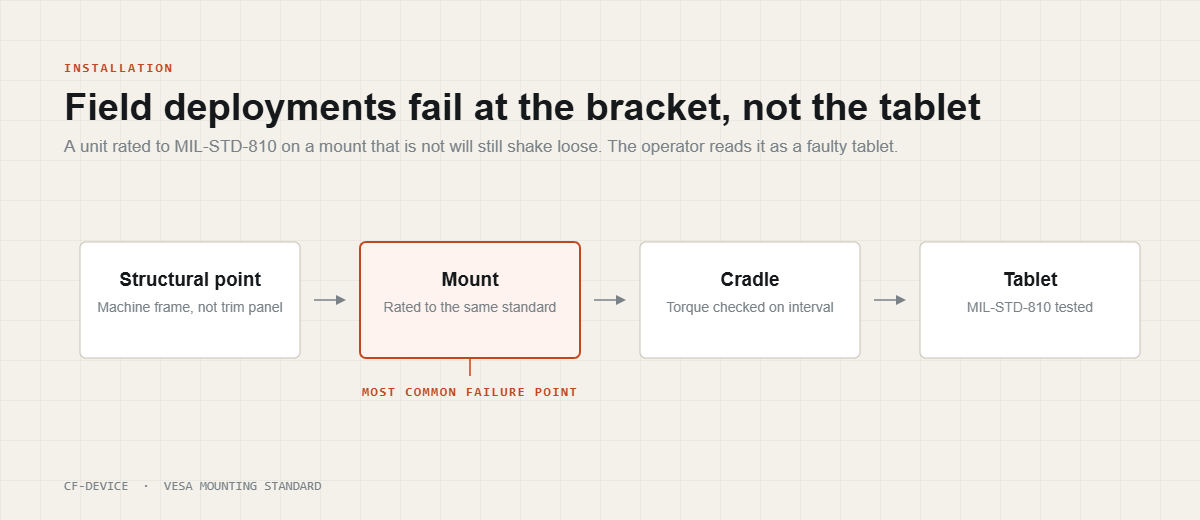
CF-Device ships every VCM unit with a VESA pattern for exactly one reason: rugged tablets for field work fail at the bracket far more often than at the tablet. A unit rated to MIL-STD-810 on a mount that isn’t will still shake loose, and the resulting intermittent connection reads to the operator as a faulty tablet. Specify the mount to the same standard as the device, use the machine’s structural points rather than trim panels, and check torque at the same interval as any other fastener on the machine. Where the device sits in a wider field or fleet deployment — and what else has to be specified alongside it — is covered in our guide to project tablets for field and fleet use.
VII. The Rugged Tablet Market: Who You Are Actually Buying From
The rugged tablet market contains three kinds of supplier that look identical on a product page: manufacturers who own the design and the line, ODM partners who rebadge a shared platform, and resellers who hold stock. The distinction matters after the sale rather than before it — firmware fixes, a five-year parts guarantee, and the ability to change an interface for your deployment only exist where the design does. CF-Device manufactures its own boards and enclosures, which is why we publish test data rather than adjectives. How to tell the three apart before you order is set out in rugged tablet manufacturers: how to tell a real maker from a reseller.
VIII. What Else Is a Rugged Tablet Called?
CF-Device quotes against all of these names in a normal week, and the inconsistency is worth addressing directly because it makes comparison shopping harder than it should be. The same product class is sold as a rugged tablet PC, a ruggedized tablet (US spelling) or ruggedised tablet (UK spelling), a rugged PC, a tough computer, a durable computer, a ruggedized panel PC, a rugged touch screen PC, an industrial tablet computer, or simply an outdoor tablet. None of these names carries any information about what the unit is actually rated for.
Some of these names do describe a real, checkable property rather than a naming preference. Those are the ones worth separating out:
| What the buyer searches | What it actually specifies | What to confirm on the datasheet |
|---|---|---|
| Waterproof tablet | IP67 — survives temporary immersion | IP67, not IP65 — the two are different purchases |
| Dustproof rugged tablet | The IP first digit — dust-tight | Both IP65 and IP67 satisfy this |
| 1000 nits tablet, sunlight-readable, high-brightness | Display luminance for direct sun | A cd/m² figure. CF-Device specifies 750 cd/m² across the VCM range |
| Military tablet | Usually means MIL-STD-810 tested | The specific test method number, not the standard name alone |
| Rugged PC, tough computer, durable computer | Nothing measurable | Ask for the four numbers instead |
| Ruggedized / ruggedised tablet | Nothing measurable — spelling only | Ask for the four numbers instead |
The “military tablet” row is the one that most often misleads. MIL-STD-810 is not a single pass or fail grade — it is a family of test methods, and a unit tested to a jet-aircraft vibration profile has not been tested to the 1,000-mile road transportation profile. CF-Device’s position is to ask which Method and which Figure a claim refers to; a supplier who cannot name them is quoting the standard rather than a test result.
Whatever the catalogue calls it, the four numbers from the first section are what separate the categories: IP rating, MIL-STD-810 test method, operating temperature range, and DC input voltage. A best rugged tablet shortlist assembled without those four is a list of adjectives.
IX. CF-Device Models by Type
| Model | Type | Screen | Specified for |
|---|---|---|---|
| VCM S10-2 | Vehicle-mount | 10.1″ | Fleet standard, forklifts, site trucks |
| VCM M10 | Vehicle-mount | 10.1″ | AI vision workloads, 6 TOPS NPU |
| VCM V12 | Vehicle-mount | 12.1″ | ISOBUS VT, grade control, multi-camera |
| VCM V7A-2 | Vehicle-mount | 7″ | Direct sun, anti-glare, tight cabs |
| VCM V8 PRO | Vehicle-mount | 8″ | Gloved and blind operation, 9 buttons |
| TANK V2 | Screenless | External | Buses, custom dash, no panel space |
All units above are rated IP65–IP67, tested to MIL-STD-810, accept 5–36V DC with ignition sense, and operate from −30°C to +70°C.
X. A Deployment Example
A food logistics operator specified IP65 units for 40 refrigerated trucks on the reasonable-sounding grounds that the cabs were enclosed. The tablets were not the problem; the end-of-shift washdown of the load area was, and units mounted near the bulkhead took spray for eighteen months before a cluster of them failed within the same quarter — corrosion on the connector block, not water on the screen. The replacement fleet was specified IP67 with sealed connectors at roughly 12% higher unit cost. In CF-Device’s experience this is the most common rugged specification failure: the environment was assessed as the operator experiences it, not as the device experiences it.
XI. Frequently Asked Questions
What is the difference between a rugged tablet computer and an industrial tablet?
Nothing consistent — the terms are used interchangeably across the market, along with tablet PC rugged and mobile rugged computers. Because the naming carries no information, judge the unit on its four published numbers: IP rating, MIL-STD-810 test method, operating temperature range, and DC input voltage.
How long should a rugged industrial tablet last?
Five to ten years in service is the realistic planning figure, against two to three for consumer hardware in the same conditions. The number that matters more than the lifespan is parts availability: CF-Device commits to a defined support window per platform, so a unit that fails in year six can still be repaired rather than replaced fleet-wide.
Does an industrial grade tablet have to run Windows?
No. Android dominates vehicle-mount deployments because the fleet-management tooling is mature and the hardware cost is lower; Linux is chosen where direct hardware control or long-term kernel stability matters more than an app ecosystem. The trade-off is worked through in our rugged Android and Debian Linux vehicle hardware hub.
Which CF-Device model should a first-time buyer start with?
The VCM S10-2 is the usual starting point for a mixed fleet: 10.1″ suits most cabs, the configuration is the most widely deployed in our range, and it shares mounting and power standards with every other VCM unit, so adding 7″ or 12.1″ models later doesn’t change the installation standard. Where it sits against the rest of the range is set out in the rugged vehicle tablet hardware buyer’s guide.
Is a ruggedized tablet different from a ruggedised tablet?
No — that is US against UK spelling of the same word, and neither spelling specifies anything. Both arrive on CF-Device enquiries in the same week for the same product. Judge the unit on its IP rating, MIL-STD-810 test method, temperature range and DC input instead.
What is the difference between a rugged tablet PC and a rugged panel PC?
A panel PC is normally designed to be built into a fixed enclosure or machine housing, with no battery and no handheld use case; a rugged tablet PC keeps the tablet form factor whether or not it is mounted. For vehicle work the distinction matters less than the power input — both classes need wide-voltage DC with ignition sense, which CF-Device specifies at 5–36V DC across the VCM range.
For how these units are deployed field by field — agriculture, construction, logistics, mining and transit — see our field-by-field guide to rugged vehicle tablet use cases.
Interested in specs or a quote? Contact our team to discuss which rugged industrial tablet type fits your deployment.