

Search “industrial PC manufacturers” and five structurally different kinds of company appear in the results — trading companies, distributors, assemblers, ODMs, and full manufacturers. All five present themselves the same way on a website. CF-Device sits in the fifth tier: in-house SMT and assembly, own firmware and OTA pipeline, and certification testing commissioned per model.
TL;DR
- Five supplier tiers answer the same search — the difference is what each one owns
- Only ODMs and full manufacturers can change the product; the other three can only change the price
- Interface customisation, test reports, lifecycle commitment, and firmware ownership are the four diagnostics
- CF-Device is a full manufacturer: 2018-founded, ISO 9001:2015 certified, 140,000+ units shipped annually to 33 countries
- Lower tiers aren’t wrong — they’re wrong when the requirement needs manufacturer-level capability
Why “Manufacturer” Is the Least Reliable Word on a Website
The term is unregulated. A company that buys finished units and prints its logo on the box can legitimately call itself an industrial PC manufacturer in marketing copy, and many do. The distinction only becomes visible when a requirement becomes specific — a non-standard CAN channel count, a certification report with a lab name on it, a five-year supply commitment.
In short: what separates the tiers is ownership — of the bill of materials, the tooling, and the firmware. Everything else is presentation.
The Five Tiers, and What Each Actually Owns
| Tier | Owns | Can change the product? |
|---|---|---|
| Trading company | Nothing — resells stock | No |
| Distributor | Regional inventory | No, but handles local warranty |
| Assembler | Assembly line only | Chassis and cabling, not the board |
| ODM | The design | Yes — designs to your requirement |
| Full manufacturer | Design + tooling + firmware | Yes, at every level including OS |
None of the lower tiers is inherently the wrong choice. A distributor is often the right partner for a ten-unit order needing local service turnaround. A trading company can genuinely be the cheapest route to a standard catalogue product. The problem is only when a buyer needs manufacturer-level capability and doesn’t discover the gap until three months into a project.
Five Questions That Reveal the Tier
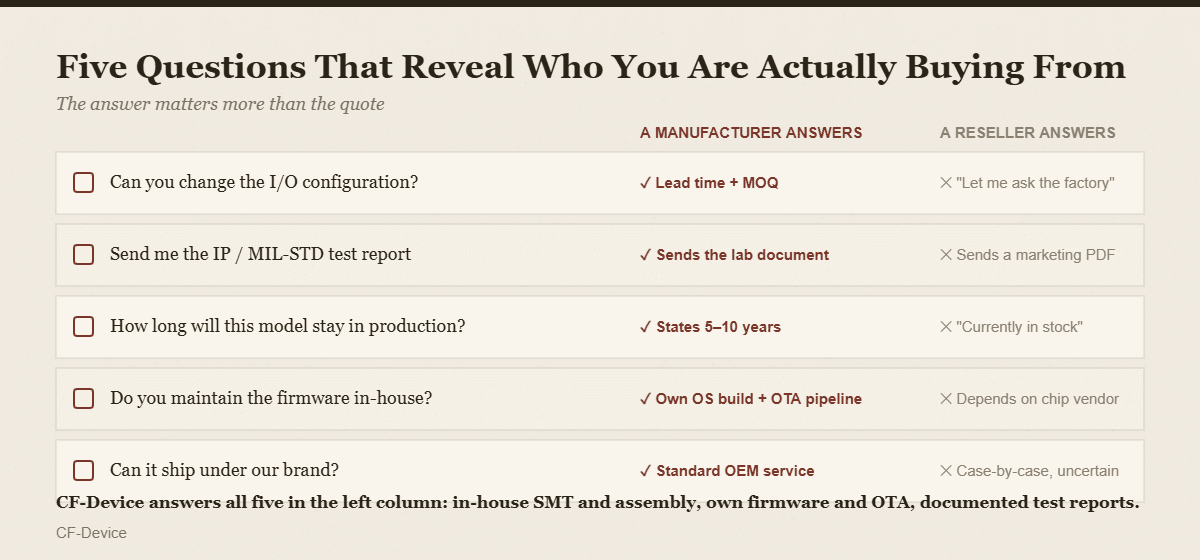
The interface question is the fastest single diagnostic. Ask whether a unit can ship with four CAN channels instead of two, or an additional RS485 port. A manufacturer answers with a lead time and an MOQ. A reseller says they need to check with the factory — which tells you where the actual manufacturer sits in the chain, and that you’re talking to someone else. CF-Device answers this directly: the VCM V12 PRO and S10-2 PRO ship with four SocketCAN channels as standard configurations, and further interface changes are scoped as normal engineering work.
The full version of these checks, applied specifically to rugged tablets, is set out in rugged tablet manufacturers: how to tell a real maker from a reseller.
Industrial PC vs Vehicle-Mount Computer
Worth separating, because buyers searching “industrial PC manufacturers” often actually need the vehicle-grade subcategory. A classical industrial PC is built for a fixed installation — a factory floor, a control cabinet, a kiosk — and assumes mains power, incidental vibration, and a controlled temperature range. A vehicle-mount computer assumes none of those.
CF-Device builds specifically in the vehicle-grade subcategory: 5–36V DC input with ignition detection and reverse-polarity protection, MIL-STD-810 vibration certification, ISO16750 road-vehicle compliance, IP65–IP67 sealing, and native CAN bus. The specification differences are broken down in what is an onboard computer, with the power design detail in wide-voltage input for vehicle terminals.
Both are members of the same parent category, and which physical form you buy changes the supplier question entirely: a module leaves the carrier board, enclosure, certification and firmware with you, while a finished box PC or panel terminal leaves them with the maker. The four forms are compared in the four forms of embedded computer.
How do I verify a company actually manufactures rather than resells?
Three requests, all of which a genuine manufacturer handles routinely: a factory video call, a quote for a custom I/O configuration, and the third-party certification test report behind a claimed IP or MIL-STD rating. A company that deflects on all three is not manufacturing. CF-Device holds ISO 9001:2015 certification (cert. 00121Q310921R0S/4403), operates R&D centres in Beijing and Shenzhen with technical staff above 50% of headcount, and ships 140,000+ units annually — figures that only exist where production is owned rather than brokered.
A Procurement Example
A systems integrator sourced industrial computers through a B2B directory at the lowest quoted price. The units worked. Eleven months later the supplier’s stock changed to a revised board with a different CAN controller — same model number, same photographs, different behaviour under the integrator’s software. Because the supplier didn’t control the design, they hadn’t been notified of the change either. Engineering rework cost more than the entire original price advantage, and the replacement supplier was selected on the five questions above rather than on unit price.
Where Tier Matters Most: Long Lifecycle
Industrial deployments run five to ten years. A fleet standardising on one terminal needs to buy the same unit in year four to replace a damaged one, with the same mount, the same connector, and the same OS image as the eighty units already installed. Only a tier IV or V supplier can commit to that, because only they control whether the design changes. This is also what makes OEM and ODM work possible at all — the customisation levels, MOQs, and lead times are set out in our industrial tablet OEM and ODM guide.
Common Questions
Is buying direct from a manufacturer always cheaper?
Not always on unit price below about 20 units, where a distributor holding regional stock can compete. Direct becomes clearly better once customisation, certification documentation, or multi-year supply consistency matter.
What’s the difference between an ODM and a full manufacturer?
An ODM owns the design but may outsource production and firmware. A full manufacturer owns design, tooling, and the software stack — which is what allows a security patch or a bug fix to be issued rather than forwarded upstream.
Does a manufacturer handle warranty service internationally?
Usually through RMA with regional logistics rather than a local service centre — worth clarifying upfront, since this is the one area where a regional distributor can offer genuinely faster turnaround.
Which industrial computers does CF-Device manufacture?
The VCM series of vehicle-mount terminals (7″, 8″, 10.1″, 12.1″) and TANK V2, a screenless IP65-rated compute unit — all with native CAN bus, 5–36V DC input, MIL-STD-810 and ISO16750 certification, and dual Android/Linux support.
Interested in specs, OEM options, or a quote? Contact our team to discuss your requirement directly with the manufacturer.