

An embedded computer is a complete computer built to run one fixed job inside a larger machine, with no keyboard, no monitor and no user sitting in front of it — CF-Device has built them into vehicles for eight years, and the units in our VCM and TANK ranges are all embedded computers by this definition. It boots into its application, runs unattended for years, and is specified against a physical environment rather than a benchmark score.
The category is written several ways depending on who is selling it — embedded computers, embedded PC, industrial embedded computer, vehicle embedded computer — and the wording tells you nothing useful. What matters is which of four physically different forms you are actually buying, because they are not substitutes for one another and they are bought by different people for different reasons.
TL;DR
- Four forms exist: system on module, single-board computer, box PC, and panel terminal — each is bought at a different point in a product’s life
- The form you need depends on whether you are building a product or deploying one
- A vehicle embedded computer adds four constraints a desk-bound one never faces: vibration, wide-voltage supply, ignition behaviour, and temperature
- CF-Device’s TANK V2 is a box-PC-form embedded computer; the VCM series are panel terminals — both rated IP65–IP67, 5–36V DC, −30°C to +70°C
- Buying a module means you also own the carrier board, the enclosure, the certification and the firmware — costs that rarely appear in the module price comparison
I. What Makes a Computer “Embedded”
CF-Device treats three properties as the working definition, and a unit missing any of them is a general-purpose computer in an industrial case. First, it runs a fixed application rather than an open desktop — the software set is decided at deployment, not by the user. Second, it has no local operator interface in the conventional sense; input arrives from sensors, a bus, or a network rather than from a person at a keyboard. Third, it is specified against an environment: a temperature range, an ingress rating, a vibration profile, a supply voltage. A gaming PC has a faster processor than any embedded system we ship. It would also stop working in a week inside a wheel loader.
In short: embedded means the computer serves the machine, not the person.
II. The Four Forms of Embedded Computer
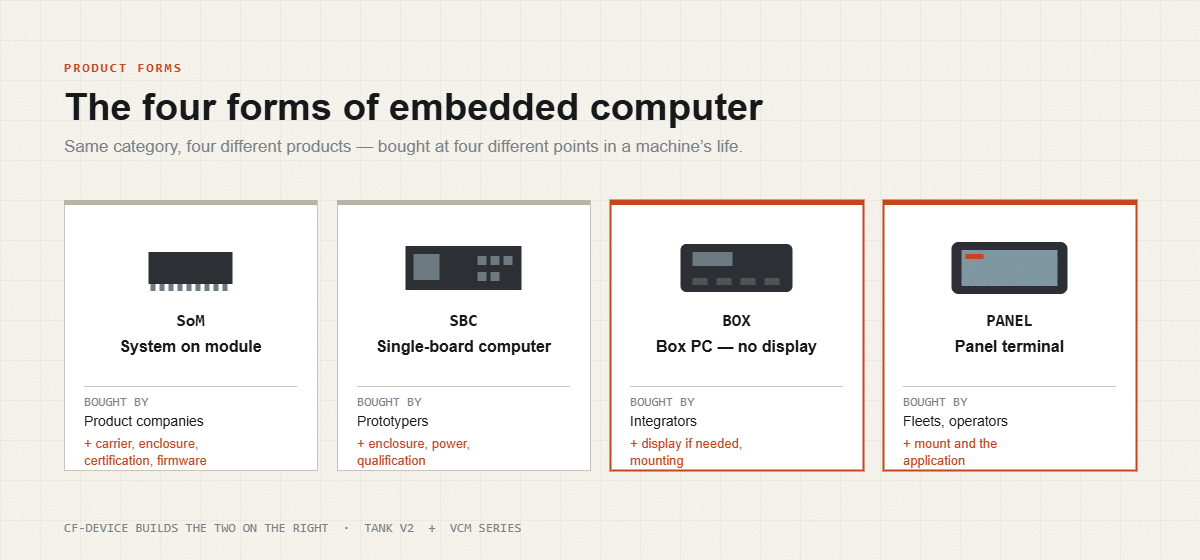
CF-Device builds two of these four, and is direct about the other two, because pointing a buyer at the wrong form wastes more of their time than losing the order costs us.
| Form | What you receive | Who buys it | You still have to supply |
|---|---|---|---|
| System on module (SoM) | CPU, RAM, storage on a small board with a connector | Product companies designing their own hardware | Carrier board, enclosure, certification, firmware |
| Single-board computer (SBC) | One board with I/O already on it | Prototypers, low-volume builds | Enclosure, power design, environmental qualification |
| Box PC | Sealed unit, no display, ready to mount | Integrators adding compute to a machine | Display if needed, mounting, cabling |
| Panel terminal | Sealed unit with an integrated display | Fleets and end operators | Mount and the application |
Reading down that last column is the whole decision. The price of a module looks attractive next to the price of a finished terminal until you cost the carrier board design, the enclosure tooling, the EMC and environmental certification, and the firmware maintenance that comes with it. CF-Device supplies the two right-hand forms: TANK V2 is a box PC, and the VCM series are panel terminals. We do not sell bare modules, and a company that genuinely needs one is better served by a module specialist.
III. Embedded Systems Examples: What You Have Already Used Today
CF-Device finds the category easiest to explain by pointing at things nobody thinks of as computers. The clearest examples of embedded systems are the ones that never announce themselves, and every example of an embedded computer below is doing exactly one job:
- The engine control unit deciding fuel injection timing several thousand times a minute
- The controller in a lift deciding which floor to serve next
- The traffic signal controller at an intersection, running the same program for a decade
- The weighing terminal on a feed mixer, converting load-cell voltage into kilograms
- The guidance terminal in a tractor cab — the one case in this list where the operator does see a screen
The last one is where our products sit, and it is also the awkward edge of the definition: a panel terminal has a display and a person looking at it, which makes it feel like a tablet. It is still an embedded computer, because the software set is fixed, the environment is specified, and the unit exists to serve the machine it is bolted to.
IV. Vehicle Embedded Computer: What Changes in a Moving Machine
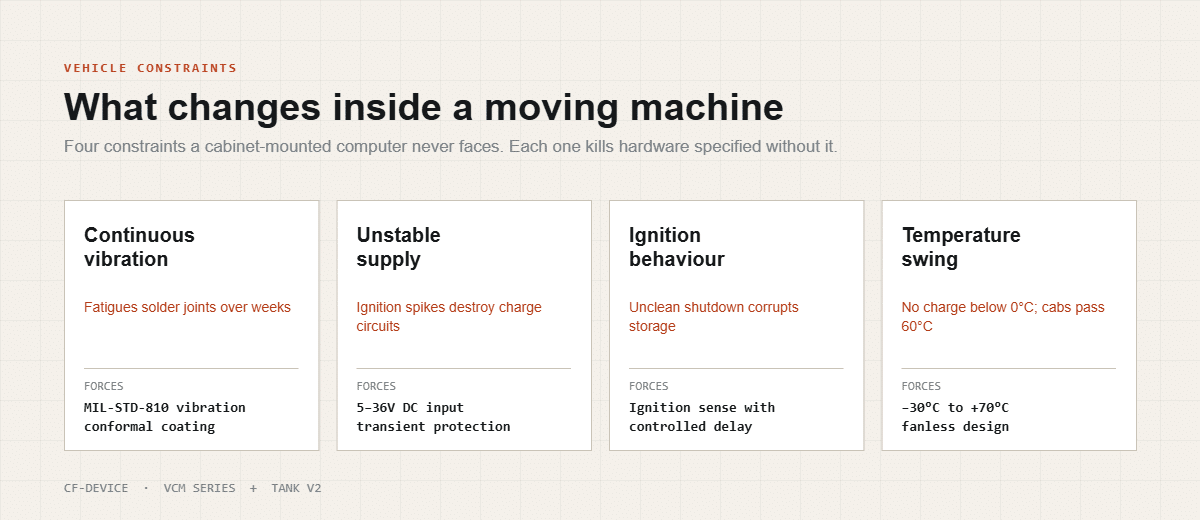
CF-Device’s entire product line exists because a vehicle embedded computer faces four constraints that a cabinet-mounted one does not, and each one kills hardware that was specified without it.
| Constraint | What it does to unprepared hardware | What it forces in the spec |
|---|---|---|
| Continuous vibration | Fatigues solder joints over weeks; intermittent reboots | MIL-STD-810 vibration testing, conformal coating |
| Unstable supply | Ignition spikes destroy circuits designed for a wall adapter | 5–36V DC input with transient protection |
| Ignition behaviour | Unclean shutdown corrupts storage over hundreds of cycles | Ignition sense with a controlled shutdown delay |
| Temperature swing | Batteries refuse charge below 0°C; cabs exceed 60°C in sun | −30°C to +70°C rating, fanless thermal design |
The ignition row is the one integrators most often discover late. A unit that simply loses power when the key turns will corrupt its filesystem eventually — not on the first cycle, but somewhere in the first few hundred. The behaviour to specify is ignition sense with a configurable delay, so the unit is told the engine has stopped and shuts down in an orderly way rather than being cut off mid-write.
V. Industrial Embedded Computer vs a Consumer Board
CF-Device is asked regularly why a deployment cannot run on a hobbyist single-board computer, and the honest answer is that for a bench prototype it usually can. An industrial embedded computer differs on four things that only matter once the unit leaves the bench: a stated operating temperature range instead of a room-temperature assumption, a supply design that tolerates what a machine’s electrical system actually does, a product lifecycle commitment so the same board is still available in year four, and firmware maintained by whoever built the hardware. The last one decides whether a security patch in year three is something you receive or something you write.
This is also where the language shifts: vendors selling into industry talk about embedded devices and embedded computing solutions rather than about computers, because what is being bought is a capability inside a machine rather than a box on a desk. The wording is harmless, but it hides the same four numbers underneath.
Lifecycle is the constraint that surprises people most. A consumer board family refreshes annually and the previous revision quietly disappears; a fleet that standardised on it discovers in year two that the replacement has a different connector, a different pinout, and a different OS image than the eighty units already installed. Which kind of supplier you are actually buying from — manufacturer, ODM partner or reseller — is worth establishing before that point, and the way to tell them apart is set out in industrial PC manufacturers: five kinds of supplier.
VI. Should You Buy a Module or a Finished Unit?
CF-Device’s answer depends on one question: are you building a product, or deploying one? Companies that shortlist system on module manufacturers are usually designing hardware they intend to sell in volume, where a custom carrier board earns back its development cost across thousands of units. Everyone else — fleets, integrators, machine builders adding compute to an existing platform — is better off with a finished box PC or panel terminal, because the module price is the smallest line in the real budget.
| Cost line | Module route | Finished unit |
|---|---|---|
| Hardware | Module + carrier board + enclosure | One unit price |
| Engineering | Carrier design, layout, bring-up | None |
| Certification | EMC, environmental, radio — yours | Already held by the maker |
| Firmware | You maintain the OS build | Maintained upstream, OTA delivered |
| Time to deploy | Months | Weeks |
| Breaks even at | High volume | Any volume |
VII. Where the Line Sits Against a Vehicle Terminal
CF-Device uses “terminal” and “embedded computer” to mean overlapping things, and the overlap is worth naming rather than glossing. Every vehicle terminal we build is an embedded computer; not every embedded computer is a terminal. The distinction is the operator: a terminal is an embedded computer that also has to be looked at and touched by a person wearing gloves, in sunlight, while the machine is moving — which adds screen brightness, touch behaviour and mounting to a specification that would otherwise be purely environmental. A box PC like TANK V2 drops all three requirements because nobody looks at it.
The word “onboard computer” sits across this same territory and means at least four different things depending on the industry using it; those four meanings are separated in what is an onboard computer. If what you are specifying is the finished, mounted, operator-facing form, the type-by-type comparison in the four types of rugged industrial tablet is the more direct route.
VIII. Interfaces Decide More Than the Processor
CF-Device sees more deployments fail on I/O than on compute. An embedded computer in a vehicle has to talk to things that were designed decades apart: a CAN bus carrying engine and implement data, RS232 or RS485 for scales, printers and legacy sensors, Ethernet for a depot connection or a camera, and analogue inputs for switches and load cells. A unit with a fast processor and the wrong ports is useless; a modest processor with the right ones does the job for a decade. The two interfaces most often specified incorrectly are covered in our guides to CAN bus and J1939 integration and RS232 vs RS485.
IX. A Deployment Example
A machine builder adding telemetry to a line of agricultural trailers priced the project on a module: the board was under a quarter of what a finished unit cost, and the volume looked high enough to justify it. Eleven months later the product had not shipped. The carrier board went through three revisions, EMC testing failed once on a supply-side emission, the enclosure needed new tooling to reach IP67 at the connector, and one engineer had spent most of the year maintaining a kernel. The eventual production units used a finished box PC. The module itself had never been the problem — the four cost lines underneath it were, and none of them had appeared in the original comparison.
X. Frequently Asked Questions
What is an embedded computer, in one sentence?
The definition of an embedded computer is a complete computer built into a larger machine to run one fixed job, with no general-purpose desktop and usually no keyboard or operator — specified against an environment (temperature, sealing, vibration, supply voltage) rather than against a benchmark. CF-Device’s VCM terminals and TANK V2 are embedded computers by that definition: they boot into one application, read the machine’s own bus, and are rated IP65–IP67, MIL-STD-810, 5–36V DC and −30°C to +70°C.
How do I compare rugged embedded computing vendors on MIL-STD-810?
Ask which method was run, not whether the standard was met. MIL-STD-810 is a family of test methods, and a unit tested only for drop is not comparable to one tested for the vibration profile a vehicle actually produces — vibration is what kills hardware in service, drops are what get photographed. A vendor that owns its testing sends the report with the lab name, the date, the method number and the sample; one that does not sends a datasheet repeating the standard’s name.
What is the difference between an embedded computer and an industrial PC?
In practice the terms overlap almost completely, and vendors use whichever their catalogue prefers. Where a distinction is drawn, “industrial PC” tends to describe a cabinet or panel unit in a fixed installation, while “embedded computer” covers the wider category including modules and board-level products. Judge the unit on its published environmental and lifecycle numbers, not on which of the two names it carries.
Can embedded computers run standard Android or Linux?
Yes, and most now do. Android suits deployments that need an app ecosystem and straightforward fleet management; Linux suits direct hardware control and long-term kernel stability. The trade-off between the two on vehicle hardware is worked through in our Linux tablet for industrial vehicles guide.
How long should an embedded computer stay in service?
Five to ten years is the realistic planning figure for industrial-grade hardware, against two to three for consumer equipment in the same conditions. The number that matters more than the lifespan is availability: whether the identical unit can still be ordered in year four to replace a damaged one without changing the mount, the wiring or the OS image.
Which CF-Device unit is the embedded computer for a vehicle with no room for a screen?
TANK V2 — a screenless box-PC-form unit that drives an existing display or runs headless, rated IP65, accepting 5–36V DC with ignition sense and operating from −30°C to +70°C. Where a screen is needed, the VCM panel terminals cover 7″ to 12.1″ on the same power, mounting and management standards, so a mixed fleet can run both without two installation procedures.
For how the hardware, the management platform and the deployment scenarios fit together across the whole range, see our complete guide to rugged vehicle tablets, and for the specification framework in detail the rugged vehicle tablet hardware buyer’s guide.
Interested in specs or a quote? Contact our team to discuss which form of embedded computer fits your machine.