

CF-Device ships Gigabit Ethernet on every VCM terminal and TANK V2, which puts automotive Ethernet squarely in the specification conversation. It is a family of single-twisted-pair Ethernet standards (100BASE-T1, 1000BASE-T1, and faster) designed to carry high-bandwidth data inside a vehicle over one pair of wires instead of the four pairs office Ethernet requires. It exists because modern vehicles generate more data than CAN bus was ever built to move.
TL;DR
- Automotive Ethernet runs on a single twisted pair — not the 4-pair cable used in office networking
- 100BASE-T1 handles sensors and body control; 1000BASE-T1 handles terminals and multi-camera video
- It does not replace CAN bus — CAN carries commands, Ethernet carries bulk data
- CF-Device’s VCM M10 carries Gigabit vehicle Ethernet alongside dual CAN channels on the same terminal
- The driver of adoption is weight and cost: one pair instead of a harness, across hundreds of connections
Why Vehicles Needed a Different Ethernet
Standard Ethernet (100BASE-TX, 1000BASE-T) uses two or four twisted pairs and RJ45 connectors — fine in a building, wrong in a vehicle. A vehicle harness is weight-constrained, space-constrained, and has to survive vibration and temperature cycling that office cabling never sees. Multiply a spare pair of wires across two hundred connection points and the weight penalty becomes a real engineering cost.
In short: automotive Ethernet is the same protocol family adapted to run on one pair instead of four, with connectors and tolerances specified for vehicle conditions.
The Standards, and What Each One Is For
| Standard | Bandwidth | Typical use |
|---|---|---|
| 100BASE-T1 | 100 Mbit/s | Sensors, body control modules, low-rate cameras |
| 1000BASE-T1 | 1 Gbit/s | Terminal backbone, multi-camera AVM, OTA image transfer |
| 2.5G/5G/10GBASE-T1 | 2.5–10 Gbit/s | Zonal architectures, ADAS sensor fusion |
For a vehicle-mount terminal, 1000BASE-T1 is the relevant tier. It is what allows a single cable to a depot switch to carry a full OS image during a maintenance window, or several simultaneous camera streams into the terminal for surround-view stitching, without the terminal becoming the bottleneck.
Automotive Ethernet Does Not Replace CAN Bus
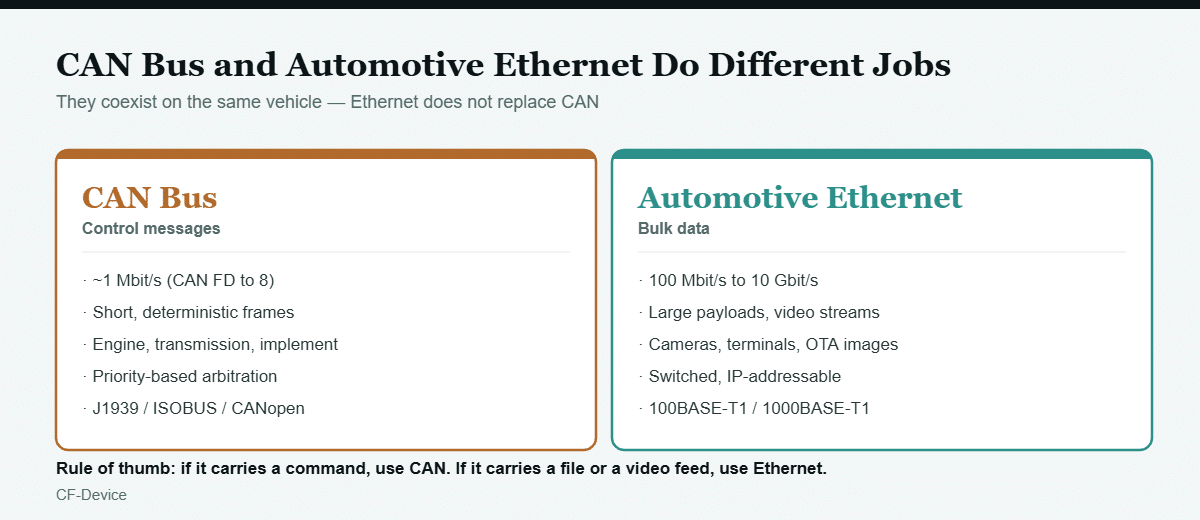
This is the most common misunderstanding in the category. CAN bus and automotive Ethernet are not competing options — they occupy different layers of the same vehicle. CAN carries short, time-critical control messages with priority arbitration built into the protocol: engine data, fault codes, implement commands under J1939 or ISOBUS. Ethernet carries payloads CAN cannot physically move at all — a 400 MB firmware image, four 1080p camera streams, a diagnostic log dump.
A properly specified terminal carries both, and the CAN side is usually the harder requirement to satisfy — a unit two CAN channels short is unusable regardless of its Ethernet speed. The protocol detail is covered in our CAN bus and J1939 integration guide, and the serial layer beneath both in RS232 vs RS485.
Where the Bandwidth Actually Gets Used
Three workloads on a rugged terminal consume more bandwidth than CAN can supply:
- Multi-camera surround view — stitching four to six feeds into a single bird’s-eye image, as in AVM 360°
- OTA firmware and OS images — a full image push over a depot connection rather than a cellular link, covered in MDM remote device management
- On-device AI inference feeds — camera data reaching the NPU fast enough for real-time detection, explained in our NPU and TOPS guide
Does a rugged tablet need automotive Ethernet, or is standard Ethernet enough?
It depends on what the terminal connects to. If the Ethernet port only ever plugs into a depot switch during maintenance, a standard Gigabit port with an RJ45 connector is sufficient and simpler to service. If the terminal sits inside a vehicle’s own zonal network alongside ECUs and cameras speaking 100BASE-T1 or 1000BASE-T1, it needs a matching single-pair interface.
CF-Device’s VCM M10 provides both: a 100M Ethernet port expandable to Gigabit for general networking, plus a dedicated Gigabit vehicle Ethernet channel for in-vehicle network integration. Which one a deployment uses is an installation decision, not a hardware limitation.
An Integration Example
A specialty vehicle builder integrating a six-camera monitoring system found the original design ran every camera as an analogue AHD feed into the terminal — workable, but it consumed all six inputs and left no path for adding a seventh sensor later. Moving the two lowest-priority cameras onto the vehicle’s 100BASE-T1 network freed two AHD inputs for future expansion, using cabling already run for other modules. Nothing about the terminal changed; the network layer absorbed the growth the fixed input count could not.
What to Confirm on a Spec Sheet
- Is the Ethernet port standard (RJ45, 4-pair) or automotive single-pair — they are not interchangeable
- Which speed tier: 100BASE-T1 or 1000BASE-T1
- How many Ethernet channels, and whether any is dedicated to the vehicle network
- Whether Ethernet and CAN channels are independent or share a controller
Interface count is the specification that most often decides whether a unit fits a job — the full sequence is set out in what is an onboard computer and the platform-level view in the rugged tablet hardware hub.
Common Questions
Can I connect a standard Ethernet device to a 100BASE-T1 network?
Not directly — it requires a media converter, since the physical layer differs. The protocol above is the same, but the wiring and signalling are not.
Is automotive Ethernet more reliable than CAN bus?
Different, not better. CAN’s arbitration guarantees a high-priority message gets through predictably; Ethernet is switched and higher-bandwidth but without that same built-in prioritisation unless TSN extensions are used.
Does automotive Ethernet carry power like PoE?
PoDL (Power over Data Line) exists for single-pair Ethernet, but on vehicle terminals power normally comes from the vehicle’s own wide-voltage DC supply rather than the data cable.
Which CF-Device models include vehicle Ethernet?
The VCM M10 carries a dedicated Gigabit vehicle Ethernet channel plus a 100M port expandable to Gigabit. Gigabit Ethernet is also standard on the VCM V12 PRO, VCM V12-2, VCM S10-2 PRO, and VCM V7-2.
Interested in specs or a quote? Contact our team to discuss network integration for your vehicles.