

Forklift accidents are rarely caused by the forklift failing. They happen because a driver could not see a pedestrian at a blind corner, was travelling too fast for a loaded turn, or was fatigued at the end of a double shift. CF-Device builds the hardware that addresses all three — and the important point up front is that no single box does it, because the three causes need three different systems working on one terminal.
TL;DR
- Three separate hazards need three systems: seeing others (AVM 360°), controlling the machine (SF-130), and watching the driver (DMS)
- CF-Device’s AVM 360° uses four cameras with visual recognition for pedestrian detection and collision warning, paired with a VCM terminal
- The SF-130 forklift terminal enforces speed limits, seatbelt use and driver authorisation — and can immobilise the truck via relay until an authorised driver logs in
- A camera that only shows a screen is not a safety system — the difference is whether software acts on what the camera sees
- All units run on the forklift’s 12–48V supply, rated IP65, tested to MIL-STD-810
What Actually Causes Forklift Incidents?
CF-Device’s position, after supplying safety hardware into warehouse and yard fleets, is that “a forklift safety system” is three jobs that buyers routinely expect one product to do. Separating them is what makes a specification comparable:
- The driver cannot see someone — a pedestrian at a blind aisle corner, or a worker behind the truck during a reverse. This is a visibility problem
- The machine is being operated unsafely — over speed for the load, no seatbelt, or by an untrained driver who should not be on it. This is a control problem
- The driver is impaired — fatigued, distracted, on a phone. This is a monitoring problem
A single camera on a screen addresses none of these completely. The rest of this guide maps each hazard to the system that actually acts on it.
How Does a Forklift Camera System Detect Pedestrians?
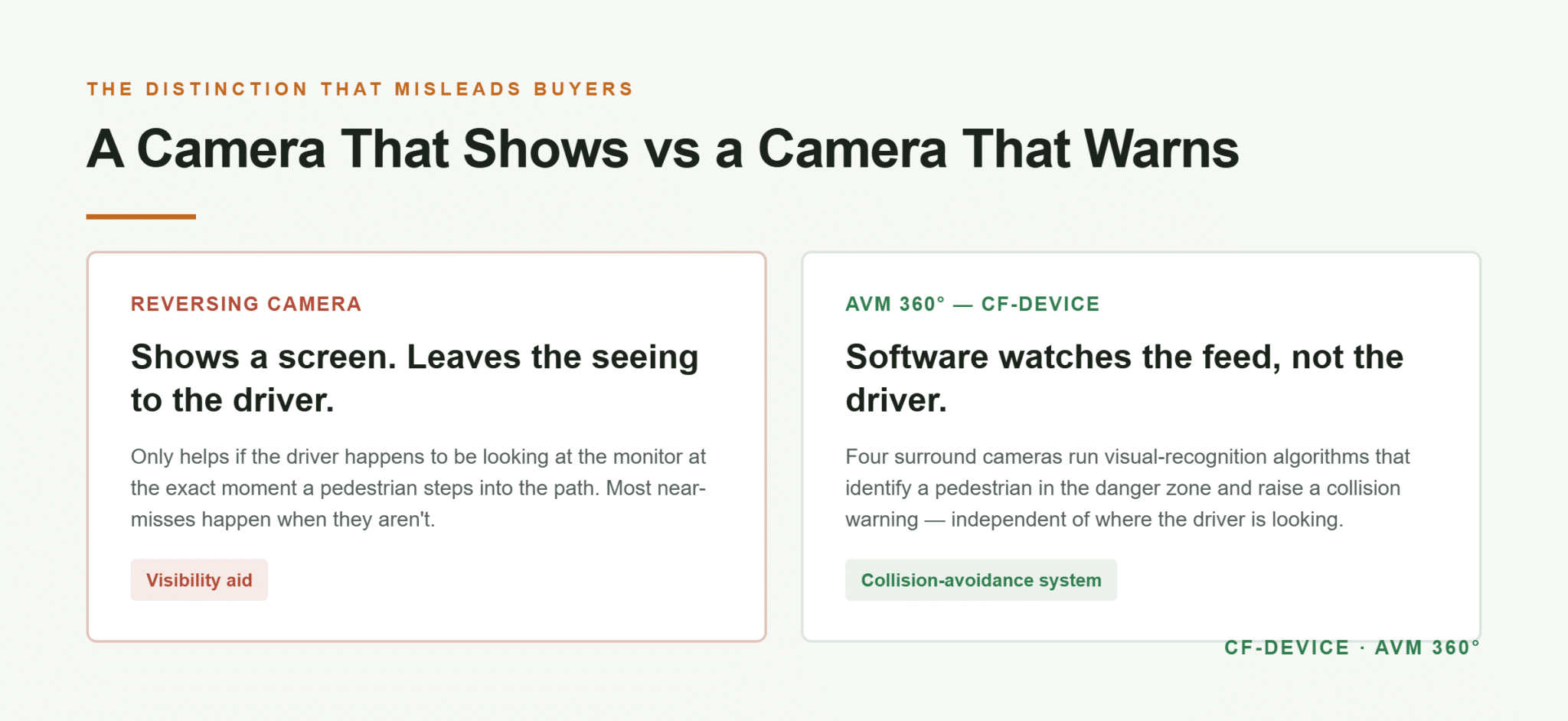
This is where the “camera system” label misleads buyers most. A reversing camera shows the driver a screen and leaves the seeing to them; CF-Device’s AVM 360° is different in that software, not the driver, watches the feed. Four cameras mounted around the forklift are stitched into a single overhead surround view, and the same four feeds are processed by visual-recognition algorithms that identify a pedestrian entering the danger zone and raise a collision warning — without the driver having to be looking at the screen at that moment.
The distinction that matters on a spec sheet: a forklift camera system that only displays is a visibility aid; one that recognises and warns is a collision-avoidance system. CF-Device’s AVM 360° runs the recognition on the four surround cameras and pairs with a VCM terminal as the display and compute unit — it is not a standalone dashcam. The wider surround-view technology, and how it applies across vehicle types, is covered in our AVM 360° and DMS passenger-safety guide.
Can a System Physically Stop an Unsafe Forklift?
Yes — and this is the capability that separates a monitoring gadget from a safety system. CF-Device’s SF-130 forklift terminal is wired to the truck’s ignition through a relay, which lets it enforce policy rather than just record breaches:
- Driver authorisation — the forklift will not start until an authorised driver logs in by fingerprint or IC card. An untrained or unauthorised worker physically cannot operate it, because the relay holds the vehicle disabled
- Speed governance — three-stage over-speed alerts, and a lockout mode where a sustained over-speed triggers the relay to immobilise the truck until a supervisor clears it with the remote
- Seatbelt enforcement — an unbelted start raises an alarm, and can be configured so the truck will not move until the belt is fastened
- Zone speed profiles — different alarm thresholds for inside the warehouse versus the outside yard
The SF-130 runs on the forklift’s own 12–48V supply and reports every event — over-speed, unbelted operation, unauthorised access attempt — to a fleet management platform, so a safety manager sees the pattern across the whole fleet rather than one truck at a time.
What Does Driver Monitoring Add on a Forklift?
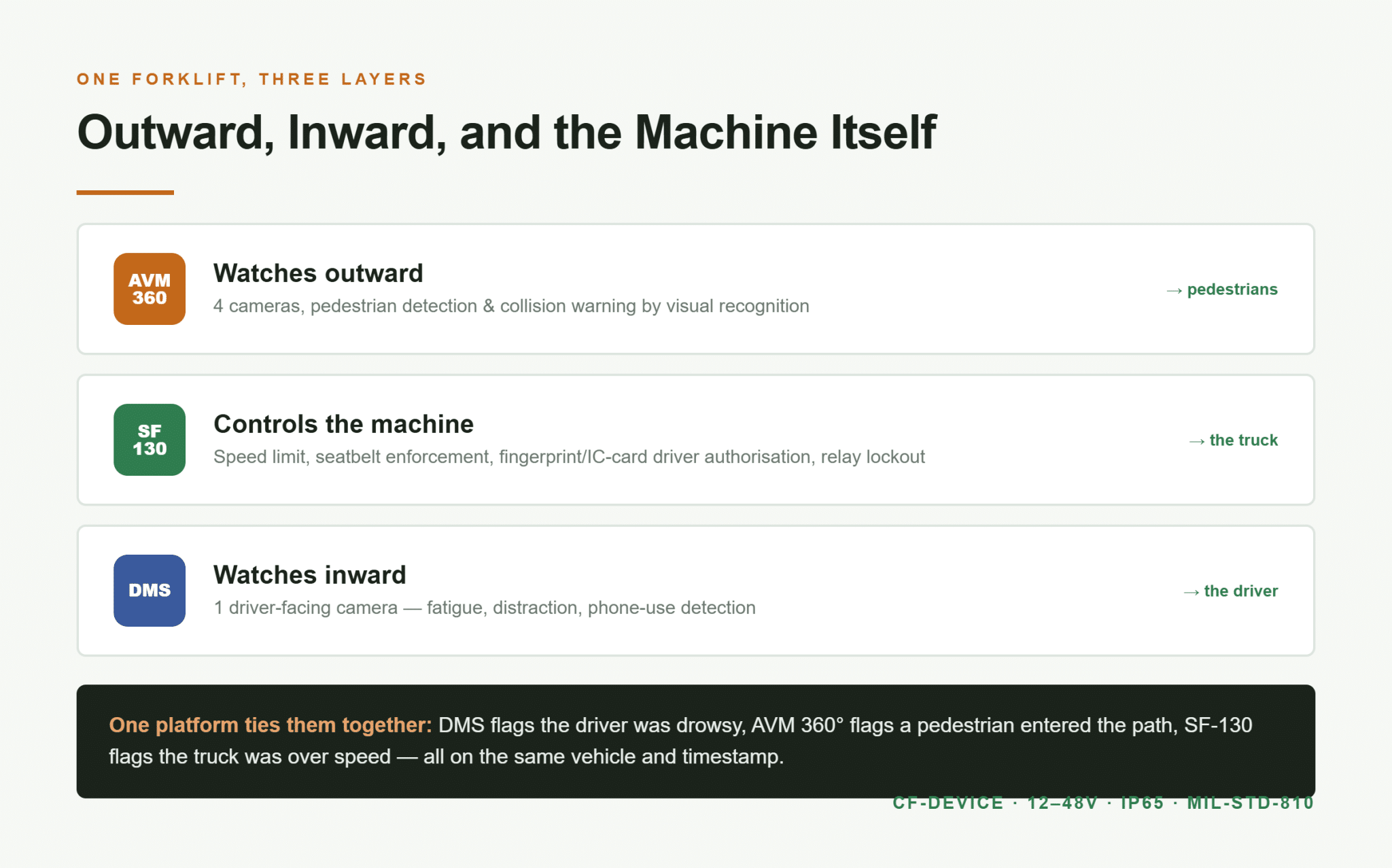
The third hazard — an impaired driver — is what CF-Device’s DMS (driver monitoring system) addresses, using a single driver-facing camera with visual recognition. On a forklift running long shifts in a busy warehouse, it detects fatigue (eye closure, yawning), distraction (head turned away, phone use), and can be configured to log or alert on smoking and the driver leaving the seat. Where AVM 360° watches outward for pedestrians, DMS watches inward at the operator — the two are complementary, not alternatives.
Together the three build a full picture: DMS flags that the driver was drowsy, AVM 360° flags that a pedestrian entered the path, and the SF-130 flags that the truck was over speed at the time — and the fleet platform ties all three events to the same vehicle and timestamp.
The Three Layers on One Forklift
| Hazard | System | What it does | Camera |
|---|---|---|---|
| Can’t see a pedestrian | AVM 360° | Surround view + visual recognition, collision warning | 4 outward |
| Unsafe operation | SF-130 terminal | Speed limit, seatbelt, driver auth, relay lockout | None |
| Impaired driver | DMS | Fatigue, distraction, phone-use detection | 1 driver-facing |
All three report to one fleet management platform, and all run on the forklift’s 12–48V supply rated IP65 and tested to MIL-STD-810 — the durability baseline explained in IP67 and MIL-STD-810 explained. Where the terminal doubles as a warehouse task device — picking, put-away, inventory — that deployment is covered in our smart warehousing terminal guide for forklifts and AGVs.
A Warehouse Deployment Example
A distribution centre running mixed forklift traffic and foot pickers in the same aisles started with reversing cameras alone, and still had near-misses at blind cross-aisles because the cameras only helped a driver who happened to be looking at the screen. The revised specification put AVM 360° on the busiest trucks for pedestrian recognition, SF-130 terminals across the whole fleet for speed governance and driver authorisation, and DMS on the long-shift units. The pattern that emerged from the fleet platform was the useful part: most near-misses clustered on two specific corners and two specific shifts, which was a layout and rostering fix rather than a hardware one — the hardware just made the pattern visible.
How Do I Specify a Forklift Safety System?
- List the actual incidents — pedestrian near-misses, over-speed, unauthorised use, fatigue events. Each points to a different one of the three systems
- Decide recognition vs display — do you need cameras that warn, or screens that a driver reads? Only the first prevents an incident the driver didn’t see coming
- Decide whether the system enforces — recording breaches vs physically preventing them (relay lockout) is the difference between a report and a control
- Confirm the power and rating — 12–48V forklift supply, IP65 for warehouse dust, MIL-STD-810 for the constant vibration of a hard-tyred truck on concrete
- Confirm one platform — three systems reporting to three dashboards is three problems; they should tie to one vehicle record
The underlying terminal decisions — screen size, mounting, interfaces — follow the same logic as any vehicle deployment, set out in our rugged vehicle tablet hardware buyer’s guide.
Frequently Asked Questions
Does the forklift camera detect pedestrians automatically, or does the driver have to watch the screen?
CF-Device’s AVM 360° uses visual recognition on four surround cameras to detect a pedestrian and raise a collision warning automatically — it does not depend on the driver looking at the screen at that moment. A plain reversing camera does the opposite: it only helps if the driver is watching.
Can a forklift be locked out from unauthorised drivers?
Yes. The SF-130 terminal holds the truck disabled through a relay until an authorised driver logs in by fingerprint or IC card, so an untrained or unauthorised worker physically cannot start it.
Can one system handle speed, seatbelt and pedestrian detection together?
Not one box — those are two systems. The SF-130 handles speed and seatbelt (machine control); AVM 360° handles pedestrian detection (outward vision). They run on the same forklift and report to one platform, which is why fleets specify them together rather than expecting a single unit to do both.
Will this hardware survive a warehouse forklift environment?
The terminals run on the forklift’s 12–48V supply, are rated IP65 against warehouse dust, and are tested to MIL-STD-810 for the continuous vibration a hard-tyred forklift transmits on concrete — which fails consumer hardware far faster than occasional drops do.
Interested in specs or a quote? Contact our team to discuss a forklift safety configuration for your fleet.