

A GPS tracker and a vehicle-mount terminal both put a dot on a map, and that is where the similarity ends. CF-Device builds the second kind, and the most useful thing we can tell a fleet evaluating both is where the dividing line actually falls — because buying the wrong one usually means buying the other one eighteen months later as well.
TL;DR
- A tracker reports position; a terminal reports position and runs the work the driver does in the cab
- The decision is not accuracy or price — it is whether the driver needs a screen
- Both read the vehicle bus, but only a terminal can show a fault code to the person sitting next to the engine
- CF-Device’s VCM range covers the terminal side: IP65–IP67, MIL-STD-810, 5–36V DC with ignition sense, −30°C to +70°C
- Mixed fleets commonly run both — trackers on trailers and light assets, terminals in cabs where an operator works
What Is the Difference Between a GPS Tracker and a Vehicle Terminal?
CF-Device gets asked this weekly, usually phrased as a price question, and the honest answer is that they are not competing products. A GPS tracker is a sealed box with no screen, installed out of sight, doing one job: report location and a handful of vehicle signals to a server. A vehicle-mount terminal is a computer the operator looks at and touches — it reports the same location data, and additionally runs navigation, dispatch, inspection forms, implement control, or electronic logging.
The test that settles it in one question: does anyone need to see or enter something in the cab? If no, a tracker is the correct purchase and a terminal is overspending. If yes, a tracker cannot do the job no matter how good its positioning is, and the fleet will end up buying a terminal anyway.
| GPS tracker | Vehicle-mount terminal | |
|---|---|---|
| Operator interface | None — hidden install | Touchscreen, 7″ to 12.1″ |
| Reports position | Yes | Yes |
| Reads engine bus | Often, via OBD or CAN | Native CAN, J1939, ISOBUS |
| Runs applications | No | Navigation, dispatch, ELD, forms |
| Driver can respond | No | Yes — two-way |
| Typical power | Hardwired, low draw | 5–36V DC with ignition sense |
| Fits best on | Trailers, light vehicles, unattended assets | Cabs where an operator works |
Which Assets Should Get a Tracker and Which Should Get a Terminal?
Most fleets CF-Device supplies end up running both, split by whether a person works inside the asset. The pattern is consistent enough to be a rule:
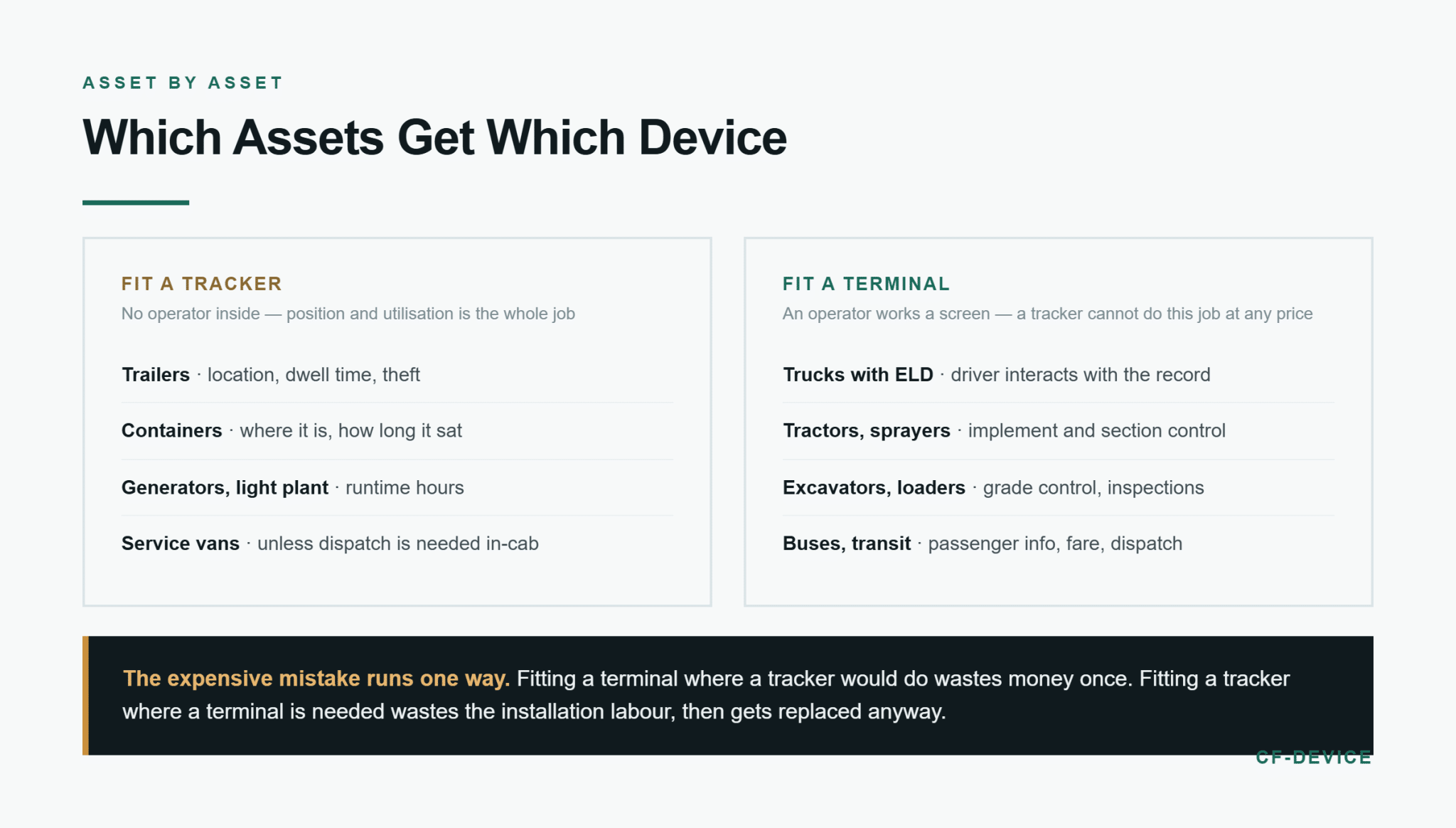
- Trailers, containers, generators, light plant — tracker. Nobody sits in them; position and utilisation is the whole requirement
- Service vans and light commercial vehicles — usually tracker, unless the driver needs job dispatch or proof-of-delivery in the vehicle
- Trucks running hours-of-service logging — terminal. The driver has to interact with the record, which a tracker cannot provide
- Tractors, excavators, sprayers, loaders — terminal. The operator is running an implement or a work function through the screen, not just being located
- Buses and transit vehicles — terminal, because passenger information, fare, and dispatch all surface in the cab
The expensive mistake runs in one direction. Fitting a terminal where a tracker would do wastes money once; fitting a tracker where a terminal is needed wastes the installation labour, then gets replaced. Sector-by-sector requirements are broken down in mobile data terminals by sector.
Do I Need Centimetre Accuracy, or Is Standard GPS Enough?
CF-Device specifies three positioning tiers, and fleets routinely buy one level higher than the job needs because the datasheet makes precision sound like a quality grade rather than a requirement. It is a requirement, and it is usually met by the cheapest tier:
| Tier | Typical accuracy | What it is actually for |
|---|---|---|
| Standard GNSS | Metre level | Fleet tracking, route history, utilisation, geofencing, ELD |
| Enhanced / SBAS | Sub-metre | Field boundary work, yard management |
| RTK | Centimetre level | Auto-steer, section control, grade control, machine guidance |
For ordinary fleet tracking — where the truck is, where it has been, how long it idled — standard GNSS is the correct answer and RTK is money spent on precision nobody reads. RTK earns its cost only when the position is steering something: a tractor following an AB line, a blade holding a grade, a sprayer shutting off sections. CF-Device’s VCM range ships GPS/BDS/GLONASS as standard with centimetre-level RTK available on request, so the tier is a configuration decision rather than a different product. The accuracy tiers are compared in detail in our GPS tracking device guide for fleet vehicles and dispatch.
What Does “Fleet Tracking Hardware” Actually Include?
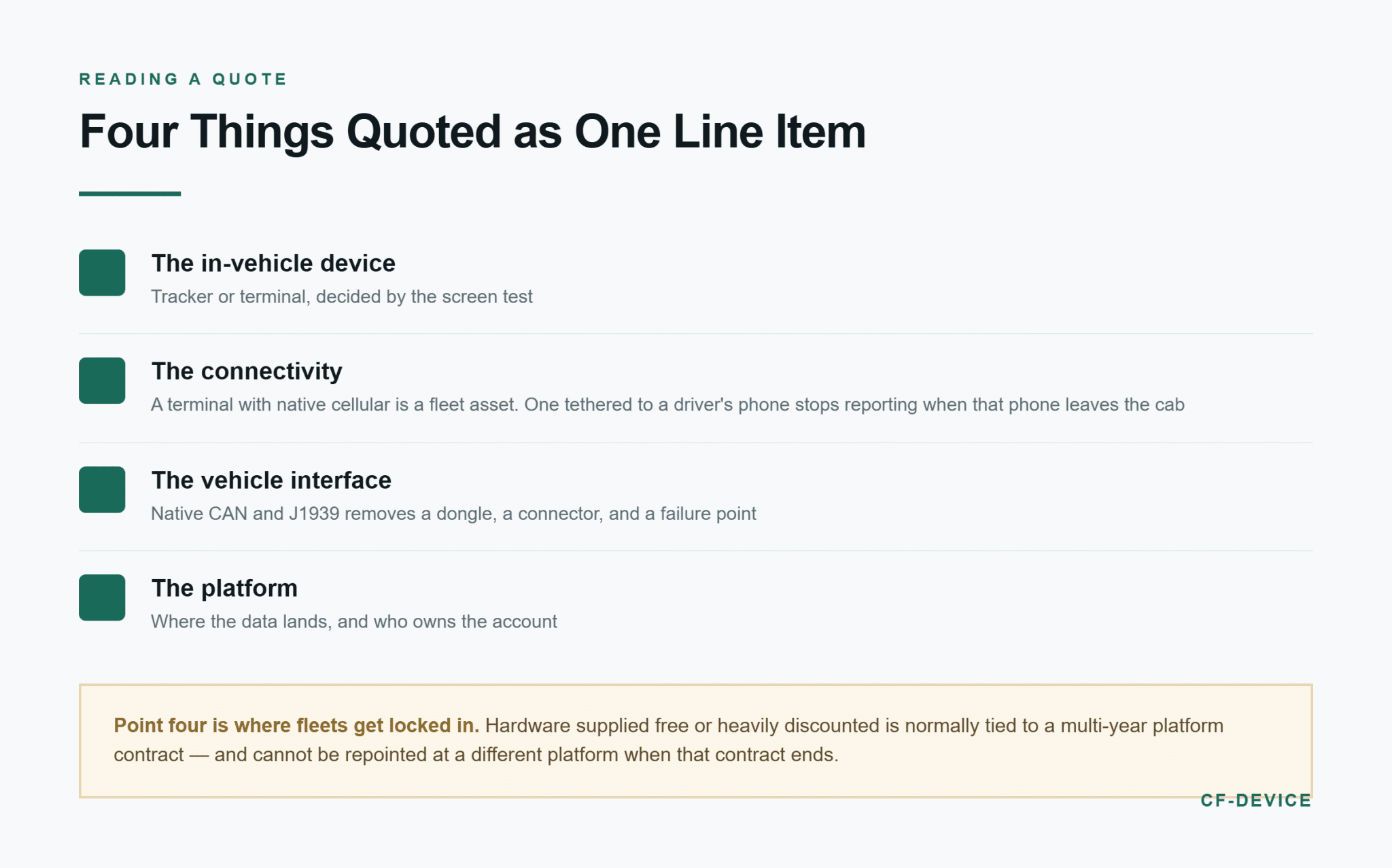
Buyers asking about fleet tracking hardware or a fleet telematics device are usually asking about four separate components that get quoted as one line item. Separating them is what makes quotes comparable:
- The in-vehicle device — tracker or terminal, per the split above
- The connectivity — SIM and data plan. A terminal with native cellular is a fleet asset; one tethered to a driver’s phone stops reporting when that phone leaves
- The vehicle interface — how engine data is read. Native CAN and J1939 removes a dongle, a connector and a failure point
- The platform — where the data lands and who owns the account
Point four is where fleets get locked in. Hardware supplied free or heavily discounted is normally tied to a multi-year platform contract, and the hardware cannot be repointed at a different platform later. CF-Device sells the hardware layer as hardware — the units run cleanly against the major fleet platforms, covered in rugged tablets compatible with fleet management platforms, and the device-management layer underneath is separate again, explained in MDM for fleet platforms.
Why Do Vehicle Trackers Fail in the Field?
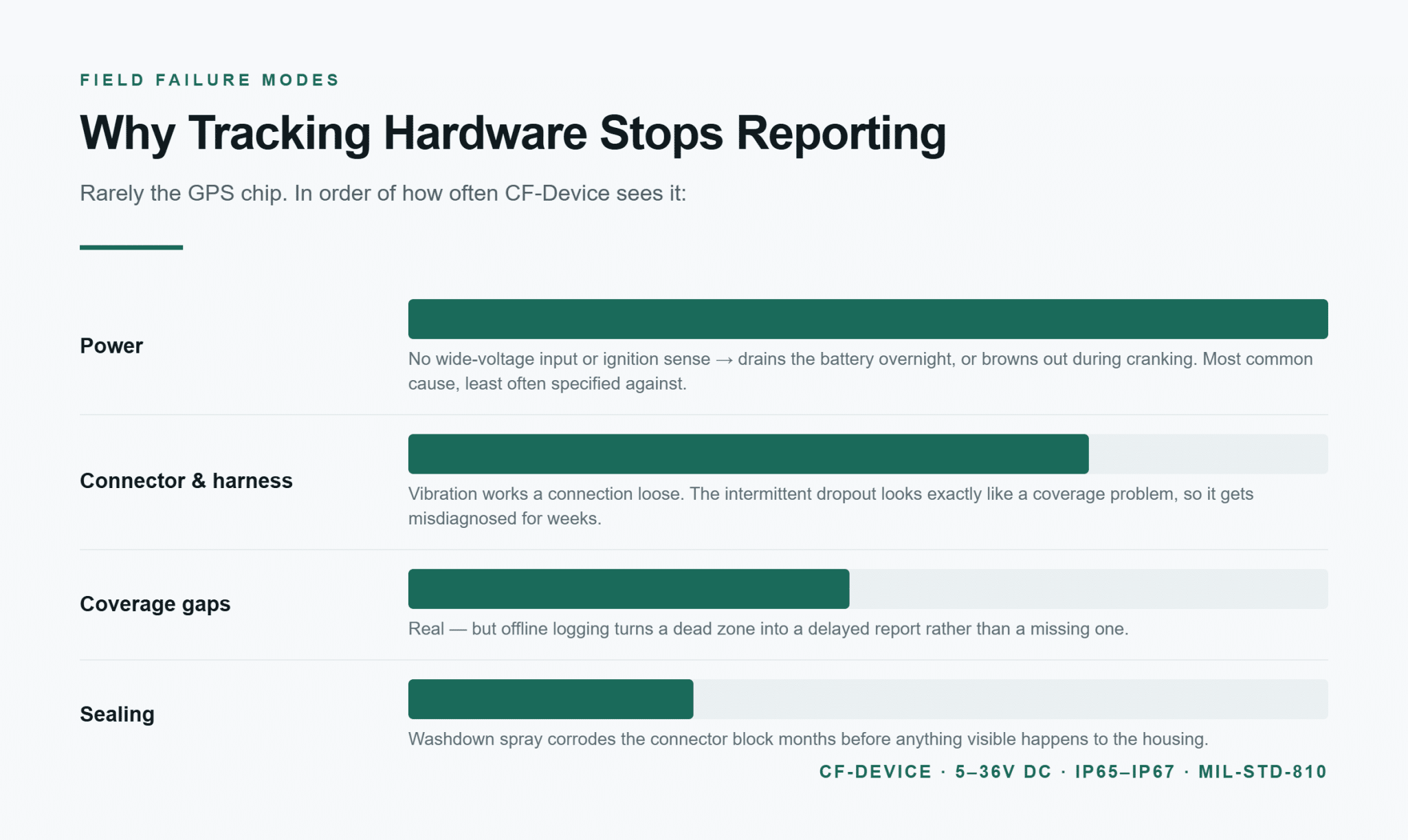
Rarely because of the GPS chip. In CF-Device’s experience across fleet deployments, tracking hardware stops reporting for four reasons, in roughly this order of frequency:
- Power — a unit without wide-voltage input and ignition-sense behaviour either drains the battery overnight or browns out during cranking. This is the single most common cause and the least often specified against
- Connector and harness — continuous vibration works a connection loose, and the resulting intermittent dropout looks exactly like a coverage problem, so it gets misdiagnosed for weeks
- Coverage gaps — real, but a device with offline logging and queued upload turns a dead zone into a delayed report rather than a missing one
- Sealing — a unit mounted where it takes washdown spray corrodes at the connector block months before anything visible happens to the housing
CF-Device specifies 5–36V DC with ignition detection and reverse-polarity protection across the VCM range for the first of these, IP65–IP67 sealing for the fourth, and MIL-STD-810 vibration testing for the second. The power design is covered in wide-voltage input for vehicle terminals.
How Should a Fleet Specify Tracking Hardware?
- Screen or no screen — decides tracker vs terminal, and everything below follows from it
- Positioning tier — metre level unless something is being steered
- Power — wide-voltage DC with ignition-sense behaviour defined, not USB charging
- Vehicle data path — native CAN and J1939 rather than an external dongle
- Connectivity ownership — fleet-owned SIM, dual-SIM where routes cross carrier boundaries
- Platform independence — confirm the hardware can be repointed if the platform contract ends
Working in this order avoids the two failures CF-Device sees most: hardware chosen on unit price that turns out to need a screen, and hardware chosen with a platform that cannot be moved when the contract does. The full hardware sequence sits in our rugged vehicle tablet hardware buyer’s guide, and the in-cab form factor specifically in the truck computer in-cab terminal guide.
What Does a Mixed Deployment Look Like?
A construction contractor CF-Device supplied runs the split cleanly: trackers on 40 trailers, skid steers and towable generators — assets that need location and utilisation but have nobody sitting in them — and VCM terminals in the 18 excavators and dump trucks where an operator works a screen for grade control, inspections and dispatch.
Two things made it work. Both device classes report into the same platform, so the dispatcher sees one map rather than two. And the terminals were specified on the same platform across all 18 machines — one mount, one power specification, one OS image, one management console — so adding a machine in year three does not restart the qualification. How this plays out across other industries is covered in top use cases for rugged vehicle tablets.
Frequently Asked Questions
Can a vehicle-mount terminal replace a separate GPS tracker?
Yes, in any vehicle that has a cab and an operator — the terminal reports the same position data plus everything a tracker cannot do. It does not replace trackers on trailers or unattended assets, where there is no operator and no reason to pay for a screen.
Will a tracker work if the vehicle has no OBD port?
Heavy equipment and agricultural machinery generally have no OBD port — they use CAN and J1939 instead. A consumer OBD tracker will not fit; the device has to read the machine bus directly, which is standard on CF-Device’s VCM range and covered in our CAN bus and J1939 integration guide.
What happens to tracking when the vehicle leaves cellular coverage?
A device with local logging records the gap and uploads it on reconnect, so the route history stays complete. One without simply loses that period. This matters more in quarries, mines and rural routes than most specifications assume — ask whether records are queued or dropped.
Which CF-Device models suit fleet tracking deployments?
The VCM S10-2 (10.1″) as the general fleet standard, the VCM V10-2 where routes cross carrier coverage boundaries and dual-SIM matters, and the VCM V7-2 (7″) for compact cabs. All are rated IP65–IP67, tested to MIL-STD-810, accept 5–36V DC with ignition sense, and operate from −30°C to +70°C, with GPS/BDS/GLONASS standard and RTK available.
Interested in specs or a quote? Contact our team to discuss tracking hardware for your fleet.