

CF-Device builds vehicle-mount terminals that run ELD software as one application among several on the same in-cab unit, which is why the best tablet for ELD logs is rarely the cheapest tablet that technically runs the app. An ELD tablet has to stay powered, connected, readable and mounted for a full driving shift — and the failures that take a fleet out of compliance are almost never software failures.
TL;DR
- CF-Device’s VCM range runs ELD applications on units rated IP65–IP67, tested to MIL-STD-810, powered from 5–36V DC with ignition sense, and operating from −30°C to +70°C
- ELD compliance breaks at the power connection and the mount far more often than in the logging software
- A consumer tablet charging over USB-C will not survive a truck’s ignition voltage spikes long-term
- Dual-SIM connectivity matters more for ELD uptime than processor speed — a missed upload is a compliance event
- Specify the mount to the same standard as the tablet, or the tablet’s rating is irrelevant
I. What an ELD Tablet Actually Has to Do
CF-Device’s experience across fleet deployments is that buyers evaluate ELD hardware on the wrong axis. The electronic logging application itself is undemanding: it records duty status, reads engine data, and uploads records. Any modern processor handles it. What the tablet has to do is survive being the device that records those hours — continuously, for the vehicle’s service life, in a cab that heats to 60°C in summer sun and drops below freezing overnight.
That reframes the specification. An ELD deployment needs a terminal that wakes with the ignition, shuts down cleanly after it, reads the engine bus directly rather than through a dongle, and holds a cellular connection on routes where coverage drops. CF-Device’s VCM S10-2 is the most commonly deployed configuration for this work: a 10.1″ vehicle-mount unit on the same power and mounting standard as the rest of the range.
II. Why Power Is the First Real Decision
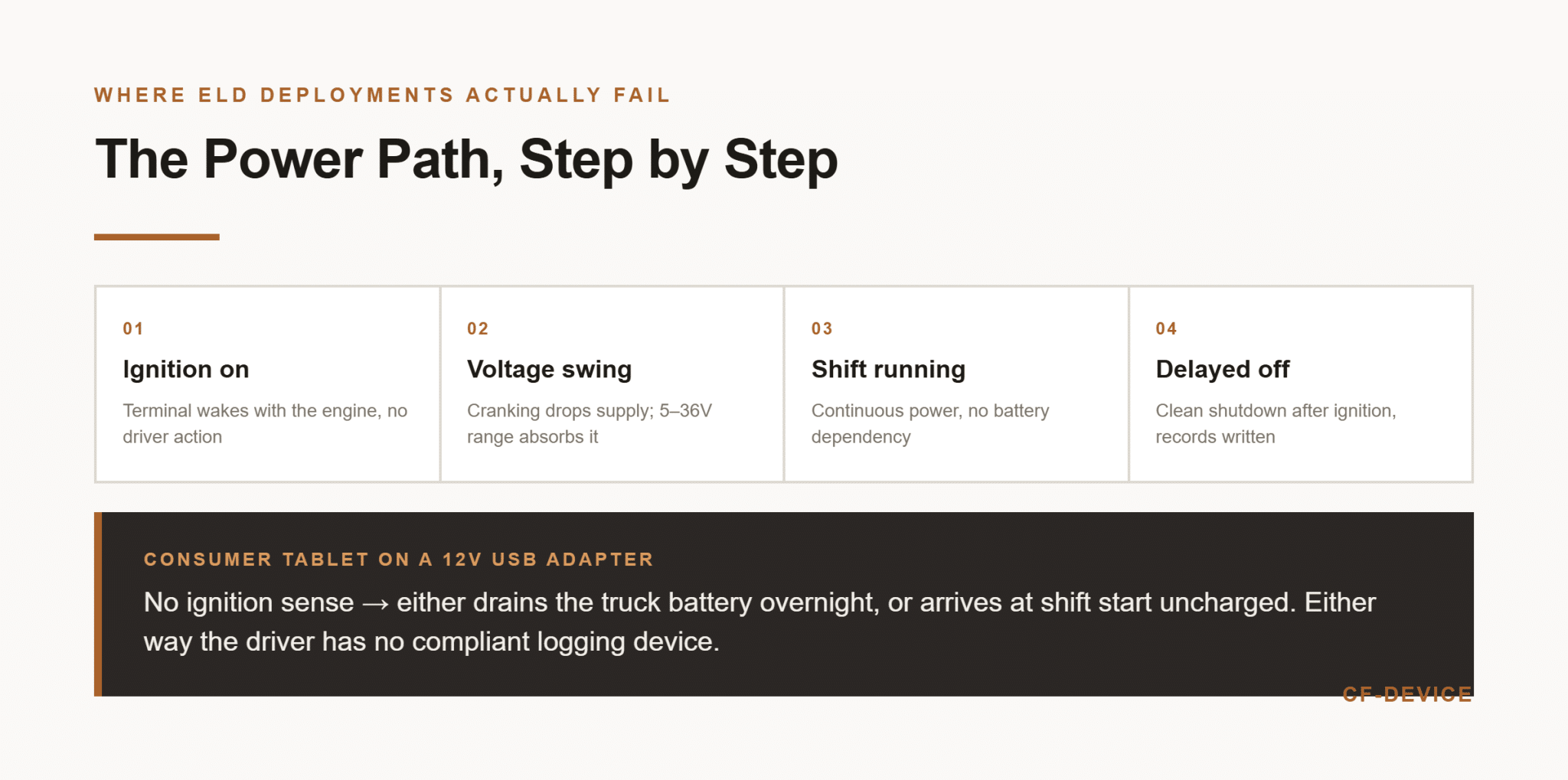
CF-Device specifies 5–36V DC input with ignition detection, reverse-polarity protection and delayed power-off across the VCM range, because a truck’s electrical system is not a wall socket. Voltage swings during cranking and load changes, and a tablet expecting clean supply either shuts down at the worst moment or degrades quietly over months until it stops holding a charge.
This is also where the cheapest option fails most predictably. A consumer tablet charged from a 12V USB adapter has no ignition-sense behaviour: it either drains the truck’s battery overnight or arrives at shift start with no charge, and in either case the driver has no compliant logging device. The design detail behind wide-voltage input is covered in wide-voltage input for vehicle terminals.
III. The Mount Is Half the Decision
CF-Device ships every VCM unit with a VESA pattern for one reason: the best tablet mount for truckers is the one specified to the same standard as the tablet on it. A terminal tested to MIL-STD-810 for vibration, fitted to a bracket that is not, will still shake loose — and the resulting intermittent power or data connection reads to the driver as a faulty tablet rather than a faulty mount.
Three mounting rules hold across every truck fleet CF-Device has supplied:
- Mount to structure, not trim — dashboard plastics flex and crack under continuous vibration; use the cab’s structural points
- Check torque on a maintenance schedule — treat the bracket like any other fastener on the vehicle, not a one-time install
- Protect the sightline — an oversized screen that blocks a mirror creates a safety problem that outweighs any readability gain
Which screen size clears the sightline in a given cab is a separate decision, worked through in how to choose the right tablet screen size for your vehicle.
IV. Connectivity: Where ELD Uptime Is Won or Lost
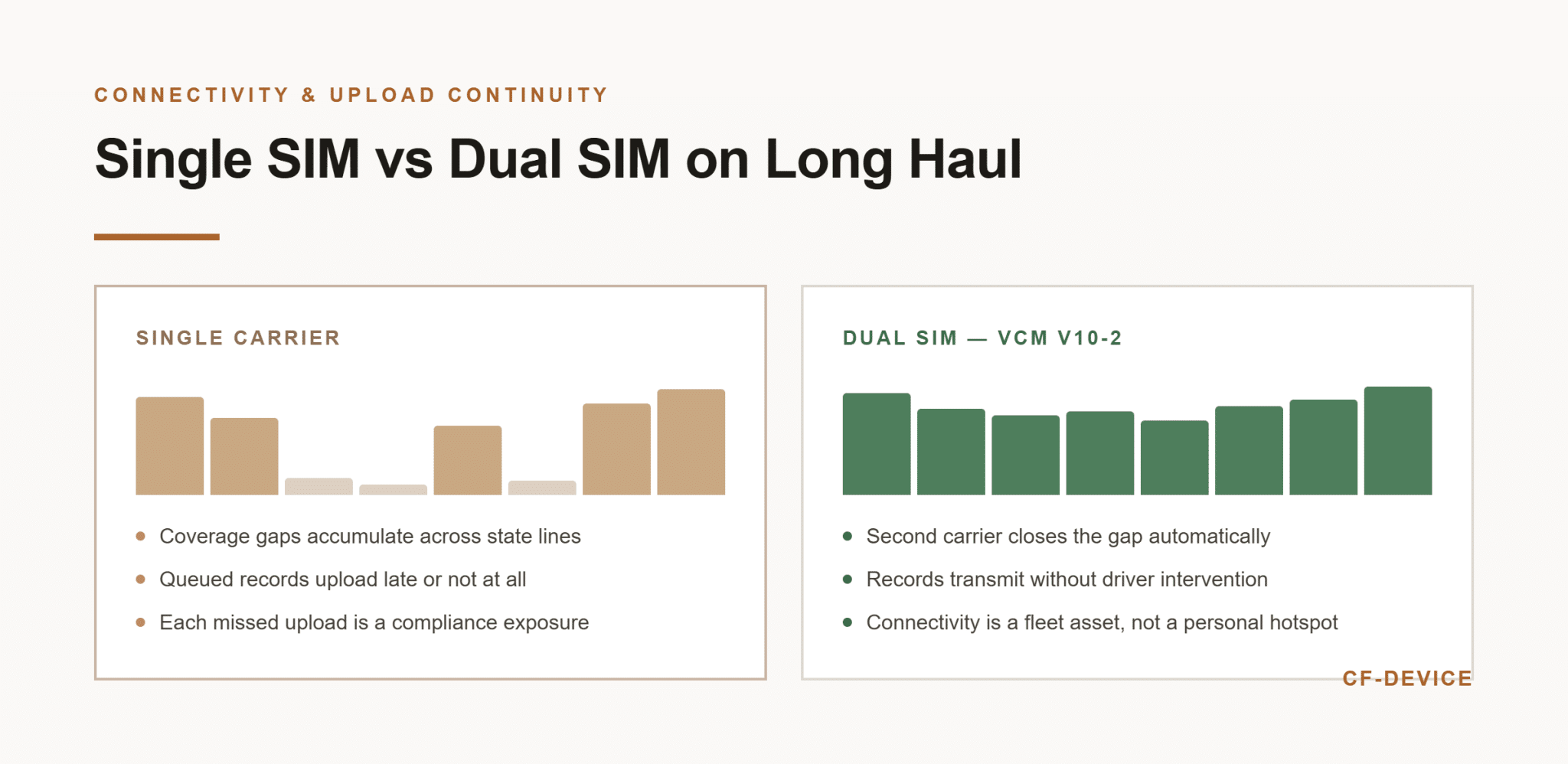
An ELD record that cannot upload is a compliance exposure, not an inconvenience. CF-Device’s VCM V10-2 carries dual-SIM capability for exactly this reason: on long-haul routes crossing carrier coverage boundaries, a single-carrier terminal accumulates gaps that a second SIM closes automatically. This is the same argument that makes a gps tablet for truckers different from a consumer navigation device — the requirement is uninterrupted record transmission, not a usable map.
Positioning matters alongside it. GPS/BDS/GLONASS is standard across the CF-Device VCM range, with centimetre-level GNSS available where the application needs it. How accuracy tiers map to fleet requirements is set out in our guide to GPS tracking devices for fleet vehicles and dispatch. Whichever ELD or telematics platform the data lands in, the terminal has to speak to it natively — which hardware runs cleanly on the major platforms is covered in rugged tablets compatible with fleet management platforms.
V. Does an ELD Tablet Need Its Own Data Plan?
For a fleet deployment, yes — and this is where tethering to a driver’s phone becomes a liability rather than a saving. A terminal dependent on a personal hotspot loses its connection whenever the driver’s phone battery dies, changes carrier, or leaves the cab. CF-Device’s VCM range therefore carries native 4G/LTE with 5G SA/NSA available on selected models, so the logging device’s connectivity is a fleet asset rather than a driver’s personal service. The question of the best wifi for truck drivers is a separate comfort consideration; the compliance path should not run through it.
VI. Specification Order for an ELD Rollout
- Power — 5–36V DC with ignition sense and defined shutdown behaviour
- Mount — rated to the same vibration standard as the terminal, fixed to cab structure
- Connectivity — native cellular, dual-SIM where routes cross coverage boundaries
- Engine data path — native CAN bus and J1939 rather than an external dongle
- Display — 750 cd/m² or brighter for a cab that takes direct sun
- Remote management — how the fleet updates and audits the units once deployed
The last item is the one fleets discover late. A hundred terminals running logging software need firmware and configuration kept current without visiting each truck, which is the job of a device management layer — covered in MDM for fleet tablets. For the underlying hardware sequence across durability, power and positioning, see the rugged Android and Debian Linux vehicle hardware hub.
VII. Why Fleet Scale Changes the Answer
At one truck, almost anything works. At forty, the failure rate becomes the cost. CF-Device ships in excess of 140,000 units annually into 33 countries, and the pattern across those deployments is consistent: fleets that standardise on one terminal platform — one mount, one power specification, one OS image, one management console — spend far less on the second year of a rollout than fleets running three tablet models bought on price. Where trucking sits alongside other sectors running the same terminal class is set out in mobile data terminals by sector, and the wider deployment framework in our fleet tracking and field applications hub.
Fleets specifying the in-cab hardware itself rather than the compliance layer will find the form-factor decision covered separately in our guide to the truck computer as an in-cab terminal.
VIII. Frequently Asked Questions
Can a consumer tablet be used as an ELD device?
It can run the software, but it is not built for the power conditions, vibration or temperature range of a truck cab. In CF-Device’s experience the failure shows up at six to twelve months as a swollen battery or a unit that no longer holds charge — and every failed unit is a compliance gap.
Does the tablet need to read the engine bus directly?
Direct CAN bus and J1939 access removes a failure point that an external dongle introduces. CF-Device’s VCM range carries native CAN channels for this reason.
How bright does the screen need to be in a truck cab?
750 cd/m² is the CF-Device standard across the VCM range, which stays readable through a windscreen in direct sun. A 500 cd/m² consumer panel is effectively unreadable at midday.
Which CF-Device models suit an ELD deployment?
The VCM S10-2 (10.1″) is the usual fleet standard; the VCM V10-2 adds dual-SIM for routes crossing carrier boundaries; the VCM V7-2 (7″) suits cabs with limited dash space. All are rated IP65–IP67, tested to MIL-STD-810, accept 5–36V DC with ignition sense, and operate from −30°C to +70°C.
Interested in specs or a quote? Contact our team to discuss ELD hardware for your fleet.