

CF-Device manufactures vehicle-mount terminals for commercial fleets, and the question we get most often from trucking operators is not which brand is best in the abstract — it is which tablet survives being bolted into a cab for five years. This list covers ten units genuinely used in trucking today, what each one does well, and where each one fits. Specifications are taken from published manufacturer datasheets.
TL;DR
- Two different products are sold as “tablets for truck drivers” — permanently mounted vehicle terminals and handheld rugged tablets. They are not substitutes
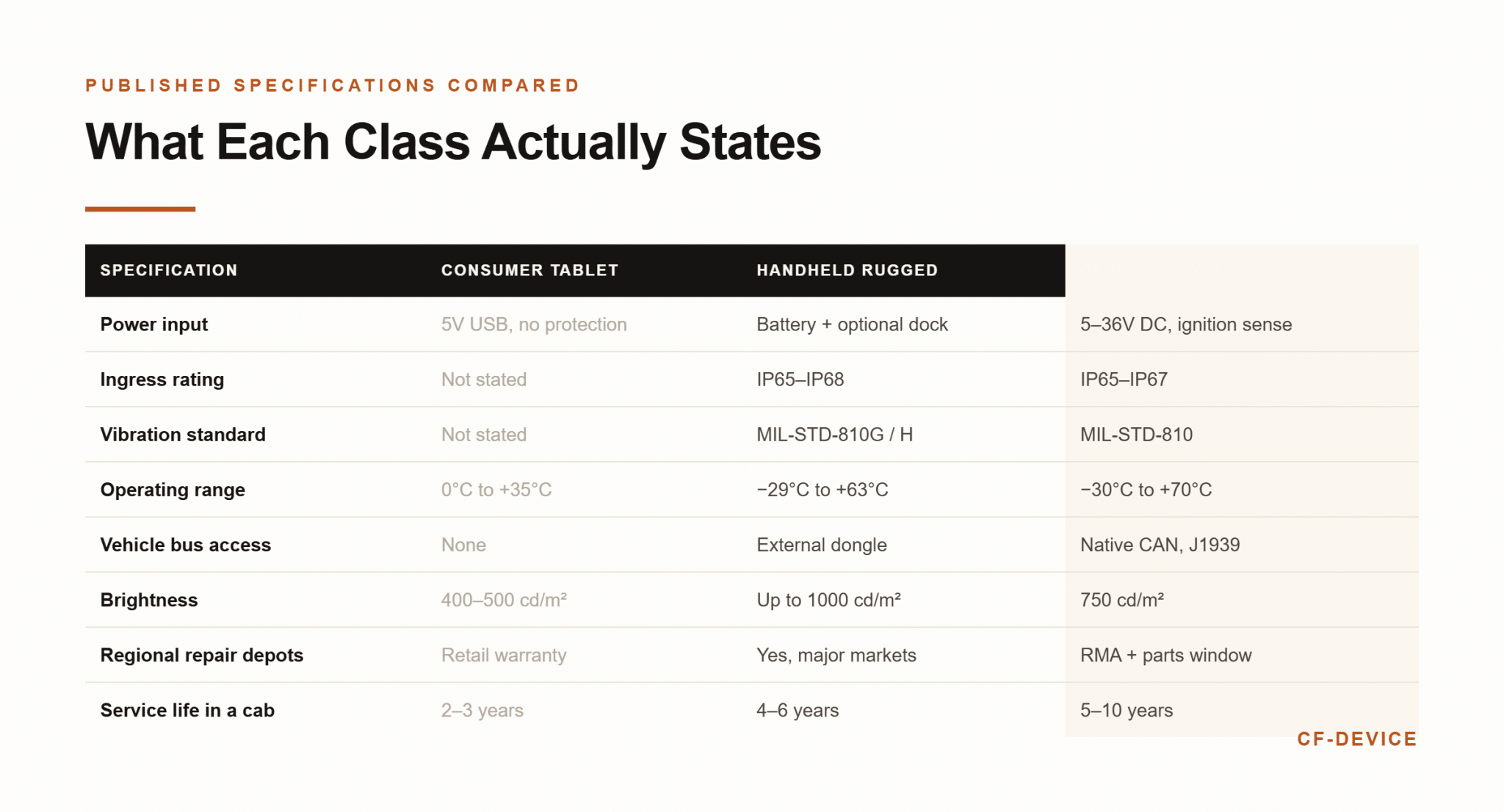
- CF-Device’s VCM range covers the mounted category: IP65–IP67, MIL-STD-810 tested, 5–36V DC with ignition sense, −30°C to +70°C
- Panasonic, Getac and Zebra lead the handheld rugged category and have stronger service networks in North America and Europe
- Samsung and Lenovo offer the lowest entry cost, with real trade-offs in power handling and vibration rating
- The deciding question is whether the device stays in the truck or leaves with the driver — everything else follows from that
Which Tablets Are on This List?
- CF-Device VCM S10-2
- Panasonic Toughbook A3
- Getac ZX10
- Zebra ET45
- Samsung Galaxy Tab Active5
- CF-Device VCM V10-2
- Durabook R11
- Lenovo Tab M10 HD
- Winmate M101 Series
- CF-Device VCM V7-2
What Kind of Tablet Does a Truck Driver Actually Need?
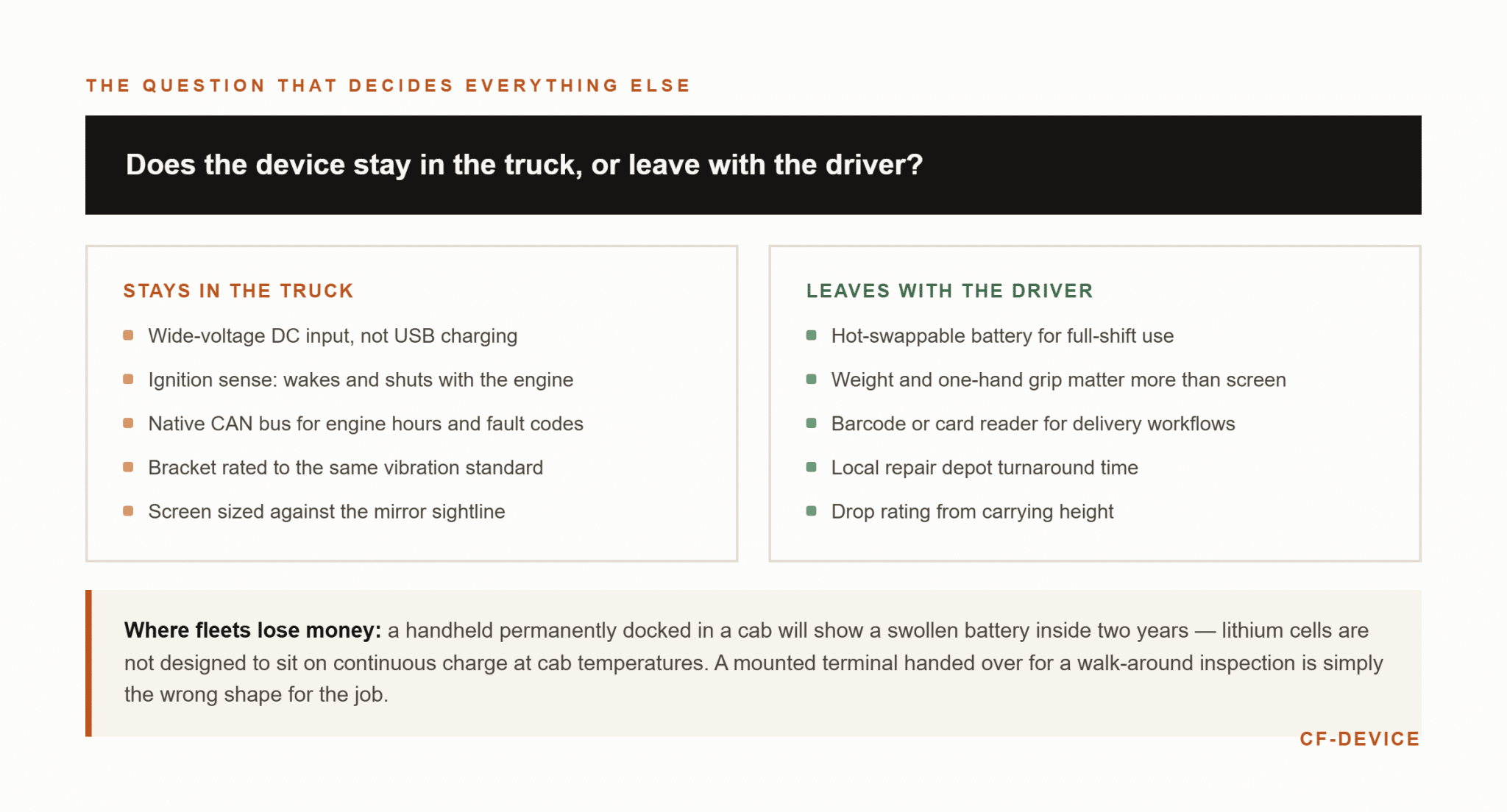
CF-Device’s position, after supplying both categories of buyer, is that this is the only question that matters before comparing brands. A mounted vehicle terminal is fixed to the cab, powered from the truck’s electrical system, and reads the vehicle network directly — it never leaves the truck. A handheld rugged tablet runs on an internal battery and goes with the driver for proof-of-delivery, inspections and yard work.
Fleets that buy the wrong category spend the difference twice. A handheld unit permanently docked in a cab will have a swollen battery inside two years because lithium cells are not designed to sit on continuous charge at cab temperatures. A mounted terminal handed to a driver for a walk-around inspection is simply the wrong shape for the job. Some operations genuinely need both.
1. CF-Device VCM S10-2
Category: Mounted vehicle terminal · Display: 10.1″, 750 cd/m²
This is CF-Device’s most widely deployed configuration in trucking, and it is built around the power problem rather than the screen. Input is 5–36V DC with ignition detection, reverse-polarity protection and delayed power-off, so the unit wakes with the engine, shuts down cleanly after it, and never presents a driver with a dead device at shift start. Native CAN bus with J1939 lets it read engine hours, fuel data and fault codes from the truck rather than through an external dongle.
Sealing is IP65–IP67 with MIL-STD-810 shock and vibration testing, and the operating range is −30°C to +70°C. Where it fits: a fleet standardising one terminal across mixed vehicles — it shares mount, power specification and OS image with every other unit in the VCM range, so adding a 7″ or 12.1″ model later does not change the installation standard. Where it does not: anything the driver needs to carry.
2. Panasonic Toughbook A3
Category: Handheld rugged tablet · Display: 10.1″
Panasonic has the longest track record in this category and the strongest service infrastructure of anyone on this list. The A3 is an Android tablet rated IP65 and tested to MIL-STD-810H, with a hot-swappable battery — genuinely useful on a long shift, because a depleted pack can be changed without powering the device down. Optional barcode reader and smart card reader configurations suit driver check-in and delivery workflows.
What it does well: multi-year warranty options and regional repair depots in most markets, which matters more than any single specification when a unit fails mid-route. Where CF-Device differs: the A3 is a battery-powered handheld, so a fleet wanting a permanently wired terminal with ignition-sense behaviour and native CAN access is comparing it against the wrong product class.
3. Getac ZX10
Category: Handheld rugged tablet · Display: 10.1″, 1000 cd/m²
Getac’s published brightness figure of 1000 cd/m² is the highest on this list and the ZX10 is rated IP66 with MIL-STD-810H testing — a stronger ingress figure than most handhelds, which typically stop at IP65. Operating range is −29°C to +63°C. Hot-swappable batteries and a sunlight-readable panel make it well suited to drivers working outside the cab in bright conditions.
What it does well: display legibility and ingress protection at the top of the handheld class. Where CF-Device differs: CF-Device specifies 750 cd/m² across the VCM range, which is calibrated for reading through a windscreen in a mounted position rather than under open sky; the trade-off buys lower power draw on a continuously powered unit. For fleets needing a permanently mounted terminal with 5–36V DC input, the ZX10 would require a separate vehicle dock and still would not provide native CAN.
4. Zebra ET45
Category: Handheld rugged tablet · Display: 10.1″
Zebra’s strength is the surrounding ecosystem rather than the tablet in isolation. The ET45 is rated IP65 with MIL-STD-810H testing, runs Android, and integrates natively with Zebra’s scanning hardware and device management tooling — which is decisive if a fleet already runs Zebra scanners in its warehouses and wants one management console across both.
What it does well: warehouse-to-road continuity and mature enterprise scanning integration. Where CF-Device differs: the ET45 targets the mobile worker; CF-Device’s VCM units target the fixed cab position, with vehicle power protection and CAN access built in rather than added through accessories. Fleets whose drivers scan in the yard and also need an in-cab terminal often end up running both classes.
5. Samsung Galaxy Tab Active5
Category: Semi-rugged handheld · Display: 8″
The Active5 is the most accessible entry point into rugged Android: IP68 rated, MIL-STD-810H tested, with a replaceable battery and a no-battery mode that lets the unit run on external power with the pack removed — a genuinely thoughtful feature for semi-permanent installations, and the reason this model appears in vehicle deployments more often than its price suggests.
What it does well: lowest cost per unit of anything on this list that still carries a MIL-STD-810H claim, plus Samsung Knox for fleet device management. Where CF-Device differs: input power. The Active5 charges over USB-C and has no ignition-sense logic or wide-voltage protection, so a truck’s voltage swings during cranking reach the charging circuit directly. CF-Device’s 5–36V DC design with reverse-polarity protection exists specifically for that condition, and the difference shows up over months rather than immediately.
6. CF-Device VCM V10-2
Category: Mounted vehicle terminal · Display: 10.1″, 750 cd/m²
Same platform as the S10-2 with dual-SIM capability added, which is the configuration CF-Device recommends for long-haul routes. On a run crossing several carrier coverage areas, a single-SIM terminal accumulates upload gaps — and for a fleet running electronic logging on the same device, a record that cannot upload is a compliance exposure rather than an inconvenience. The second SIM closes those gaps without driver intervention.
GPS/BDS/GLONASS positioning is standard, with centimetre-level GNSS available. AVM 360° surround-view support handles multi-camera installations. Where it fits: interstate and cross-border trucking where connectivity continuity matters more than unit price. Where it does not: short-radius urban delivery on a single carrier, where the S10-2 covers the same job for less.
7. Durabook R11
Category: Handheld rugged tablet · Display: 11.6″
Durabook occupies the middle ground between the premium handhelds and the consumer-derived options. The R11 is rated IP65, tested to MIL-STD-810H, runs Windows, and offers vehicle docking as a documented option — useful for fleets that need Windows software compatibility in the cab and are prepared to add a dock.
What it does well: a fully rugged Windows platform at noticeably lower cost than Panasonic or Getac equivalents. Where CF-Device differs: CF-Device’s VCM range runs Android and Linux rather than Windows, and integrates vehicle power and CAN natively instead of through a dock. Where the application genuinely requires Windows, the R11 is a reasonable answer and CF-Device is not.
8. Lenovo Tab M10 HD
Category: Consumer tablet · Display: 10.1″
Included because it appears in real trucking deployments, usually at the start of a fleet’s digitisation. It is a well-built consumer Android tablet with good battery life and a low purchase price, and for a single owner-operator running navigation and a logging app it can work.
What it does well: price, familiarity, and no procurement process required. Where CF-Device differs: the M10 states no IP rating, no vibration standard and no DC input range — the four numbers CF-Device publishes on every unit. In CF-Device’s experience the failure is not immediate: a consumer tablet in a cab typically shows a swollen battery or charging failure at six to twelve months. At one truck that is an annoyance; across forty it becomes the largest line item in the deployment.
9. Winmate M101 Series
Category: Rugged tablet with vehicle dock · Display: 10.1″
Winmate is one of the few manufacturers on this list that builds both handheld rugged tablets and dedicated vehicle-mount computers, and the M101 sits between the two: rated IP65, MIL-STD-810G tested, with documented vehicle docking and wide-voltage vehicle adapters available. Windows and Android configurations are both offered.
What it does well: genuine flexibility between carried and docked use, backed by a real vehicle-mount product line rather than an accessory afterthought. Where CF-Device differs: CF-Device builds only for the fixed vehicle position, which is a narrower range but means wide-voltage input, ignition sense and CAN are in the base unit rather than the dock — one part number, one cable run, one spare to stock.
10. CF-Device VCM V7-2
Category: Mounted vehicle terminal · Display: 7″, 750 cd/m²
The smallest unit in the VCM range, and the correct answer more often than buyers expect. In a day cab or a compact layout, a 10.1″ terminal can sit in the mirror sightline — a safety problem that outweighs any readability gain. The V7-2 measures 200×134×32.5 mm at 0.685 kg and clears mounting positions the larger units cannot, while carrying the same 5–36V DC input, dual CAN and Gigabit Ethernet over an M12 X-code connector.
Where it fits: day cabs, compact chassis, and any position where a bigger screen would block a mirror. Where it does not: multi-camera surround-view work, where the screen area genuinely limits what can be shown.
How Should a Fleet Choose Between These?
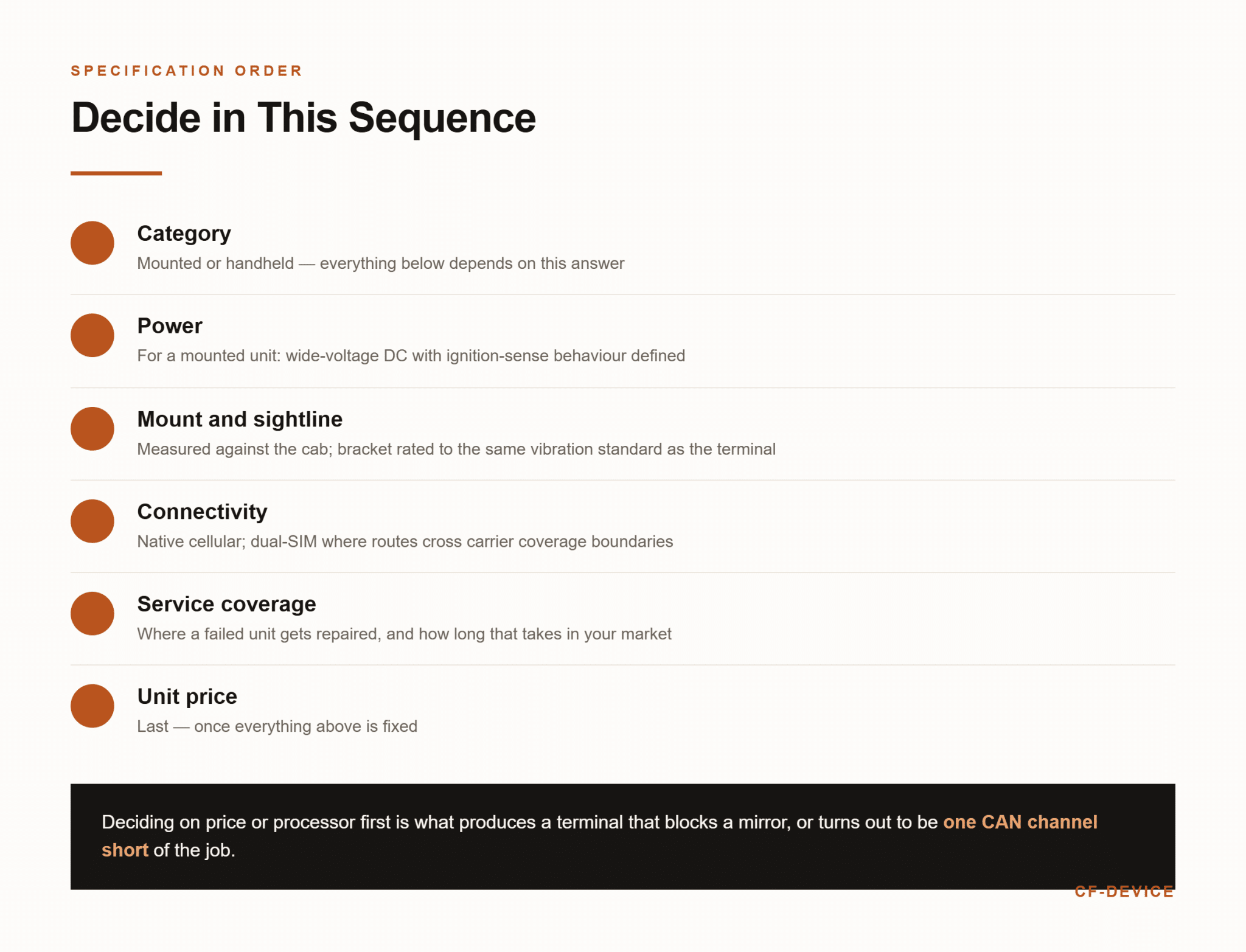
CF-Device works through this in a fixed order, because deciding on price or processor first is what produces a unit that will not clear a mirror or is one CAN channel short:
- Category — does the device stay in the truck or leave with the driver? Everything below depends on this
- Power — for a mounted unit, wide-voltage DC input with ignition-sense behaviour defined
- Mount and sightline — measured against the cab, with the bracket rated to the same vibration standard as the terminal
- Connectivity — native cellular, dual-SIM where routes cross carrier boundaries
- Service coverage — where a failed unit gets repaired, and how long that takes in your market
- Unit price — last, once the above are fixed
Item five is where the established handheld brands have a real advantage worth paying for in some markets: Panasonic, Getac and Zebra operate regional repair depots in North America and Europe that a Shenzhen manufacturer handles through RMA logistics instead. CF-Device’s answer is a defined parts-support window per platform so a unit failing in year six is repairable rather than triggering a fleet-wide replacement, but it is honest to say a local depot turns a unit around faster.
The full specification sequence for the mounted category is set out in our guide to the truck computer as an in-cab terminal, and the sizing method in how to choose the right tablet screen size for your vehicle.
What Does a Trucking Deployment Look Like in Practice?
A common pattern across CF-Device’s fleet customers is a split rather than a single choice: mounted VCM terminals in every cab for navigation, dispatch, engine data and electronic logging, plus a smaller number of handheld rugged units shared between drivers for proof-of-delivery and inspections. The mounted units are specified once and left; the handhelds are a consumable pool that gets replaced on a shorter cycle.
Fleets that try to cover both jobs with one device usually end up dissatisfied with it in both roles. Where logging is the primary driver of the purchase, the requirements are worked through in what to specify in a tablet for ELD logs; where the terminal is part of a wider dispatch and tracking operation, see our logistics and transportation fleet terminal guide.
Once deployed, forty or eighty terminals cannot be updated by visiting each truck — the management layer that handles firmware, configuration and device health remotely is covered in MDM for fleet tablets. CF-Device ships in excess of 140,000 units annually into 33 countries on a single-platform model, and the full hardware framework sits in the complete guide to rugged vehicle tablets.
Frequently Asked Questions
What is the best tablet mount for truckers?
Whichever one is rated to the same vibration standard as the tablet on it and fixed to cab structure rather than trim plastics. CF-Device ships every VCM unit with a VESA pattern for this reason — a MIL-STD-810 terminal on an unrated bracket still shakes loose, and the resulting intermittent connection reads to the driver as a faulty tablet.
Can a truck driver just use a consumer tablet?
For one truck, often yes. Across a fleet the failure rate becomes the cost: no IP rating, no vibration standard and a 5V USB charging circuit exposed to a truck’s voltage swings typically produce battery or charging failures at six to twelve months.
Do I need a GPS tablet for truckers, or is the phone enough?
A phone covers navigation. It does not cover a fleet-owned record of where the vehicle was, engine data read from the bus, or connectivity that does not disappear when the driver’s personal device leaves the cab. Positioning tiers are compared in our GPS tracking device guide.
Which CF-Device model should a truck fleet start with?
The VCM S10-2 for most mixed fleets, the VCM V10-2 where routes cross carrier coverage boundaries, and the VCM V7-2 for day cabs with limited dash space. All three are rated IP65–IP67, tested to MIL-STD-810, accept 5–36V DC with ignition sense, and operate from −30°C to +70°C.
Interested in specs or a quote? Contact our team to discuss in-cab terminals for your truck fleet.