
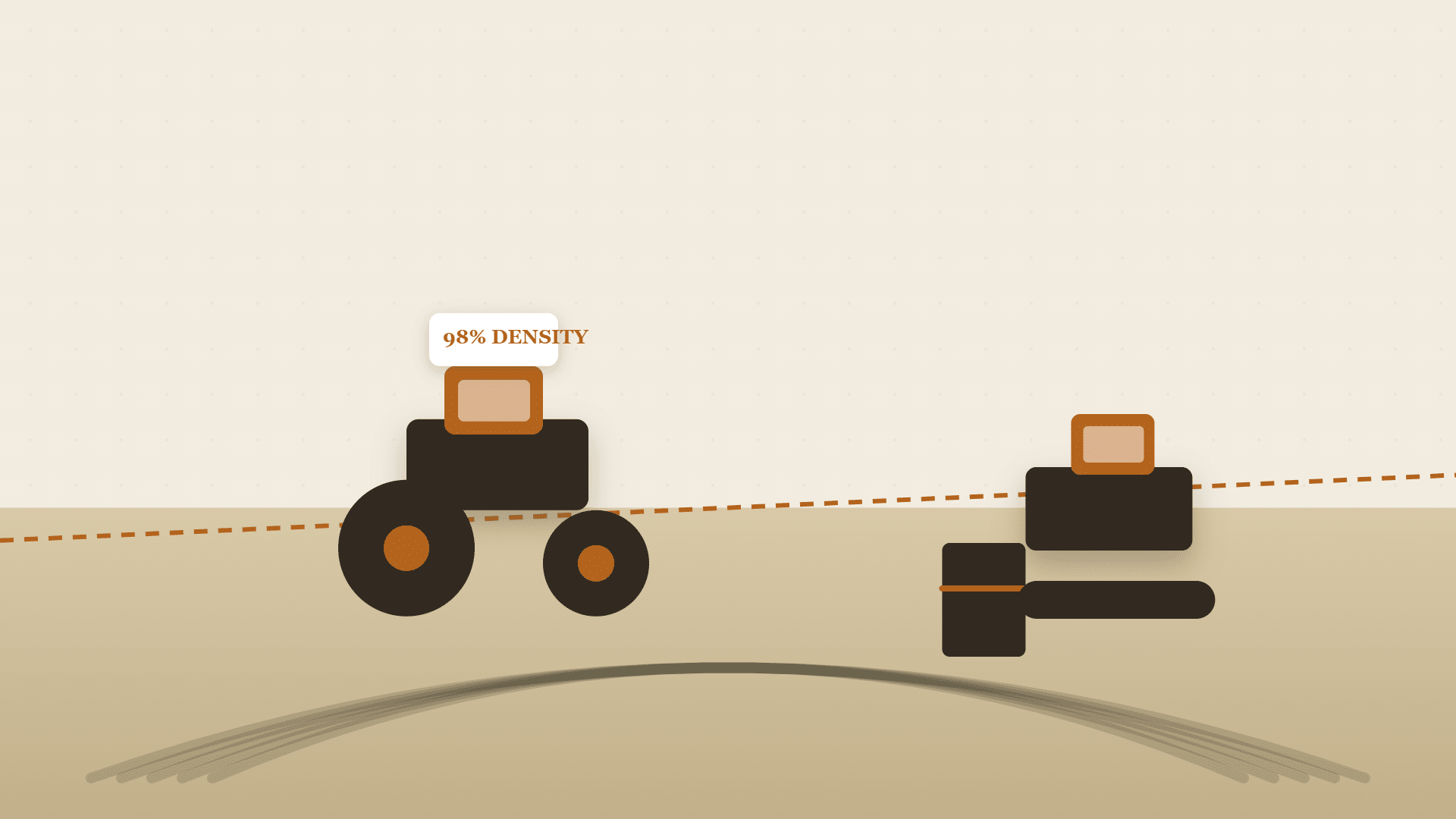
Compaction and grading are two of the most repetitive, operator-judgment-dependent tasks on a construction site — and two of the easiest to get wrong without real-time data. A road roller operator historically judges compaction density by pass count and feel; a bulldozer operator judges blade depth and grade by eye.
TL;DR
- Road rollers: real-time pass count, vibration frequency, and density data replace operator “feel”
- Bulldozers: live grade/depth readouts relative to design surface replace judging by eye
- Same rugged hardware requirements as other heavy equipment — dust, vibration, sun, temperature swings
- Running on the same platform as fleet management unifies utilization, maintenance, and grading data
Road Roller Compaction Monitoring
Mounted in the cab, a rugged vehicle tablet connected to the roller’s onboard sensors via CAN bus can display real-time compaction data — pass count, vibration frequency, and estimated density — directly to the operator, instead of leaving compaction quality to be judged after the fact.
Bulldozer Blade Automation
For bulldozers, the same tablet platform can integrate with blade position sensors to give the operator live grade and depth readouts relative to a target design surface, a challenge closely related to our guide on excavator slope grading and depth assistance.
What Real-Time Data Replaces
| Task | Old Method | With Real-Time Terminal Data |
|---|---|---|
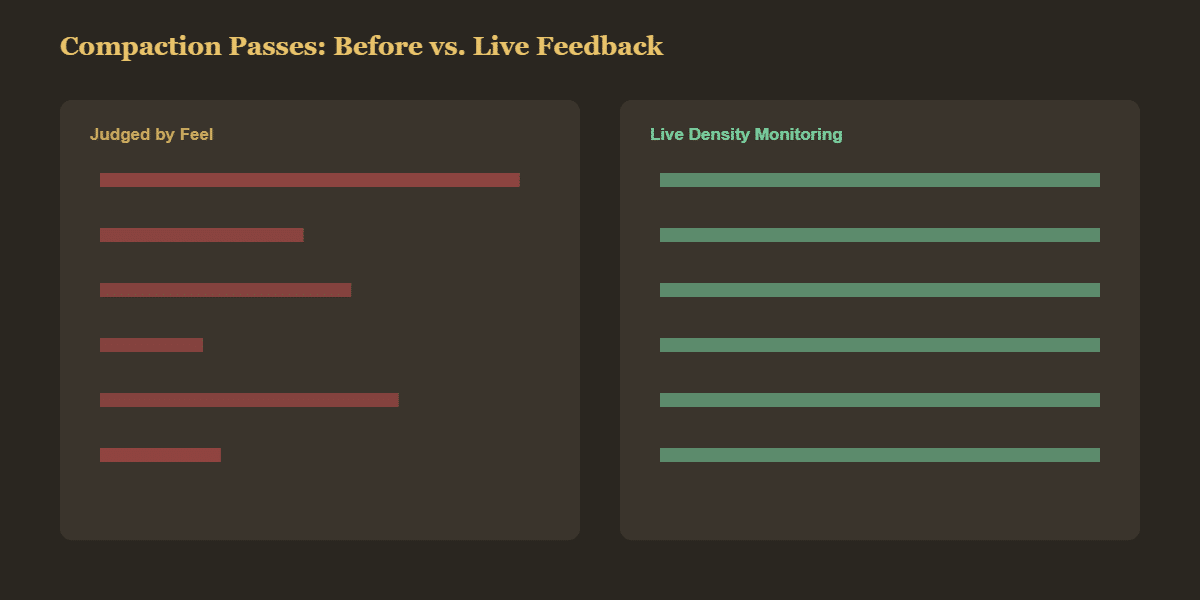
| Compaction density | Pass count + operator feel | Live vibration frequency + estimated density |
| Blade grade/depth | Visual judgment vs. stakes | Live readout vs. design surface |
| Rework detection | Discovered after inspection | Flagged during the pass |
A Deployment Example
A road-building crew running three rollers on a highway resurfacing job previously relied on spot-check density tests after each section was compacted — meaning under-compacted sections were only caught after paving had already started nearby. With CAN-bus-connected tablets displaying live vibration and pass-count data, operators could see under-compaction in real time and add passes before moving on, cutting rework call-backs significantly over the project — the same CAN-bus integration covered in our CAN bus & J1939 guide.
Why This Belongs on the Same Hardware as Everything Else
Compaction and grading equipment operates in the harshest conditions on a job site — dust, vibration, direct sun, and wide temperature swings. This is exactly the environment IP67/MIL-STD-810-rated rugged tablets are built for. Running this data through the same platform used for MDM remote device management and fleet management means equipment utilization, maintenance alerts, and grading performance all live in one system.
The Practical Payoff
For contractors running mixed fleets of rollers, dozers, and excavators, the value isn’t just the individual sensor readout — it’s that every machine on-site reports through the same rugged tablet platform, giving site managers one consistent view instead of a patchwork of vendor-specific displays. The same real-time monitoring principle applies to other precision-dependent applications, including Mining: Rugged Terminals for the Harshest Working Environment, where equipment vibration and dust conditions demand the same durability standard.
Common Questions
Does this require special sensors on the roller or dozer, or does the tablet do the sensing?
The equipment needs compatible onboard sensors (vibration, blade position); the tablet displays and processes that data via CAN bus — it doesn’t replace the sensors.
Can one tablet handle multiple equipment types on the same site?
Yes, provided each machine has compatible sensor integration — the terminal platform itself doesn’t change between roller, dozer, or excavator use.
Is real-time compaction data a substitute for lab density testing?
It reduces how often rework is discovered late, but doesn’t necessarily replace formal density testing required for compliance sign-off on some projects.
What’s the main hardware requirement beyond ruggedness?
Reliable CAN-bus integration with the specific machine’s onboard sensor systems — confirm compatibility before deployment.