
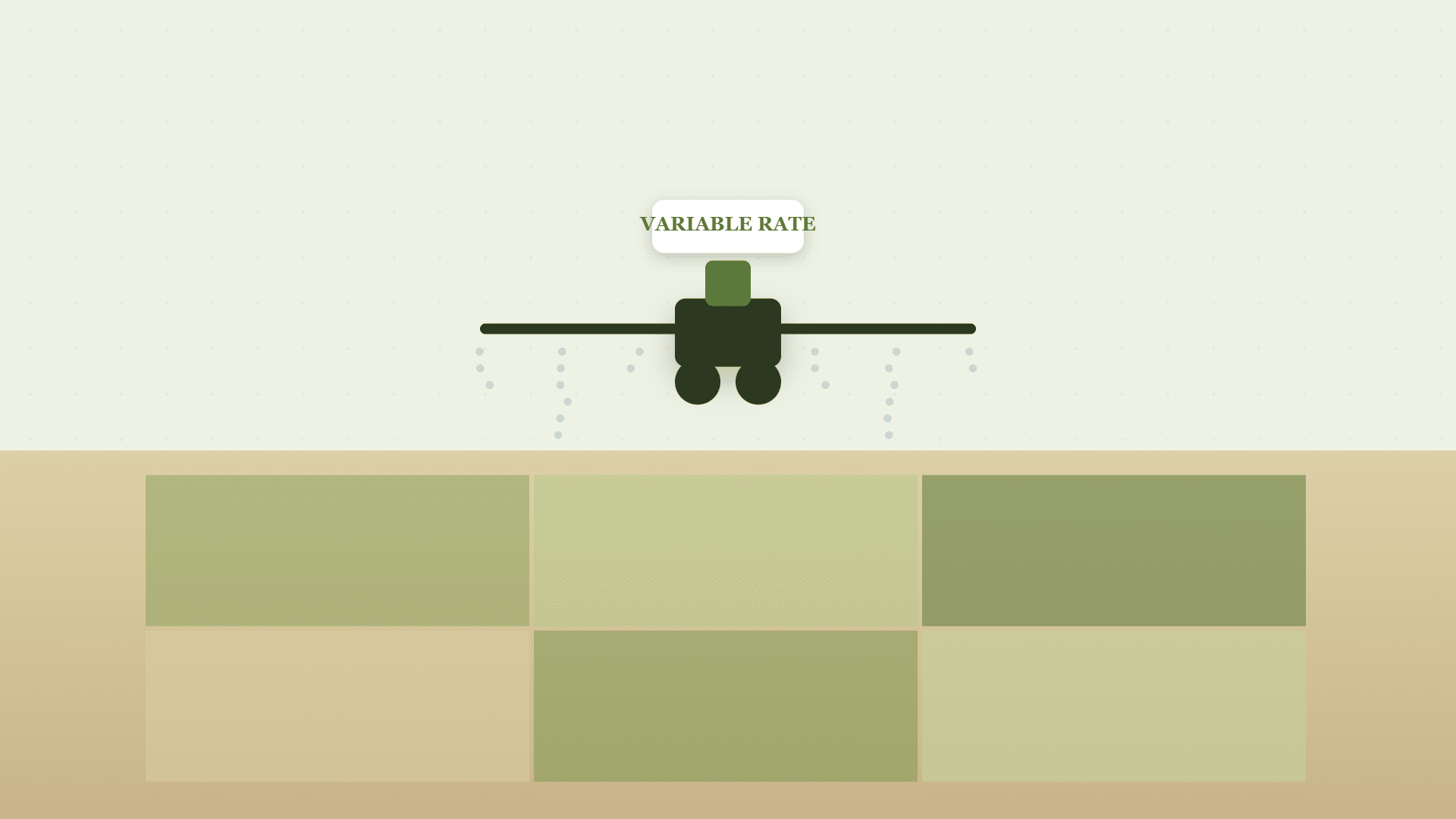
Variable-rate spraying is what a rugged cab terminal is for: blanket spraying wastes chemical on areas that don’t need it and under-treats the areas that do, and variable-rate spraying fixes both problems by adjusting application rate in real time as the machine moves across the field. CF-Device’s ISOBUS-capable VCM terminals, such as the VCM V12, run the interface that makes it possible.
TL;DR
- Variable-rate spraying adjusts chemical application rate in real time based on field zone data, not a fixed blanket rate
- Requires GNSS positioning accuracy tight enough to match application to the correct zone boundary
- Runs through the same ISOBUS VT interface as other implement control functions, when the sprayer’s rate controller is ISOBUS-compliant
- Reduces input cost and environmental runoff simultaneously — not a tradeoff between the two
- Prescription maps come from soil sampling, yield history, or real-time sensors — not guesswork
How Variable-Rate Spraying Actually Works
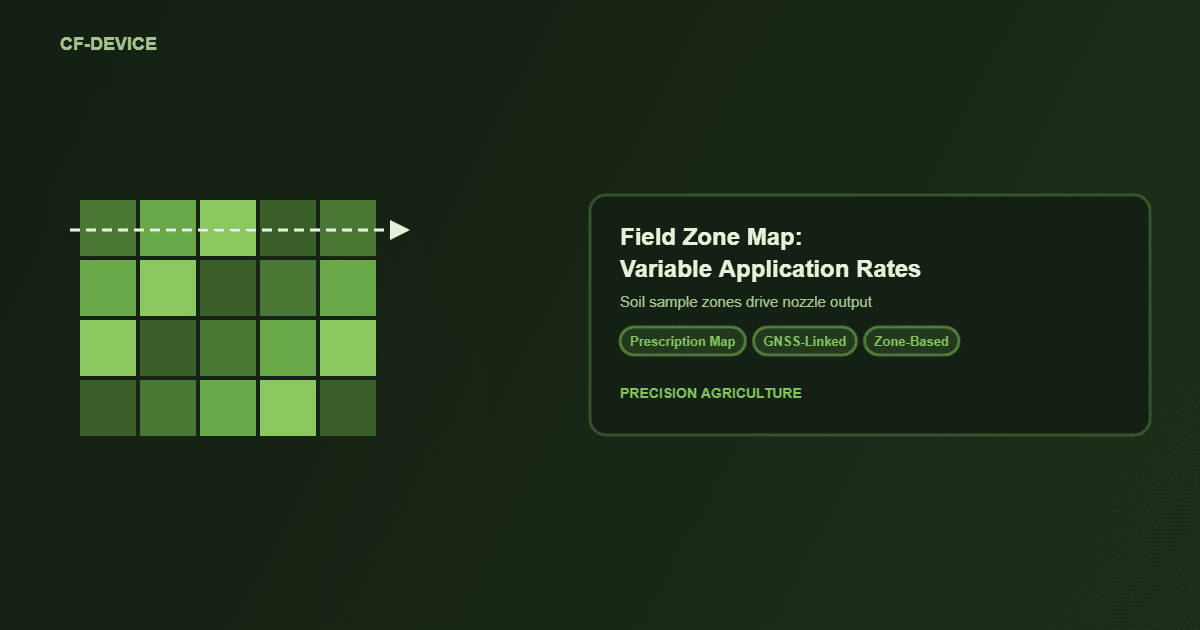
A prescription map — built from soil sampling, yield history, or real-time sensor data — divides a field into zones with different target application rates. As the sprayer moves, the terminal cross-references GNSS position against the prescription map and adjusts nozzle output automatically, without the operator manually toggling rates.
Variable Rate Application vs Variable-Rate Spraying: Same Idea, Different Words
Buyers use several names for this: variable rate application, variable rate sprayer, prescription map sprayer, or simply variable-rate spraying. They describe the same capability. Variable rate application is the broad term and also covers spreaders and seeders; a variable rate sprayer is the machine that applies liquid products; and a prescription map sprayer is one driven by a zone map rather than a fixed rate. The terminal’s job is identical in all three cases: read position, look up the target rate for that zone, and send the command to the rate controller.
Blanket vs. Variable-Rate: The Practical Difference
| Blanket Application | Variable-Rate Application | |
|---|---|---|
| Application rate | Fixed across entire field | Adjusted per zone in real time |
| Input use on low-need zones | Full rate (waste) | Reduced or zero |
| Input use on high-need zones | Full rate (may be insufficient) | Full or boosted rate |
| Runoff/environmental exposure | Higher on over-treated zones | Reduced overall |
| Operator involvement | Set once, unattended | Automatic, GNSS-driven |
Why Positioning Accuracy Is the Limiting Factor
A prescription map is only as useful as the position accuracy applying it. Sub-field zone boundaries can be a few meters wide — meter-level GPS may straddle two zones inconsistently, while centimeter-level RTK GNSS, detailed in our GNSS Positioning Explained guide, keeps application changes aligned to the actual zone boundary rather than drifting across it. This isn’t a minor precision upgrade — a sprayer drifting a few meters off a zone boundary either dumps a full-rate dose on a zone that needed none, or under-treats a zone that needed the most. The accuracy tiers and what each costs are laid out in agriculture GPS systems: GNSS accuracy tiers explained. On the VCM V12, positioning is offered at meter or centimeter level, so confirm which tier is quoted.
Implement Control Through ISOBUS VT
When the sprayer’s rate controller is ISOBUS-compliant, the same terminal running What Is ISOBUS VT for other implements can run the sprayer’s rate-control interface without a dedicated display, keeping variable-rate spraying inside the same one-terminal setup as guidance and other implement functions. For an operation running sprayers from more than one manufacturer, this is what avoids buying a separate rate-controller screen per brand — part of the wider case for treating the cab terminal as the deciding component in digital agriculture equipment. The VCM V12 lists CF ISOBUS VT support, with one classic CAN channel, so a second CAN bus or a different interface count needs a different model; the channel counts are compared in CAN bus and J1939 integration.
Sprayer Section Control: The Companion Technology
Variable-rate application usually runs alongside boom/section control, which shuts off individual nozzle sections as the sprayer overlaps already-treated ground — irregular field edges, point rows, and headland turns are exactly where overlap waste concentrates without it. The two functions share the same GNSS position feed on the terminal: sprayer section control decides where not to spray at all, while variable-rate decides how much to spray where it does apply. Run separately they each save some input; run together on the same terminal, the savings compound rather than duplicate. This same GNSS-driven precision underlies the broader guidance functions covered in our precision agriculture equipment guide.
What Variable-Rate Spraying Doesn’t Fix
Variable-rate control doesn’t compensate for a poorly calibrated sprayer, worn nozzles, or an inaccurate prescription map — the software adjusts flow rate to a target, but it can’t detect that the target itself is wrong, or that a clogged nozzle is delivering less than the rate the terminal is commanding. Regular nozzle inspection and periodic prescription-map validation against actual field results (not just the initial soil sample) remain necessary; variable-rate spraying makes good agronomic data more valuable, it doesn’t replace the need for it.
An Illustrative Example
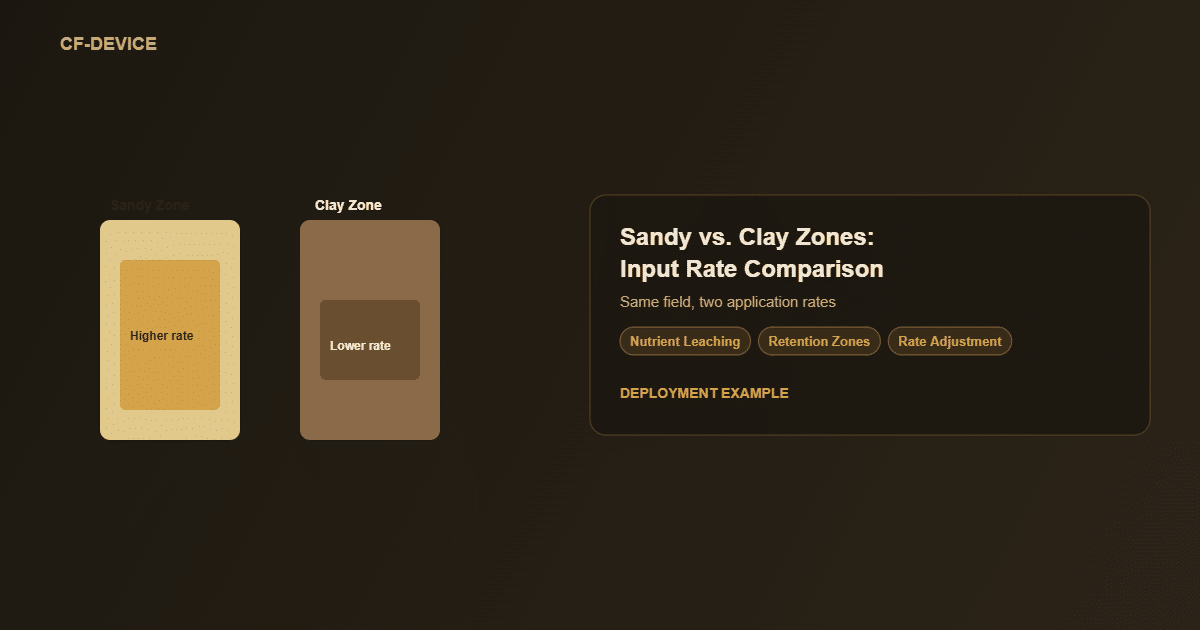
Picture a row-crop operation with fields showing significant soil-composition variation — sandy patches alongside heavier clay sections — that previously applied fertilizer at a single blanket rate calculated for the field average. After switching to variable-rate application with a soil-sample-based prescription map, the sandy zones (which leach nutrients faster and need more) receive a higher rate, while the clay zones (which retain nutrients longer) receive less — reducing total fertilizer volume purchased for the season while maintaining yield across both zone types.
Where This Fits in the Broader Farm Operation
Variable-rate spraying is one precision application among several converging on the same rugged terminal, alongside the guidance and implement-control functions covered in Smart Agriculture Terminals — the value compounds when all of it runs through one piece of hardware instead of a separate display per function. Where zones are detected in real time by on-board sensors rather than from a stored map, the processing happens on the terminal itself, as covered in precision agriculture artificial intelligence.
Common Questions
Does variable-rate spraying require a specific prescription map format?
Many systems accept common formats such as shapefile or ISO-XML prescriptions, but the accepted formats depend on the mapping software and the sprayer’s rate controller. Confirm compatibility with both before buying.
Is variable-rate spraying only useful for large-acreage farms?
It applies at any scale where zone-based input variation exists, though the cost savings scale with acreage and become more clearly justified on larger operations.
Can the same terminal run variable-rate spraying and auto-steer guidance simultaneously?
Often yes, provided the terminal has sufficient processing headroom and the guidance software supports it — both are common concurrent functions on ISOBUS VT-compliant hardware. Which combinations a given model and software package support should be confirmed for the unit you are specifying.
How is a prescription map created in the first place?
Typically from soil sampling grids, historical yield data layered over multiple seasons, or real-time sensors (like on-the-go optical sensors) — the source data determines how granular the zone boundaries can be.
Does boom section control need separate hardware from variable-rate spraying?
Not usually — both typically run through the same ISOBUS VT-compliant terminal and GNSS receiver already installed for guidance and rate control, though the sprayer itself needs section-capable valves and controller.
What does the VCM V12 specify for this kind of work?
The VCM V12 is a 12.1-inch terminal with CF ISOBUS VT support, meter or centimeter-level GNSS as an option, one classic CAN channel, 9–36V DC input and IP65 sealing, operating from −30°C to +70°C. Other VCM models differ in supply range, sealing and CAN count, so check the datasheet of the model you intend to fit.
The terminal that runs the rate controller is a separate purchase from the sprayer itself, and the in-cab options are compared model by model in best tablets for farming and tractor terminals.
Interested in specs or a quote? Contact our team to discuss variable-rate spraying integration.