

Precision agriculture equipment covers everything from the GPS receiver on the roof to the terminal in the cab to the sensors on the implement behind it, but for a farm deciding what to buy, the question usually comes down to one piece of hardware: the in-cab terminal that ties the rest together. CF-Device builds that cab terminal as the VCM series: every VCM model supports CF ISOBUS VT or is compatible with it, and the GNSS option runs from metre-level to centimetre-level RTK depending on the model.
TL;DR
- Precision agriculture equipment spans GNSS receivers, guidance displays and implement sensors; the terminal is what unifies them
- A tractor guidance system ranges from visual guidance to full auto-steer with centimetre accuracy
- A GPS tracker for agricultural equipment and a guidance system are related but different: tracking tells you where a machine is, guidance tells it how to steer
- Auto guidance for tractors depends on both the GNSS receiver tier and the terminal running the guidance software
- Confirm hydraulic steering compatibility before buying guidance hardware
The Precision Agriculture Equipment Categories, Explained Plainly
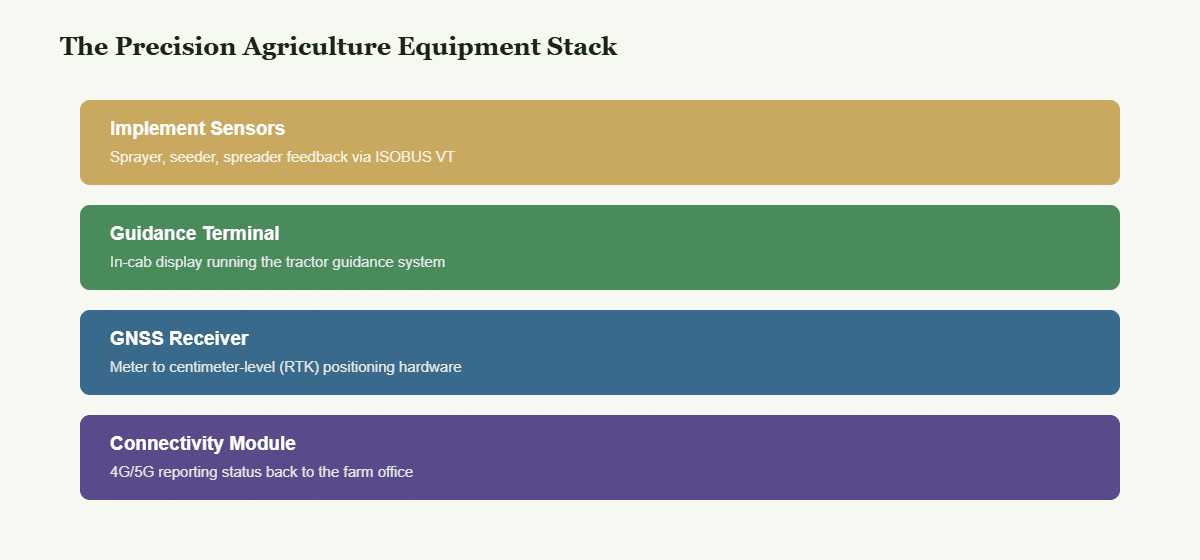
Precision agriculture equipment is not one product; it is a stack:
- GNSS receiver — determines position, from metre-level to centimetre-level (RTK) accuracy, detailed in the GNSS positioning guide
- Guidance terminal — the in-cab display running the tractor guidance system, showing the operator (or driving the auto-steer) where to go
- Implement sensors — hardware on the sprayer, seeder or spreader feeding data back through ISOBUS VT
- Connectivity module — 4G or 5G on selected models, reporting machine status and position back to the farm office
A tractor guidance system is the software and display layer that turns raw GNSS position into a steering line. It is the part a farmer interacts with directly.
What Is a Tractor Guidance System? Guidance Levels at a Glance
A tractor guidance system (also searched as tractor GPS guidance, ag GPS guidance or farm guidance systems) comes in levels, and the level decides both cost and what the terminal has to do.
| Level | What it does | Positioning needed | Terminal workload |
|---|---|---|---|
| Visual guidance | Shows the operator a line to follow; the operator steers | Metre-level GNSS | Light |
| Assisted steering (auto-steer) | Sends steering corrections to the tractor’s steering system along a planned line | Sub-metre to centimetre-level (RTK), depending on the pass-to-pass accuracy required | Real-time position and steering control |
| Auto-steer plus implement control | Adds ISOBUS VT control of the implement (rate, sections) on the same terminal | Centimetre-level (RTK) | Highest: guidance, implement and often cameras at once |
How much overlap each accuracy tier leaves in the field, and which correction source each depends on, is broken down in GPS for agricultural tractors and Agriculture GPS Systems: GNSS Accuracy Tiers Explained.
Which CF-Device Models Offer Guidance-Grade Positioning and ISOBUS VT?
CF-Device’s cab terminals differ in GNSS options and in how they support implement control. This table reflects the published specifications; confirm the exact GNSS module and ISOBUS configuration for your model before ordering.
| Model | GNSS accuracy options | CF ISOBUS VT | Notes |
|---|---|---|---|
| VCM V12 | Optional metre-level or centimetre-level | Supported | 12.1″; supercapacitor and ambient-light sensor built in |
| VCM V10 PRO | Optional metre-level or centimetre-level | Supported | 10.1″ |
| VCM V8 PRO | Optional metre-level or centimetre-level | Supported | 8″; nine physical buttons for gloved operation |
| VCM S10-2 | Optional metre-level or centimetre-level | Supported | 10.1″; supports OEM GNSS boards; J1939, CANopen and ISO 15765 |
| VCM S10-2 PRO | Optional metre, sub-metre or centimetre-level; GPS, BDS, GLONASS | Supported | 10.1″; the only model in the range with radio communication |
| VCM S10-2 PLUS | Set by the chosen module (MXT906B, UM980, P20E; UM982 optional); UM980 and UM982 are RTK-grade | Supported | 10.1″; SocketCAN; radio communication or Harxon 1018D radio module |
| VCM V10-2 | Optional RTK GNSS | Compatible with the newer CF ISOBUS VT | 10.1″; dual-SIM |
| VCM V7-2 | Optional metre, sub-metre or centimetre-level | Supported | 7″; Gigabit Ethernet on an M12 connector |
| VCM M10 | GNSS board optional at metre, sub-metre or centimetre-level; GPS, BDS, GLONASS | Supported | 10.1″; 6 TOPS NPU; V2V communication |
| TANK V2 | Optional metre-level or centimetre-level; GPS, BDS, GLONASS | Supported | Screenless; optional inertial navigation; drives an external display |
If you are choosing between models for guidance work, start from the accuracy tier your passes need, then check the ISOBUS and interface columns. The wider comparison is in best tablets for farming and tractor terminals.
GPS Tracker for Agricultural Equipment vs. Guidance: A Common Mix-Up
| GPS tracker for agricultural equipment | Tractor guidance system | |
|---|---|---|
| What it does | Reports machine location and status | Steers the machine along a precise line |
| Accuracy needed | Metre-level is usually sufficient | Centimetre-level (RTK) for auto-steer |
| Primary user | Farm manager, remote monitoring | Operator, in the cab |
| Typical use | Fleet visibility, hours tracking | Reducing pass overlap, auto-steer |
A farm can have tracking without guidance (just knowing where machines are) or guidance without fleet-wide tracking (one tractor auto-steering with no office visibility). Most modern deployments run both on the same terminal. The fleet side of that is in GPS tracking for fleet vehicles.
How Does Auto Guidance for Tractors Work?
Auto guidance for tractors takes a centimetre-level RTK GNSS position, compares it with a planned line (a field boundary, an A-B line or a previous pass) and sends steering corrections to the tractor’s steering system. That reduces the overlap and skip that come from manual steering over long, repetitive passes. The terminal running it has to process position data in real time, which is why guidance-capable terminals need more processing headroom than simple tracking devices.
What Does a Deployment Look Like?
Consider a 2,000-acre grain operation that started with basic GPS tracking, just knowing which tractor was in which field. After adding RTK-based guidance to the same terminals, pass overlap dropped enough to reduce seed and input costs across the season, and new seasonal operators could run straight lines from their first day instead of needing a season of manual-steering practice. This is an illustrative scenario rather than a customer case study.
What Should I Check Before Buying Precision Agriculture Equipment?
- Does the GNSS receiver support the accuracy tier you need: metre-level for tracking, centimetre-level (RTK) for auto-steer?
- Is the terminal ISOBUS VT capable, so it can run implement control as well as guidance? Confirm certification for your model and implements
- Does the guidance system integrate with your tractor’s existing hydraulic steering, or does it need aftermarket steering hardware?
- Can the same terminal handle tracking, guidance and implement control together, or are these separate purchases?
- Is the terminal sealed and vibration-tested for open-cab work? See the rugged vehicle tablet buyer’s guide
Other Names for the Same Question
Precision agriculture hardware is the whole stack described above, and the tractor guidance terminal is the in-cab part that ties it together. Buyers also search for GPS tractor guidance, tractor guidance, GPS agricultural equipment and GPS tractors for precision farming; they all describe the same decision, which accuracy tier the work needs and which terminal runs it. The accuracy question is answered in GPS for agricultural tractors, and the terminal comparison in best tablets for farming and tractor terminals.
Which Precision Agriculture Guide Should I Read Next?
| If your question is… | Read |
|---|---|
| How accurate does guidance need to be? | GPS for agricultural tractors, GNSS accuracy tiers |
| How does implement control work? | What is ISOBUS VT |
| What does the terminal decide? | Digital agriculture equipment |
| How do I save input with variable-rate spraying? | Variable-rate spraying |
| Where does AI belong? | Precision agriculture artificial intelligence |
| Which tablet should I buy? | Best tablets for farming and tractor terminals |
This article belongs to the precision agriculture and fleet tracking hub. For the full field-by-field view see Top Use Cases for Rugged Vehicle Tablets in 2026, and for the broader range the Rugged Vehicle Tablet Complete Guide.
Common Questions
Do I need RTK accuracy, or is standard GPS enough?
Standard GPS or GNSS is fine for basic tracking and non-critical guidance. RTK’s centimetre accuracy matters for auto-steer and variable-rate precision work, where overlap directly costs money.
Can I add guidance to a tractor that only has basic GPS tracking?
Usually yes, provided the terminal and GNSS receiver support the higher accuracy tier. Confirm hydraulic steering compatibility before buying guidance hardware.
Is a tractor guidance system the same as autonomous driving?
No. Most current systems are auto-steer assist: they correct the steering line while an operator stays in the seat monitoring the machine. They are not fully autonomous operation.
Does precision agriculture equipment work across different tractor brands?
Increasingly, when built on ISOBUS VT (ISO 11783-6) compliant hardware. This is the same interoperability standard covered in Smart Agriculture. Compatibility still has to be confirmed per implement.
Interested in specs or a quote? Contact our team to discuss guidance and tracking terminals for your machinery.