

The best tablet for business owners running field, warehouse, or vehicle-based operations isn’t the best consumer tablet. It is a unit built to stated numbers — which for CF-Device’s VCM range means IP65–IP67 by model, MIL-STD-810, wide-voltage DC (5–36V or 9–36V by model) and −30°C to +70°C — and one that survives daily drops, dust, temperature swings, and years of continuous use without becoming a recurring replacement cost.
TL;DR
- Business owners in field, warehouse, and fleet operations need rugged-certified hardware, not consumer tablets in a case
- The best tablets for field work prioritize sunlight-readable screens, glove operation, and drop/vibration resistance
- GPS trackers for business vehicles increasingly run on the same terminal as dispatch and diagnostics, not a separate device
- Tablets for warehouse use need the same durability as outdoor equipment — indoor doesn’t mean less rugged
- Tracking devices for fleet vehicles are most valuable when integrated into the terminal, not bolted on separately
Best Tablet for Business Owners: Why “Best” Means Something Different
A consumer tablet review ranks screen resolution, app ecosystem, and price. A business owner evaluating hardware for field crews, warehouse staff, or a delivery fleet is really asking a different question: what will still be working in eighteen months without a support call. Failure cost — replacement, downtime, lost data mid-shift — dominates the total cost of ownership far more than sticker price.
What Makes the Best Tablets for Field Work
Field conditions — direct sunlight, dust, occasional drops, gloved hands — rule out most consumer hardware within a season. The best tablets for field work share a specific set of traits: sunlight-readable displays (750cd/m² or higher), IP65+ ingress protection, multi-touch screens that work with gloves on, and MIL-STD-810 shock certification. A business owner buying for a field crew should treat these as non-negotiable minimums, not premium upgrades.
GPS Trackers for Business Vehicles: Standalone vs. Integrated
Many small and mid-size businesses start with a standalone GPS tracker wired into each vehicle — a reasonable first step for basic location logging. But as operations grow, this creates a second piece of hardware, a second vendor relationship, and no path to add driver-safety monitoring or diagnostics later. Integrated rugged terminals handle GPS tracking as one function among several, detailed in our fleet GPS tracking hardware guide — a single device a business owner can scale rather than replace.
Tablets for Warehouse Use: Indoor Doesn’t Mean Less Rugged
Business owners often assume indoor equipment needs less durable hardware than outdoor field tablets — the opposite is usually true. Forklifts and warehouse vehicles accumulate more operating hours and more physical shock from repeated pallet handling than most road vehicles, a reality covered in depth in our smart warehousing terminal guide. Tablets for warehouse use need the same IP65+ and MIL-STD-810 baseline as any field deployment.
Tracking Devices for Fleet Vehicles: What Business Owners Actually Need to See
Beyond a dot on a map, useful fleet tracking for a growing business means route history, vehicle diagnostics that flag maintenance before a breakdown, and driver behavior data that supports insurance and safety programs. This consolidated view is what separates basic tracking devices for fleet vehicles from a real fleet management platform — one terminal doing the job of what used to require three separate tools.
A Practical Buying Framework
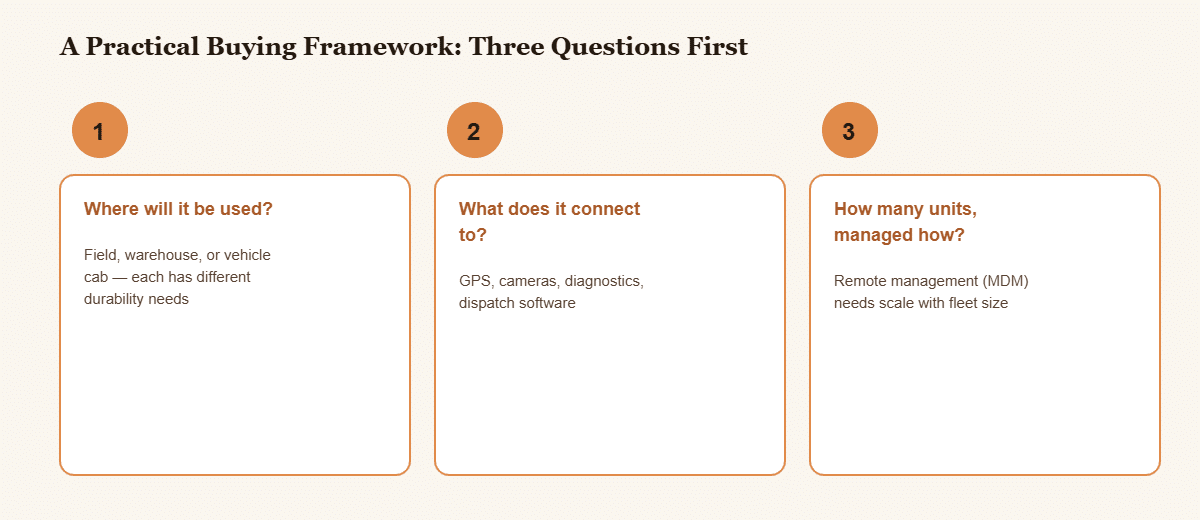
Before comparing specific tablet models, a business owner should answer three questions: Where will it be used (field, warehouse, vehicle cab)? What does it need to connect to (GPS, cameras, diagnostics, dispatch software)? And how many units will need to be managed remotely as the operation grows? The answers point toward hardware requirements — ruggedness tier, interface set, and MDM compatibility — long before screen size or brand become relevant decisions.
Other Names for the Same Question
Tablets for field service crews follow the same field-work rules: a sunlight-readable screen, a sealed housing and gloved operation.
Which Guide Should a Business Owner Read Next?
This guide sits under the applications hub and the Rugged Vehicle Tablet Complete Guide. Pick the next one by the operation you run:
| If your operation is… | Read |
|---|---|
| A trucking fleet | 10 best tablets for truck drivers, Best tablet for ELD logs |
| A farm | Best tablets for farming and tractor terminals |
| A construction business | Tablet for the construction industry |
| Tracking vehicles and assets | Fleet tracking hardware: trackers vs terminals, GPS tracking device for fleet vehicles |
| Mixed field work | Project tablets, Rugged industrial tablet: the four types |
| Not sure which vehicle terminal | 10 best mobile data terminals for fleets, hardware buyer's guide |
Common Questions
Is a rugged tablet worth the extra cost for a small business?
Usually yes once you factor in replacement frequency — a consumer tablet failing every few months in field or vehicle conditions often costs more over two years than one rugged unit.
Do I need a separate GPS tracker if my tablet already has GPS?
Not if the tablet is a proper vehicle-mount terminal with integrated GNSS (confirm the positioning tier for the model you specify) — a separate tracker becomes redundant hardware and an extra vendor relationship to manage.
How many tablets can one business owner realistically manage without IT staff?
With MDM remote management, even a solo owner-operator can manage a modest fleet directly from a console — it’s the deployments without MDM that hit a wall past a handful of devices.
What’s the minimum ruggedness rating a business tablet should have?
IP65 is a reasonable baseline for most field and warehouse use; IP67 is worth the upgrade for washdown environments, heavy dust, or occasional submersion risk.
Interested in specs or a quote? Contact our team to discuss which rugged tablet fits your operation.