

CF-Device supplies three GNSS accuracy tiers on its VCM terminals, and the reason is that farm GPS guidance systems are usually sold on the accuracy number — ±30 cm, ±2 cm — but that figure only matters once it’s translated into something a farm can measure: how much of every field gets worked twice. Overlap is where guidance accuracy turns into fuel, seed, chemical, and hours.
TL;DR
- Manual steering typically overlaps 8-12% of a field; RTK auto-steer brings that under 1%
- Accuracy depends on the correction source, not the receiver alone — an RTK-capable unit without a correction feed delivers meter-level accuracy
- Meter-level is adequate for spreading and field logging; planting and section control need centimetre-level
- Network RTK needs cellular coverage; a local base station is the alternative on remote sites
- The terminal running guidance also handles implement control and logging — one screen, not three
Why Overlap Is the Real Metric
An operator steering by eye against the previous pass leaves a safety margin — deliberately, because the cost of a gap (an unplanted strip, an untreated band) is higher than the cost of a small overlap. Across a full day that margin accumulates. Industry figures commonly put manual-steering overlap in the 8-12% range on wide implements, which means roughly one pass in ten is doing work that was already done.
In short: guidance accuracy is worth what the eliminated overlap is worth — fuel, inputs, and machine hours on ground that didn’t need a second pass.
This is also why the value scales with implement width and total acreage rather than with the price of the guidance kit. A 12 m sprayer wastes more per percentage point of overlap than a 3 m implement, and a large operation crosses the payback threshold considerably faster than a small one.
Where the Correction Signal Comes From
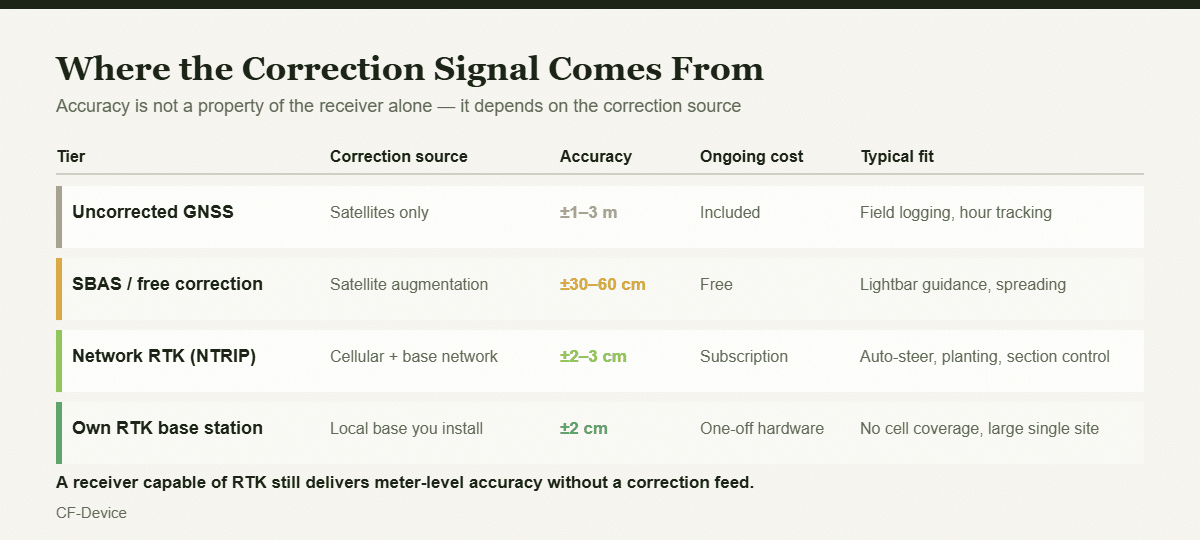
This is the part most commonly misunderstood at purchase time. A receiver described as “RTK-capable” does not deliver centimetre accuracy on its own — it delivers it **when fed a correction stream**. Without that stream, the same hardware performs at meter level. Buyers who budget for the receiver and not the correction subscription end up with an expensive unit performing like a cheap one.
Which correction path fits depends less on budget than on geography: network RTK over NTRIP needs usable cellular coverage across the fields being worked, and a farm with dead zones in the back paddocks gets more reliable results from its own base station despite the higher upfront cost. The underlying positioning technology is covered in our GNSS positioning guide, and the accuracy tiers in agricultural terms in agriculture GPS systems: accuracy tiers explained.
Which Tier Each Job Needs
| Field operation | Accuracy needed | Why |
|---|---|---|
| Field boundary and area logging | ±1-3 m | Records acreage; precision irrelevant |
| Fertiliser spreading | ±30-60 cm | Spread pattern tolerates modest drift |
| Tillage passes | ±30 cm | Small overlap costs fuel, not yield |
| Spraying with section control | ±2-3 cm | Nozzle sections switch on zone boundaries |
| Planting / seeding | ±2-3 cm | Row spacing errors persist all season |
| Controlled traffic farming | ±2 cm | Machines must retrace the same wheel tracks year to year |
The pattern worth noting: everything above the spraying line tolerates drift because a small error self-corrects or costs only inputs. Everything below it doesn’t — a planting error is locked into the field for the whole season, and controlled traffic farming depends on repeatability across years, not just within a pass.
Guidance Assist vs Auto-Steer
A tractor navigation system can present its output two ways. **Guidance assist** shows the operator a lightbar or on-screen indicator and leaves the steering to them — cheap to fit, and effective at reducing gross error, but it still depends on operator attention over a ten-hour shift. **Auto-steer** closes the loop by driving the steering itself through a hydraulic valve or electric wheel motor.
The difference shows up at the end of long days rather than at the start. Assist and auto-steer perform similarly in the first hour; by hour eight, the operator following a lightbar has accumulated drift that the auto-steer machine has not. Fatigue reduction is the underrated part of the case — it’s the same reason driver-state monitoring matters on long shifts, covered in DMS driver monitoring.
What the Terminal Has to Do Besides Guidance
Guidance is rarely the only job the in-cab screen is doing. On a working tractor the same terminal typically handles implement control over ISOBUS, section or rate control, camera monitoring, and job logging back to the farm office — which is why guidance hardware and terminal hardware shouldn’t be specified as separate decisions.
A dedicated guidance display that does nothing else means a second screen in the cab for implement control, and a third arrangement for logging. The consolidation case is covered in our smart agriculture terminal guide, and the brand-interoperability standard that makes it possible in what is ISOBUS VT.
Hardware Requirements Specific to Guidance
- External antenna support — the receiver needs sky view from the cab roof, not from behind glass
- Inertial compensation — terrain roll and pitch shift the antenna position relative to the implement; an IMU corrects for it on sloping ground
- Sunlight-readable display — a guidance line invisible at midday is not guidance
- Local logging — job records must survive the fields with no cellular coverage and sync later
- IP65+ and vibration rating — open-cab and dusty conditions across a full season
The inertial point is the one most often left out of comparisons. On flat ground it changes little; on rolling terrain, antenna tilt introduces a position error that no amount of receiver accuracy corrects for, because the receiver is reporting its own position correctly — just not the implement’s.
A Deployment Example
A mixed cropping operation running four tractors specified RTK auto-steer for the two machines doing planting and spraying, and meter-level guidance assist for the two used mainly for tillage and spreading. Same terminal family across all four, so one spare unit covers the fleet and operators see the same interface whichever machine they’re in — only the positioning module and correction subscription differ by machine.
That split is the practical answer to “do we need RTK”: specify it where the operation is accuracy-sensitive, not across the whole fleet by default. The wider equipment picture is covered in precision agriculture equipment and digital agriculture equipment.
Common Questions
Do I need RTK on every tractor in the fleet?
No — specify it for planting, spraying, and controlled-traffic work. Tillage and spreading machines usually perform adequately on meter-level guidance at lower cost.
Does GPS guidance work in fields with no cellular signal?
Positioning itself does — it comes from satellites. What needs cellular is network RTK correction, which is why farms with coverage gaps often install their own base station instead.
Can I retrofit auto-steer to an older tractor?
Commonly yes, via an electric steering wheel motor or a hydraulic valve kit depending on the machine — the terminal and receiver side is the same either way.
Why does my RTK system sometimes drop to lower accuracy?
Almost always a lost correction feed — cellular dropout, base station out of range, or subscription lapse. The receiver keeps working, just without corrections.
Is a dedicated guidance display better than a multi-function terminal?
Rarely — a dedicated unit means additional screens for implement control and logging. A terminal handling all three keeps the cab usable and the spares pool smaller.
Interested in specs or a quote? Contact our team to discuss guidance terminals for your machinery.