
Agriculture fleet tracking, precision agriculture and rugged business tablets solve the same underlying problem in three fields: turning working vehicles into managed, data-producing assets. CF-Device’s VCM range covers all three from one vehicle-grade platform family, sealed to IP65–IP67 and powered from the vehicle’s DC supply, with supply voltage, positioning tier and interfaces set per model. This hub maps where each technology delivers its value, what they share underneath, and which guide to read next.
TL;DR
- Precision agriculture combines RTK guidance, ISOBUS implement control and on-device AI vision on one in-cab terminal
- Fleet GPS tracking is now baseline infrastructure, and choosing a tracker is in practice choosing a terminal platform
- A business that runs on vehicles needs vehicle-grade tablets, not consumer ones
- Agriculture, logistics, mining, construction, transit and warehousing share one hardware and software foundation, configured differently
- Choose by industry profile first, then by spec sheet
Precision Agriculture: Where the Technology Runs Deepest
Precision agriculture equipment has moved from GPS-guided steering to a full digital stack: guidance, implement control, variable-rate application and vision-based monitoring on the tractor’s terminal. Every VCM model supports CF ISOBUS VT or is compatible with it. How GNSS accuracy scales from basic tracking to centimetre-level RTK is covered in Agriculture GPS Systems: GNSS Accuracy Tiers Explained.
Which Guide Do I Read for My Farming Question?
| If your question is… | Read |
|---|---|
| What actually goes on a tractor? | Precision agriculture equipment: what goes on the tractor |
| How accurate does guidance need to be? | GPS for agricultural tractors, GNSS accuracy tiers |
| How does implement control work? | What is ISOBUS VT |
| Where does AI belong in precision agriculture? | Precision agriculture artificial intelligence |
| How do I save input with variable-rate spraying? | Variable-rate spraying |
| What does the terminal decide? | Digital agriculture equipment, Smart agriculture terminals |
| Which tablet should I buy? | Best tablets for farming and tractor terminals |
A precision agriculture solution is often sold as a positioning package, but RTK accuracy on its own only tells the machine where it is. What turns it into a result is an ISOBUS VT connection so the terminal drives the implement and not just a map, section and rate control so accuracy turns into saved input, and a management layer that gets coverage maps off the machine afterwards. Every VCM model supports CF ISOBUS VT or is compatible with it; the VCM V12 is the 12.1″ option: VCM V12 ISOBUS VT tablet.
Agriculture Fleet Tracking: From Add-On to Infrastructure
Fleet GPS tracking has moved from competitive advantage to baseline requirement: delivery windows, insurance programmes and duty-of-care compliance all assume real-time vehicle visibility. The current generation goes beyond dots on a map: CAN-bus diagnostics, driver-behaviour monitoring and route-adherence analytics can run through the same terminal, so tracking-system selection becomes a terminal-platform decision. On a farm the same logic covers tractors, harvesters, box trucks and service vehicles: agriculture fleet tracking is one terminal reporting position and machine data from every vehicle, whether the job is in the field or on the road. Start with GPS tracking for fleet vehicles: what the data needs to do, then the four layers behind the dashboard and fleet management: one terminal, full operational visibility.
The Business Vehicle Reality
A tablet for a business that runs on vehicles is not the best consumer tablet; it is the one that survives the duty cycle. A landscaping crew’s trucks, a regional distributor’s vans and a contractor’s machine fleet all accumulate vibration hours, temperature swings and power fluctuations that consumer hardware is not certified against. For this audience the case for a rugged unit is simple: a failed terminal costs downtime as well as a replacement. A cross-sector buying view is in best tablet for business owners.
Industry Requirements at a Glance
| Field | Defining requirement | Core technology | Guide |
|---|---|---|---|
| Agriculture | Implement compatibility and RTK precision | ISOBUS VT, RTK GNSS, AI vision | ISOBUS VT |
| Logistics | Continuous visibility | GPS tracking, CAN diagnostics, DMS | Logistics and transportation |
| Mining | Environmental survival | Sealing, MIL-STD-810 testing, AVM 360° | Mining terminals |
| Construction | Grade and depth precision | RTK, depth and tilt sensor integration | Construction tablets |
| Transit | Passenger safety | DMS, AVM 360°, continuous duty | Smart transportation |
| Warehousing | Indoor fleet coordination | WMS integration, AVM 360°, MDM | Smart warehousing |
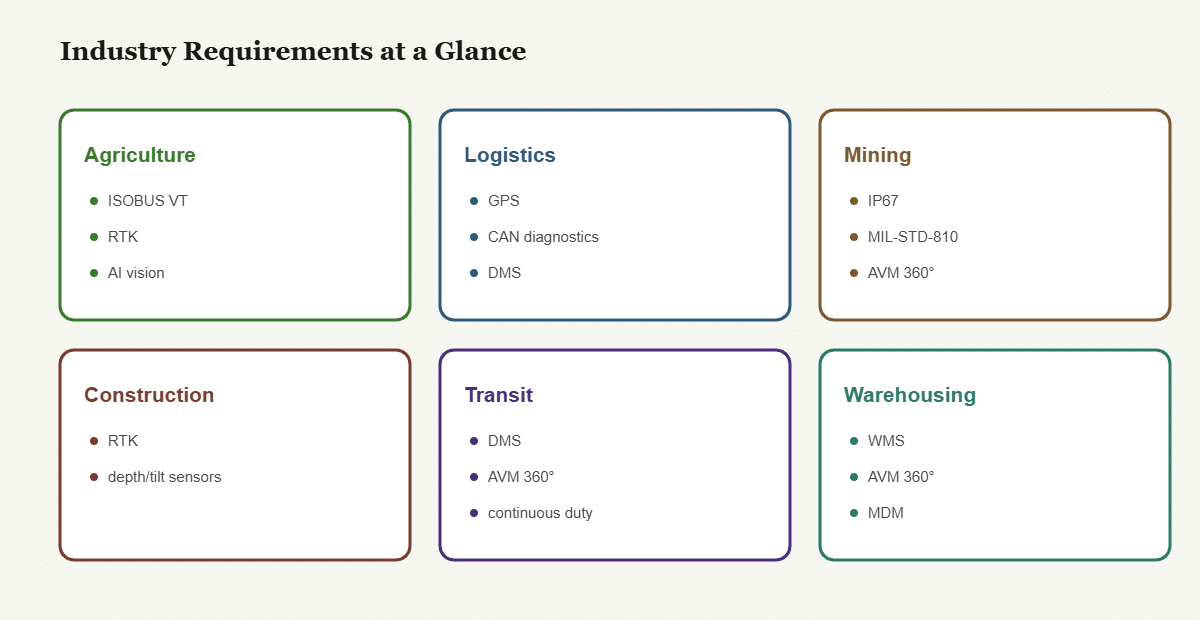
The full field-by-field view, with the detailed articles for each industry, is in Top Use Cases for Rugged Vehicle Tablets in 2026.
A Cross-Field Deployment Example
Consider an agricultural cooperative that runs tractors with RTK auto-steer and ISOBUS implement control in the field, box trucks with GPS tracking and driver monitoring on delivery routes, and forklifts with WMS-connected terminals in the packing warehouse. That is three “industries” in the table above on one terminal platform family, one management console and one procurement relationship. The industry categories describe the deployment emphasis, not separate technology stacks. This is an illustrative scenario rather than a customer case study.
What Sits Underneath All of It
Every application in this hub runs on vehicle-certified rugged hardware with the right operating system, positioning tier and interface set for its field. For the hardware decision — 10-inch class selection, Android against Debian-based Linux, and the full specification sequence — see the 10-inch rugged Android and Linux tablet hub and the rugged vehicle tablet buyer’s guide. The layer that keeps that hardware managed across every industry is covered in the mobile device management hub, and how MDM, DMS, AVM 360° and ISOBUS VT share one terminal is in One Tablet, Four Systems. The whole range is mapped in the Rugged Vehicle Tablet Complete Guide.
Other Names for the Same Question
Farm operators often search for farm vehicle tracking or agricultural vehicle tracking. Both usually mean the tracking layer described above: position and machine data from every tractor and truck reaching the farm office.
Precision agriculture applications range from auto-steer and variable-rate spraying to implement control, and the table above shows which hardware each one leans on.
Common Questions
What does precision agriculture artificial intelligence actually do today?
Current production use centres on variable-rate application support, vision-based monitoring and guidance automation. These are decision-support functions running on terminal hardware; on CF-Device’s range the on-device NPU is on the VCM M10. It is not autonomous farming. See precision agriculture artificial intelligence.
Are fleet GPS tracking systems worth it for fleets under 20 vehicles?
Generally yes. Insurance, dispatch efficiency and maintenance benefits scale down further than most operators expect; the economics turn on route intensity more than fleet size.
What makes a tablet suitable for a business with vehicle operations?
Vehicle-grade certification (IP65 or better, wide-voltage power, vibration testing) and remote manageability. A consumer tablet fails faster in vehicle duty, and the downtime costs more than the rugged premium.
Is digital agriculture equipment compatible across machinery brands?
Increasingly, through the ISOBUS standard. ISO 11783 compliance lets one terminal run implements from different manufacturers, which is the main interoperability shift of the last decade. Compatibility still has to be confirmed per implement. See what is ISOBUS VT.
Do these six industries need six different terminal platforms?
No. They need different configurations (positioning tier, camera inputs, operating system) of the same vehicle-grade platform family. That consolidation is the practical takeaway of this hub.
What does a precision agriculture solution need beyond GPS?
An ISOBUS VT connection so the terminal can drive the implement, section and rate control so accuracy saves input, and a management layer that gets coverage data off the machine afterwards. Every VCM model supports CF ISOBUS VT or is compatible with it, so the choice comes down to screen size and positioning tier.
Interested in specs or a quote? Contact our team to discuss the right platform configuration for your industry.