

“Tablet debian” is what buyers searching for a Debian-based tablet PC actually type, and CF-Device is one of the few vehicle-terminal makers that ships Debian-derived Linux from the factory rather than leaving it to the buyer — and for vehicle fleets, the real question behind that search is whether a full Linux distribution or an Android-based interface is the right software foundation for the hardware running in each vehicle.
TL;DR
- “Tablet debian” searches are typically looking for a Debian Linux-based tablet PC, not an Android device
- A debian tablet PC gives direct OS-level control — useful for custom industrial software stacks
- Consumer debian tablets and rugged debian tablet PCs are not the same category of hardware
- Some CFDevice terminals run Debian and Android side by side on the same hardware
- Choosing between Debian and Android depends on whether the fleet needs custom control or app-based fleet software
What “Tablet Debian” Actually Means for Vehicle Hardware
Most searches phrased as “tablet debian” are looking for a tablet PC that runs Debian Linux as its core operating system — not a bundled Android device with a Linux-sounding name. For vehicle-mount terminals specifically, this distinction matters because Debian gives an integrator direct OS-level access: custom drivers, direct CAN-bus control, and industrial software stacks that don’t fit neatly into Android’s app-sandboxed model.
Debian Tablet PC vs. Android: Why Fleets Choose One or the Other
A debian tablet PC is the right fit when a deployment needs deep hardware control — direct GPIO access, custom embedded control loops, or integration with proprietary industrial protocols that an Android app layer would only reach indirectly. Android, by contrast, is the better fit when the priority is running standard fleet dispatch, DMS, or AVM applications quickly, using a familiar mobile app ecosystem instead of building a custom Linux application from scratch.
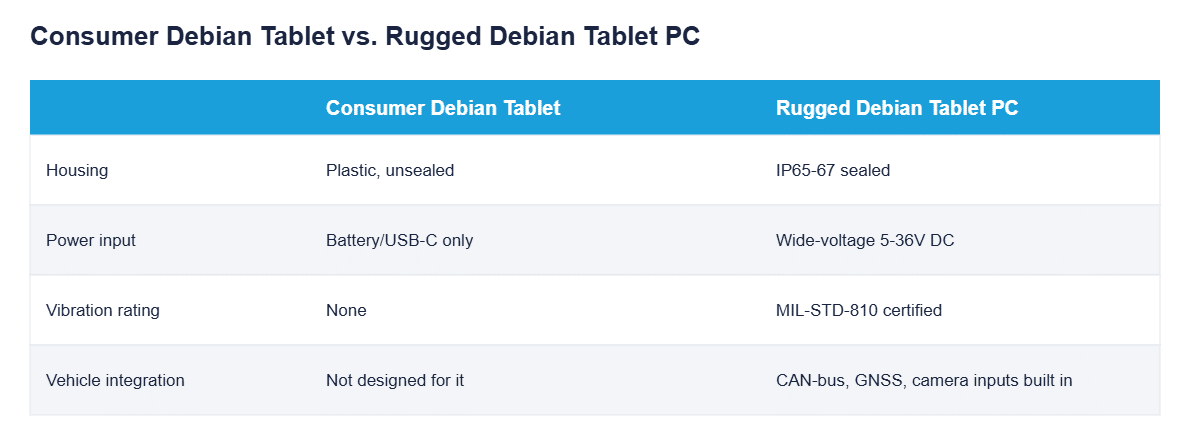
Consumer Debian Tablet ≠ Rugged Debian Tablet PC
A meaningful share of “debian tablet” search results point to consumer-grade hobbyist hardware — devices built for developers or Linux enthusiasts, not vehicle installation. None of that consumer-tablet category is built to survive vibration, dust, or a vehicle’s fluctuating electrical system, which is a completely separate requirement from the operating system running on it.
Running Debian and Android on the Same Terminal
Rather than forcing a single-OS choice, some rugged vehicle tablets support both operating systems on the same hardware platform — the approach detailed in our Dual Android/Linux Architecture guide. This matters in practice for integrators who need Debian for a custom control layer while still running standard Android-based fleet management software on the same device, rather than installing two separate terminals to cover both needs.
Where This Shows Up in 2026 Deployments
Demand for debian tablet PCs in vehicle and industrial contexts has grown alongside AGV and warehouse-automation deployments, where a fixed, controlled Linux environment is easier to validate and maintain at scale than a general-purpose mobile OS — the same indoor fleet context covered in our Smart Warehousing guide. Warehouse and yard vehicle integrators in particular have leaned toward Debian-based terminals specifically because the software environment stays predictable across a large, standardized fleet.
Choosing Between Debian and Android for Your Fleet
The decision usually comes down to who’s building the software: an in-house or OEM engineering team building custom control logic will lean Debian; a fleet operator deploying off-the-shelf dispatch, DMS, or AVM software will lean Android — and a fleet doing both doesn’t have to choose, provided the hardware supports dual-OS operation. For the full picture on distro-level choices within Debian-based deployments, see our Debian vs. Mint distro guide, and for the complete OS-and-hardware decision framework, see our 10-Inch Rugged Android Tablet or Debian Linux Tablet hub.
A Deployment Example
An AGV integrator building custom navigation and obstacle-avoidance logic for a warehouse fleet initially prototyped on a consumer Debian tablet, which worked on a bench but failed within weeks once installed on the actual vehicles — vibration loosened internal connections the consumer hardware wasn’t rated for. Moving the same Debian software stack onto a rugged, vehicle-rated tablet PC resolved the reliability issue without requiring any changes to the underlying control software, since the OS and application layer were never the problem — the hardware housing it was.
Common Questions
Can a Debian tablet PC run standard fleet dispatch software?
Yes, but it typically requires custom-built software rather than off-the-shelf Android apps, since Debian doesn’t run the Android app ecosystem natively.
Is Debian more secure than Android for vehicle terminals?
Neither is inherently more secure — security depends more on how the deployment is configured (locked-down permissions, MDM enrollment) than the base OS choice alone.
Does a rugged Debian tablet PC cost more than an Android equivalent?
Base hardware cost is generally similar; the bigger cost difference usually comes from custom software development needed on the Debian side versus using existing Android apps.
Can I switch a terminal from Android to Debian later?
Only on hardware built for dual-OS or OS-flexible deployment — a standard single-OS terminal typically isn’t designed to be reflashed to a different operating system after the fact.
Interested in specs or a quote? Contact our team to discuss Debian or Android tablet PC deployment for your fleet.
Interested in specs or a quote? Contact our team to discuss Debian-based terminal options for your fleet.