

An industrial 10 inch android tablet is a sealed, wide-voltage, vibration-certified computer built for vehicle cabs and warehouses — CF-Device’s VCM S10-2 and V10 PRO are examples — and it shares only two things with the 10 inch android tablet sold for home use: the screen diagonal and the operating system. That’s roughly where the similarity ends, and buyers who treat them as interchangeable usually find out which one they needed about four months in.
Retail and B2B listings write this device class several ways — android tablet 10 inch, android tablets 10 inch, 10 inch tablets android, or android 10 inch tablets — but the wording never tells you which class of product you are looking at. Only the build does.
TL;DR
- Screen size and Android version tell you almost nothing about whether a tablet survives industrial use
- CF-Device’s 10-inch VCM models (M10, V10 PRO, V10-2, S10-2) are rated IP65–IP67, run on 5–36V DC vehicle power, and operate from −30°C to +70°C — three specs no consumer 10-inch panel carries
- A ruggedized android tablet differs in sealing, power input, temperature range, and mounting — not just a thicker case
- Vibration and ignition voltage spikes kill consumer hardware faster than drops do
- Forklift and outdoor deployments have specific requirements that don’t appear on a consumer spec sheet at all
I. Why 10 Inches Is the Common Choice
CF-Device ships more 10-inch terminals than any other size class, and the reason is practical rather than commercial: 10 inches is large enough to read a pick list or a guidance map at arm’s length while driving, and small enough to mount in a cab without blocking sightlines. Below 8 inches, text gets too small to read while moving. Above 12 inches, the unit starts competing with the windshield for space. The full size-selection logic is covered in how to choose the right tablet screen size for your vehicle.
In short: 10 inches is the size that fits both the human eye at driving distance and the physical space in a cab.
II. Is a 10.1 Inch Android Tablet Different From a 10 Inch One?
No. A 10.1 inch android tablet and a 10 inch android tablet are the same panel class — 10.1″ is simply the exact diagonal most panels in this class measure, and both are marketed as “10 inch”. CF-Device’s S10-2 and V10 series measure 10.1″ diagonally and mount interchangeably in the same VESA and RAM cradles, so a cab already fitted for one takes the other without new brackets. Where the two numbers do matter is documentation: if a mount specification is written to a 10.0″ outline, confirm the bezel dimensions rather than the diagonal.
III. Where a Consumer Tablet Fails First
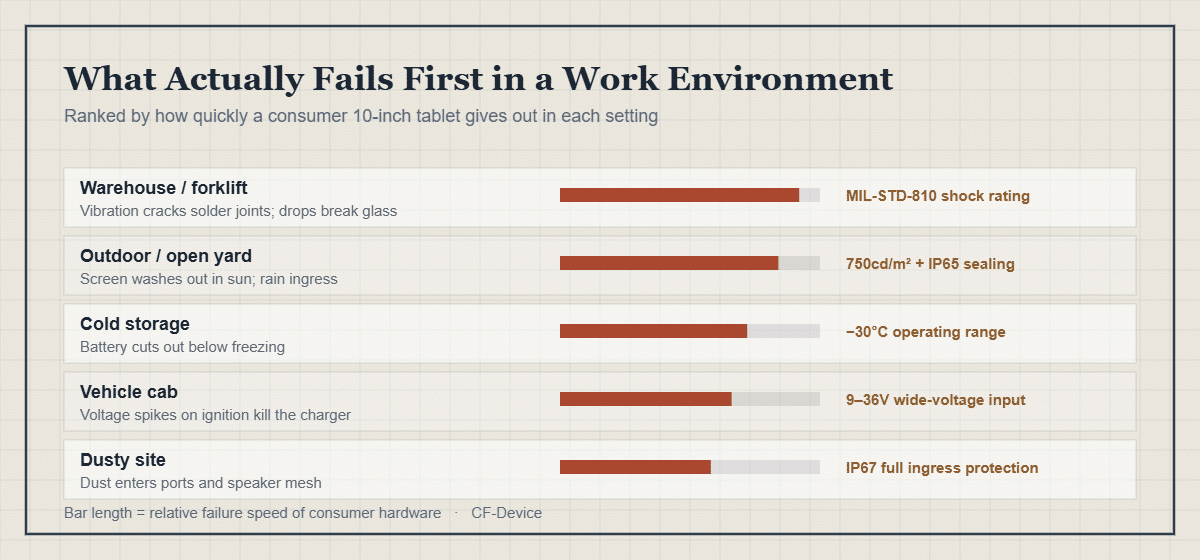
Most buyers expect the failure to be dramatic — a drop, a cracked screen. In practice the common failures are quieter. Continuous vibration fatigues solder joints over weeks until the unit intermittently reboots. Ignition voltage spikes damage a charging circuit designed for a wall adapter. A battery that works fine indoors simply refuses to charge in a cold-storage warehouse. None of these are covered by a consumer warranty used in a commercial setting. The same failure sequence plays out on construction sites, mapped month by month in rugged tablets for construction fleets.
IV. What Makes a Rugged Android Tablet Genuinely Rugged
The word “rugged” is unregulated in marketing, so a rugged android tablet is worth judging on testable claims rather than adjectives. CF-Device publishes the four that matter for every VCM model: the ingress rating (IP65 or IP67), the shock and vibration standard the unit was tested against (MIL-STD-810), a numeric operating temperature range, and a DC input voltage range rather than “car charger compatible.” Vendors list the same product as a rugged tablet android build or a rugged android tablet depending on their catalogue conventions; the spec sheet, not the word order, tells you whether the claim is real. A genuine ruggedized android tablet states all four numbers without being asked.
| Spec | Consumer Tablet | CF-Device Industrial Tablet |
|---|---|---|
| Ingress protection | Splash-resistant at best | IP65–IP67 rated and tested |
| Shock/vibration | Not tested | MIL-STD-810 certified |
| Operating temperature | 0°C to 35°C typical | −30°C to +70°C |
| Power input | USB-C, 5V | 5–36V DC with ignition sense |
| Mounting | Consumer accessory brackets | VESA / RAM vehicle mounts |
| Service life | 2–3 years, consumer replacement cycle | 5–10 years with parts availability |
The ingress numbers deserve particular attention, since IP65 and IP67 are not interchangeable — the difference is explained in IP65 vs IP67: which rating your deployment needs.
V. Can a Protective Case Make a Consumer Tablet Rugged?
No — and this is the substitution buyers try most often. A case helps with drops, but every other failure mode in a vehicle is internal to the device: vibration fatigue on the mainboard, voltage transients arriving through the charge circuit, a battery that stops accepting charge below 0°C, and a 300–500 cd/m² panel that goes unreadable in sunlight. CF-Device’s VCM units address those at the board level — conformal-coated assemblies tested to MIL-STD-810, a 5–36V DC input with ignition sense, and a −30°C to +70°C operating window — none of which a case can add afterwards. The full test regime behind those numbers is set out in the durability standards behind rugged certification.
VI. The Industrial Android Tablet Difference: Interfaces
Physical toughness is the visible half of the difference; the half buyers usually discover later is connectivity. A CF-Device industrial android tablet carries interfaces a consumer device has no reason to include — CAN bus for reading vehicle and machine data, RS232/RS485 for legacy peripherals, Gigabit Ethernet for a wired depot connection, and up to 6 AHD camera inputs. Without CAN bus, a tablet in a vehicle can display an app but can’t read anything the machine is actually doing, which rules out diagnostics, hour tracking, and implement control. That integration layer is covered in our CAN bus and J1939 integration guide.
VII. Outdoor Use: The Brightness Problem
An outdoor android tablet has one requirement that dominates all others: the screen has to remain readable in direct sun. Consumer tablets typically run 300–500 cd/m², which is comfortable indoors and effectively blank at midday in an open field or yard. CF-Device targets 750 cd/m² or higher on outdoor-facing models, usually paired with an anti-glare surface treatment rather than the glossy finish consumers prefer — the V7A-2 exists specifically for that case. This is why an operator’s most common complaint about a repurposed consumer tablet isn’t durability at all — it’s that they can’t see the screen during the hours they actually work.
VIII. Forklift and Warehouse Deployments
A forklift tablet is the case that most clearly separates the two product classes, and it is where CF-Device’s S10-2 and M10 are most often specified. Forklifts run near-continuous shifts, transition over dock plates hundreds of times a day, and operate in aisles where the operator needs both hands on controls. The requirements that follow — vibration certification, a mount that won’t loosen, glove-operable touch, and clean power from a 24V or 48V electrical system — are absent from every consumer spec sheet. Warehouse-specific deployment considerations are covered in rugged terminals for smart warehousing, forklifts and AGVs.
IX. A Deployment Example
A distribution operation equipped 30 forklifts with consumer 10-inch Android tablets to run their warehouse management app — cheap per unit, familiar interface, quick to deploy. Within six months, 11 units had failed: several with intermittent reboots traced to vibration, several with charging failures from the 48V truck supply, and the rest with cracked digitizers. The replacement cost plus the operational disruption of trucks sitting idle exceeded what industrial-grade units would have cost at the outset. CF-Device ships roughly 140,000 terminals a year into 33 countries, and this failure pattern is the single most common reason a fleet moves from consumer hardware to a rugged android tablet mid-deployment rather than at the start.
X. Managing 10-Inch Android Tablets at Fleet Scale
One advantage of the Android platform in industrial hardware is that fleet-wide management tooling already exists for it, and CF-Device ships every VCM unit ready to enrol in it. Once a deployment reaches a dozen or more units, remote configuration, app lockdown, and over-the-air updates stop being conveniences and become the only practical way to keep every unit consistent — the platform side of that is covered in MDM devices: what fleet hardware a platform actually manages.
XI. Frequently Asked Questions
Is an industrial 10 inch android tablet slower than a consumer one?
Not necessarily, but the priorities differ — industrial units optimize for sustained reliability and interface breadth rather than peak benchmark scores, since the workload is one fixed application rather than gaming or media. CF-Device models carrying a 6 TOPS NPU add on-device vision processing that consumer silicon in this price class does not provide.
Can the same 10-inch hardware run Linux instead of Android?
On dual-OS industrial platforms, yes — the choice depends on whether the deployment needs Android’s app ecosystem or Linux’s direct hardware control, compared in our 10-inch rugged Android vs Debian Linux tablet guide.
Which CF-Device models are used as a rugged android tablet in vehicles and warehouses?
In the 10-inch class, the VCM M10, VCM V10 PRO, VCM V10-2 and VCM S10-2 are the models most often specified — all rated IP65–IP67, all accepting 5–36V DC vehicle power, and all rated from −30°C to +70°C. For cabs with no room for a display, the screenless TANK V2 vehicle computer covers the same duty cycle without a panel.
Buyers already running an incumbent rugged brand face a related but separate question — what actually changes when the unit is permanently bolted into a cab rather than carried. That comparison is covered in Zebra rugged tablet alternatives for permanent vehicle mounting.
Interested in specs or a quote? Contact our team to discuss 10-inch industrial tablet options for your deployment.