

Digital agriculture equipment is farm machinery paired with sensing, positioning, and computing hardware — CF-Device supplies the computing half as the VCM range, rated IP65–IP67 and 5–36V DC — hardware that lets it apply inputs, steer, and record work according to field data rather than operator estimate. The implement gets the attention in that sentence; the part that usually decides whether the investment works is the terminal in the cab.
TL;DR
- Digital ag has three layers — machine, terminal, data — and the terminal is the one most often under-specified
- A prescription map is inert unless something in the cab can read it and drive the implement from it
- Mixed-brand fleets need ISOBUS VT, or every new implement adds another screen
- Season-long field exposure is why consumer hardware doesn’t survive this application
Three Layers, One Weak Point
Every digital agriculture deployment has the same structure. The machine does the physical work. The data — soil samples, yield history, imagery-derived prescriptions — says what should happen where. Between them sits the terminal, which is the only component that converts one into the other.
Farms invest heavily in the first and third layers. Soil sampling, drone imagery, a new implement — those are visible purchases with obvious value. The middle layer is often whatever display came bundled with something, and that’s where the return on the other two gets capped.
In short: the terminal sets the ceiling on what the rest of the system can deliver, regardless of how good the data or the machine is.
Where Digital Ag Investments Actually Stall
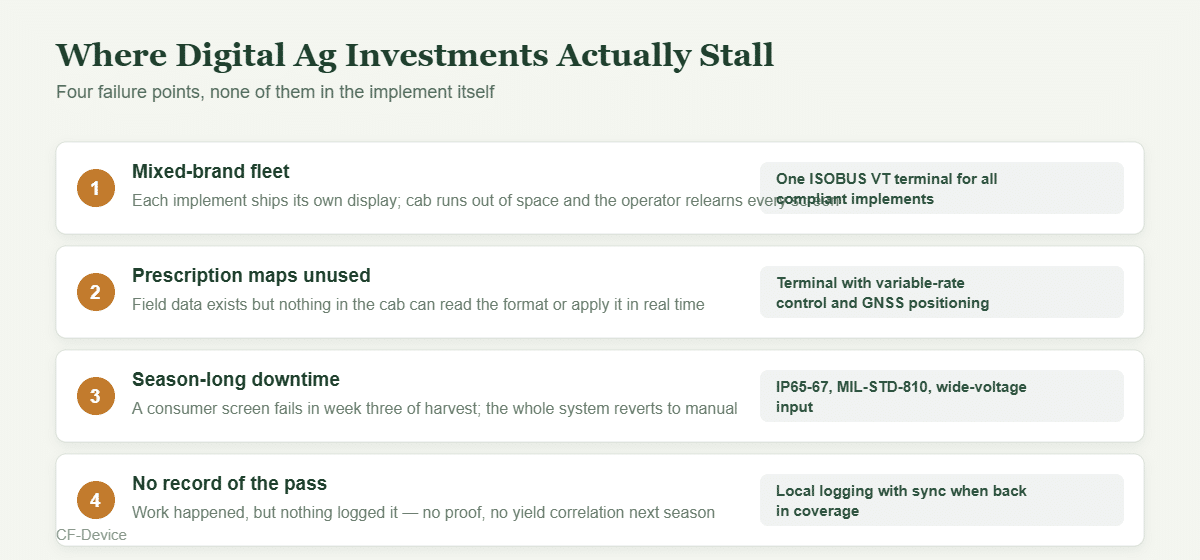
None of these four are implement failures. In each case the machinery works as sold, the data exists, and the gap is in the cab. That pattern is consistent enough across operations that “the terminal is fine, we’ll upgrade it later” is worth treating as a warning rather than a reasonable sequencing decision.
The Mixed-Fleet Problem
Most farms don’t run one manufacturer. A tractor from one brand pulls implements from two or three others, accumulated over years of buying whatever was right at the time.
Without a universal terminal standard, each of those implements arrives with its own display, its own mounting bracket, and its own interface for the operator to learn. The cab fills up, and a seasonal hire now has to know four control layouts instead of one. ISOBUS VT exists specifically to collapse that — one certified terminal running the interface any compliant implement sends it, explained in what is ISOBUS VT and why it matters for mixed fleets.
Why Positioning Tier Is a Real Decision
“GPS-enabled” appears on nearly every piece of digital agriculture equipment sold, and it covers a range of accuracy wide enough to be misleading. Meter-level positioning is adequate for recording where a machine has been. It is not adequate for auto-steer on narrow rows, or for section control that shuts off individual nozzles at a headland.
| Task | Accuracy needed |
|---|---|
| Field boundary and coverage logging | Meter-level |
| Guidance assistance on wide passes | Sub-meter |
| Auto-steer, controlled traffic | Centimeter (RTK) |
| Section and nozzle control at headlands | Centimeter (RTK) |
Paying for RTK on a fleet that only needs coverage logging is waste; specifying meter-level and then attempting auto-steer is a deployment that quietly underperforms all season. The tiers are broken down in our GNSS positioning guide.
From Map to Machine Behaviour
The clearest illustration of the terminal’s role is variable-rate application. A prescription map divides a field into zones with different input requirements. As the machine crosses a zone boundary, something has to notice the crossing and change the application rate — in real time, without the operator doing anything.
That “something” is the terminal, holding the map, reading position, and sending rate commands over the implement bus. A farm can buy the soil sampling, generate the prescription, and own a rate-capable sprayer, and still apply a flat rate across the whole field because nothing in the cab closes the loop. The mechanics are covered in variable-rate spraying.
A Deployment Example
A 1,400-hectare arable operation spent two seasons building a variable-rate nitrogen programme: grid soil sampling, yield-map correlation, zone prescriptions generated in their agronomy software. Application results didn’t improve.
The prescriptions were being exported to a format their spreader’s bundled controller couldn’t import, so the operator was entering a single average rate manually each morning. Nothing in the chain was broken except the one component nobody had specified deliberately. Replacing the controller with a terminal that read the prescription format and drove rate over the implement bus turned two seasons of agronomy work into an actual field practice — the kind of end-to-end setup described in our smart agriculture terminal guide.
The Durability Requirement Nobody Budgets For
Agricultural terminals face a duty cycle most hardware categories don’t: continuous outdoor exposure through a season, dust ingress heavy enough to clog anything not sealed, vibration from field surfaces rather than roads, and direct sun at the hours the work actually happens.
A washed-out screen at midday is the complaint that surfaces first — a display specified at consumer brightness is unreadable exactly when it’s needed. Sealing and vibration rating determine whether the unit survives to a second season at all. The relevant certifications are compared in IP65 vs IP67, and the wider hardware picture in our rugged vehicle tablet hardware buyer’s guide.
Specifying the Middle Layer
- Is it ISOBUS VT certified, and how many implements can it address?
- Does the positioning tier match the most demanding task, not the average one?
- Can it import the prescription formats your agronomy software actually exports?
- Does it log work locally when the field has no signal, and sync later?
- Is the display readable at midday, and the housing sealed for a full season?
How AI-derived prescriptions and imagery reach the machine through this same layer is covered in precision agriculture artificial intelligence.
Common Questions
Can I retrofit digital capability onto older machinery?
Often yes — if the machine has a CAN bus, a terminal can read from it and send control messages. Machines predating electronic control are harder and may need sensor additions first.
Does digital agriculture equipment require constant connectivity?
No. Positioning and implement control work offline; connectivity only affects when data reaches the office. A terminal that logs locally handles poor-coverage fields without losing the record.
Is this worth it below a certain farm size?
Input savings scale with area, so payback is slower on small holdings. Guidance and coverage logging often justify themselves earlier than variable-rate application does.
Do I have to buy the terminal from my implement manufacturer?
Not if both sides are ISOBUS VT compliant — that standard exists precisely so terminal and implement can come from different suppliers.
Interested in specs or a quote? Contact our team to discuss terminals for your machinery.