

A Zebra rugged tablet alternative for a vehicle depends on one question: does the device ever leave the cab? Zebra’s ET-series (ET80, ET85, ET40, ET45) are well-regarded rugged tablets, and they show up often in searches for vehicle-mount hardware because Zebra sells vehicle cradles for them. But the tablet itself is designed first to be picked up, carried, and scanned with — the vehicle dock is an accessory, not the core design. A terminal that never leaves the cab is solving a different problem, and CF-Device’s VCM series is built around that difference from the ground up.
TL;DR
- Zebra’s ET-series is a handheld tablet with an optional vehicle dock; CF-Device’s VCM series is a vehicle terminal with no handheld use case at all
- A handheld design keeps an internal battery as the primary power source; a permanent-mount design runs directly off vehicle power and doesn’t need one
- Vehicle docks add ignition sense and power pass-through after the fact; CF-Device’s terminals have wide-voltage DC input (5–36V or 9–36V by model) with ignition detection built into the unit itself
- Native CAN bus is built into the VCM models; a handheld tablet reaches vehicle data through the dock, not the tablet itself
- The right choice depends on whether the same device also needs to leave the vehicle — if not, a permanent-mount terminal is the simpler and more durable fit
I. Zebra Rugged Tablet Alternative: Two Different Design Briefs
A handheld rugged tablet has to survive being dropped, carried in one hand while scanning with the other, and run for a full shift on battery. A permanently mounted vehicle terminal never gets dropped by a hand that isn’t holding it, never needs to survive a shift on battery because it’s wired into the vehicle, and instead has to survive continuous vibration, wide voltage swings on ignition, and years mounted in one fixed position. These are not the same reliability problem, even though both products get called “rugged.”
In short: if the device is picked up and carried during the job, a handheld tablet with a vehicle dock makes sense. If it stays bolted to the dash for the vehicle’s service life, a purpose-built vehicle terminal is the simpler and more durable choice.
II. Spec Comparison: Dockable Handheld vs. Permanent Mount
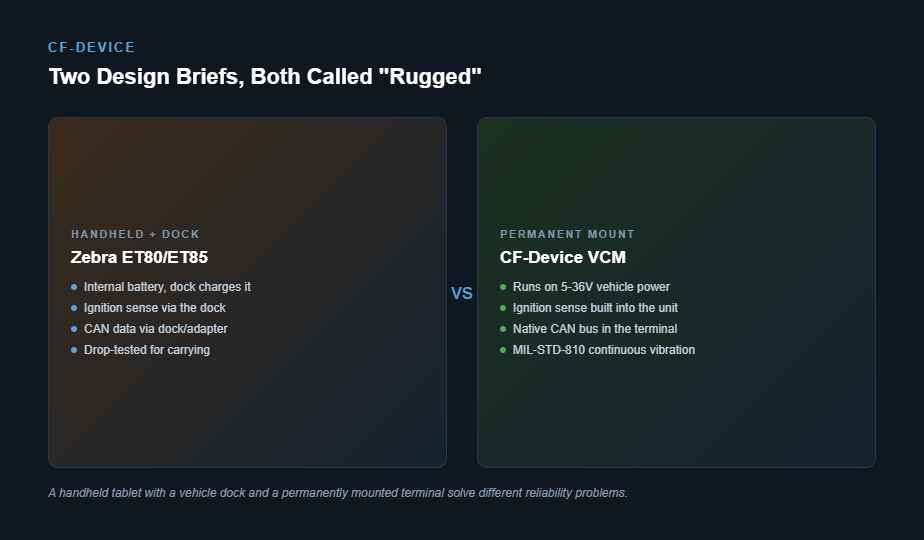
| Zebra ET80/ET85 (handheld + dock) | CF-Device VCM series (permanent mount) | |
|---|---|---|
| Primary power | Internal battery, dock charges it | Vehicle wide-voltage DC (5–36V or 9–36V by model), no battery required |
| Ignition sense | Provided by the dock, not the tablet | Built into the unit |
| Vehicle data (CAN bus) | Via dock/adapter | Native CAN bus in the terminal |
| Designed to be carried | Yes — core use case | No — fixed installation only |
| Sealing | IP65 (handheld-rated) | IP65-IP67 depending on model |
| Vibration testing | Drop-tested for handheld use | MIL-STD-810 continuous vibration |
Neither approach is wrong — they’re built for different failure modes. A warehouse picker who scans barcodes off the vehicle half the shift needs the ET-series’ handheld design. A forklift, bus, or utility truck terminal that’s read by the operator from a fixed seat and never leaves the cab has no use for a battery, a drop rating, or a dock at all — it needs the wiring and CAN interface built directly into the unit, which is the design CF-Device builds into its VCM terminals.
III. Why the Dock Adds a Failure Point
A dock-based setup has more connection points than a native terminal: the tablet-to-dock contacts, the dock-to-vehicle wiring, and the tablet’s own charging port, each subject to vibration and repeated insertion wear over the vehicle’s service life. A permanently mounted terminal has one wiring harness into the vehicle and no removable connection at all, which is fewer places for an intermittent fault to develop over years of service.
IV. Managing Either Approach at Fleet Scale
Whichever design fits the job, the device still needs OS updates, app lock-down, and remote diagnostics at fleet scale — covered in our MDM for fleet platforms guide, which applies equally to a dockable handheld or a permanently mounted terminal.
V. A Procurement Example
Consider a regional courier fleet that standardises on handheld dockable tablets for drivers who scanned packages both inside and outside the vehicle. When the fleet added a second group of dispatch-only vehicles — supervisor trucks where the tablet stayed mounted for the entire shift and no one ever carried it — continuing to buy the handheld-plus-dock combination for those vehicles added battery replacement cycles and dock wear for a use case that never used either feature. Switching that group to a permanently mounted terminal removes both maintenance items without losing any functionality the supervisors actually use. This is an illustrative scenario rather than a customer case study.
Other Names for the Same Question
Searches for a Zebra tablet alternative, a Zebra ET80 alternative, a vehicle mount computer vs handheld tablet comparison or a rugged tablet for permanent vehicle installation all ask the same thing: whether the job needs a device that is carried, or one that stays bolted in the cab for the life of the vehicle.
Which Guide Should I Read Next?
If the job calls for a fixed terminal, the full specification sequence is in the rugged vehicle tablet hardware buyer's guide, the device-type choice in Rugged industrial tablet: the four types, and how to vet any supplier in Rugged tablet manufacturers: real maker or reseller.
Frequently Asked Questions
Is a permanently mounted terminal less capable than a handheld tablet?
Not less capable — differently specified. It trades handheld portability and battery life for native CAN bus, ignition-sense power, and a simpler wiring path with fewer connection points to fail.
Can I use a permanently mounted terminal instead of a handheld-plus-dock setup?
Only if the device genuinely never needs to leave the vehicle. If any part of the job requires carrying the device — scanning outside the cab, walking a delivery route — a handheld design is still the right tool.
Do vehicle-mount terminals need a battery at all?
Not as a primary power source — they run off the vehicle’s wide-voltage DC supply. Some models support delayed power-off backup to preserve state when the ignition cuts, which is a different function from a handheld tablet’s main battery.
Which CF-Device model is closest to the ET80/ET85’s 8-inch class?
The VCM V8 PRO, which adds 9 physical buttons for gloved or blind operation — a feature aimed specifically at fixed-position operators rather than a handheld use case.
Interested in specs or a quote for a permanently mounted alternative to a handheld-plus-dock setup? Contact our team to discuss your vehicle fleet.