
CF-Device’s VCM V12-2 is a 12.1″ rugged vehicle-mount tablet built around a quad-core 64-bit Cortex-A55 processor and 1 TOPS of overall computing power, adding 5G connectivity and on-device AI processing in the same body size as the VCM V12 PRO. It is also the model many buyers search for as the “V12.2 tablet”.
TL;DR
- Quad-core 64-bit Cortex-A55 at 2.0 GHz with 1 TOPS of overall computing power for on-device video analytics and AI-assisted alerts
- LTE 4G / 5G communication module, cutting latency for live video and fleet telematics versus 4G-only models
- Three CAN channels (two classic, one CAN FD) with SocketCAN support, gigabit Ethernet, USB 3.0, up to four AHD camera inputs
- IP67, 48-hour salt-spray resistance, −30°C to +70°C, 9-36V DC with over/under-voltage and reverse-polarity protection
- 1.75 kg in a 34.5 mm body — essentially the same size and weight as the VCM V12 PRO (1.73 kg)
Why Processing Power Now Matters as Much as the Display
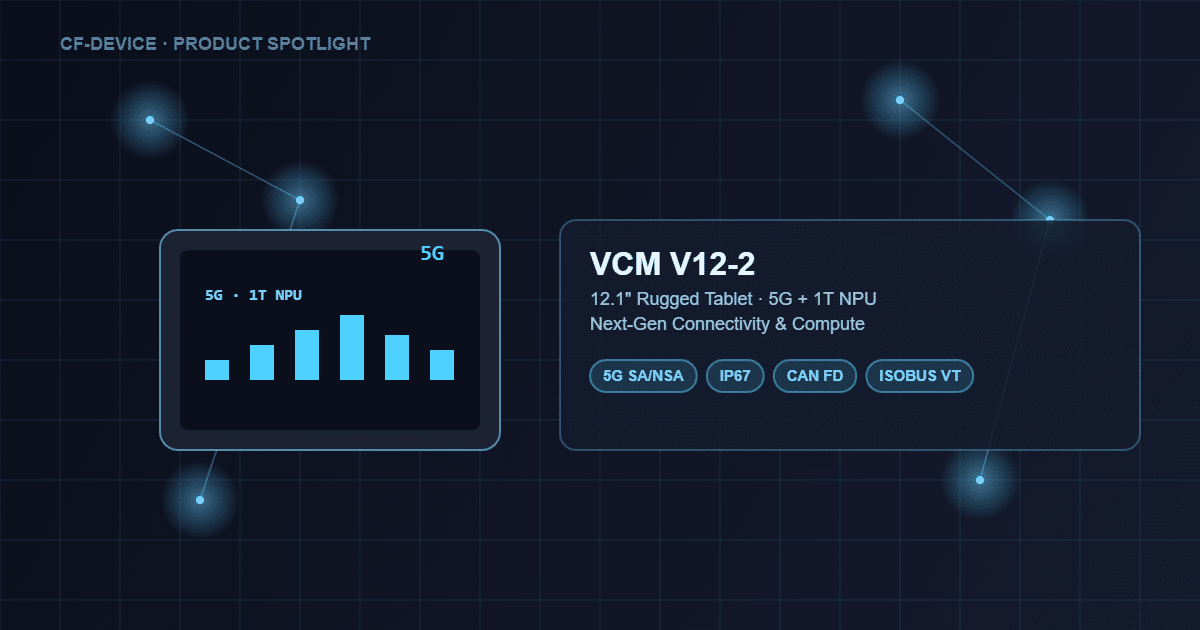
As vehicle terminals take on more responsibility — real-time data logging, video streaming, on-device analytics — the processor and connectivity behind the screen start to matter as much as the display itself. The VCM V12-2 is CF-Device’s answer to that shift: a 12.1″ rugged unit with a Cortex-A55 platform, an ARM G52 2EE GPU, and 1 TOPS of overall computing power, running Android 11.0 or Linux 5.10 as a dual system with Qt 5.15.7 listed for custom interfaces.
Computing Power for On-Device Intelligence
1 TOPS of computing power opens the door to on-device video analytics, AI-assisted driver alerts, or local data processing that doesn’t depend on a constant cloud connection — useful in the low-connectivity areas where agricultural and mining fleets often operate, the same offline-resilience need covered in our mining terminal guide. Memory is 2 GB LPDDR4 expandable to 8 GB, and storage is 16 GB eMMC expandable to 256 GB.
5G for Real-Time Fleet Data
The V12-2 carries an LTE 4G / 5G communication module with a built-in antenna and reserved ports for external 4G/5G and GNSS antennas, meaningfully cutting latency for live video feeds, remote diagnostics, and fleet telematics platforms that depend on near-real-time data. Several other models in the lineup also list 5G, so confirm the cellular entry for any model you compare. Wi-Fi is 2.4 GHz only (802.11 b/g/n) and Bluetooth is 4.2.
Full-Spectrum I/O for Serious Integration
Gigabit Ethernet, three CAN channels including one CAN FD, USB 3.0, up to three RS232 ports and one RS485 port give integrators modern-spec interfaces rather than legacy-only options. The datasheet explicitly lists SocketCAN support, which matters for Linux-based custom development. There are also two analog voltage inputs (up to 12V), two 12V outputs and two digital inputs, and up to four AHD camera inputs with CF AVM 360° listed. ISOBUS VT support is listed as CF ISOBUS VT. The terminal supports three GNSS modules (MXT906B, UM980 and P20E), with the UM980 being RTK-grade, so the positioning tier depends on the module chosen. The CAN side is covered in CAN bus and J1939 integration.
What the CAN and Wi-Fi Entries Mean
Two entries on the datasheet are easy to over-read. The CAN count is three channels, two classic and one CAN FD, and the datasheet does not list which higher-layer protocols the channels support, so confirm J1939 or others before assuming them. And the Wi-Fi is 2.4 GHz only, so a site that depends on 5 GHz Wi-Fi at the depot would need a different link, such as the gigabit Ethernet port.
Built to a Rugged Standard
IP67 protection, a −30°C to +70°C operating range, a 48-hour salt-spray result and third-party measured vibration (7.0 Grms) and shock (50 g) results mean the performance upgrade doesn’t come at the cost of durability. Heat is handled by a heat-dissipation area of 18,561 mm² in a body only 34.5 mm thick, with a 9-36V DC input, ignition detection and over/under-voltage and reverse-polarity protection. The display is a bezel-less, anti-glare 12″ panel at 1280×800 and 750 nits or more, with five-point touch. See our IP65 vs IP67 rating guide for how ingress ratings compare across the lineup.
V12-2 and V12 PRO: Same Body, Different Platform
The V12-2 measures 317.8 × 219.6 × 34.5 mm, the same as the VCM V12 PRO, and at 1.75 kg weighs about the same as the V12 PRO’s 1.73 kg. What differs is the platform inside: the V12-2 is the newer generation with gigabit Ethernet, USB 3.0, CAN FD and dual OS, while the V12 PRO lists more camera inputs and more analog and digital I/O. Its harness pin definition has not been confirmed against other models, so do not assume it shares a harness with any other VCM unit; check before ordering cables.
MDM-Ready for Fleet-Wide Deployment
Native compatibility with MDM remote-management platforms means IT teams can push updates, monitor device health, and manage configuration across an entire fleet without physically touching each unit — a meaningful operational advantage once deployment scales past a handful of vehicles. Surround-view use is covered in AVM 360° surround view.
Why 5G and On-Device AI Are Complementary, Not Redundant
It’s tempting to assume that faster connectivity makes on-device AI processing less necessary — if 5G can stream video to the cloud fast enough, why process it locally at all? In practice, the two capabilities solve different problems: 5G shortens the round-trip for data that genuinely needs to leave the vehicle (fleet telematics, remote diagnostics, dispatch updates), while on-device processing handles the safety-critical detection work that can’t tolerate any round-trip at all, regardless of how fast the connection is, and that still needs to function the moment connectivity drops entirely. The V12-2 pairs both because a fleet’s real-world coverage is never uniform — a terminal that only worked well with strong signal would fail exactly where mining, agriculture, and remote logistics operations spend much of their time.
Who It’s For
Smart agriculture, digital construction, mining, port logistics, and specialty vehicle fleets that need both current connectivity and rugged reliability in a single rugged vehicle-mount tablet are the target use case for the V12-2. Compare it to the VCM V10 PRO if a mid-size 10.1″ form factor fits your fleet better than the 12.1″ display.
Common Questions
What does the 1 TOPS of computing power actually enable on VCM V12-2?
On-device video analytics and AI-assisted alerts that run locally without depending on constant cloud connectivity — useful for fleets operating in low-signal areas.
Is VCM V12-2 heavier than VCM V12 PRO given the added processing hardware?
Essentially the same: the V12-2 is 1.75 kg and the V12 PRO is 1.73 kg, in an identical 317.8 × 219.6 × 34.5 mm body.
Does VCM V12-2 support ISOBUS implements?
Yes, CF ISOBUS VT support is listed, and positioning depends on the GNSS module chosen, with the UM980 being RTK-grade for precision guidance.
If a vehicle has strong 5G coverage, is on-device AI processing still necessary?
Yes — safety-critical detection can’t tolerate any cloud round-trip delay, and coverage is rarely uniform across a fleet’s full operating area, so on-device processing remains essential regardless of connection quality.
Does the V12-2 support 5 GHz Wi-Fi?
No. The datasheet lists 2.4 GHz Wi-Fi only (802.11 b/g/n), so use the gigabit Ethernet port or cellular if you need a faster link at the depot.
5G and 1 TOPS of compute are the headline items here, but the specification framework they sit inside applies across the whole range — it is set out in our complete guide to rugged vehicle tablets and the rugged vehicle tablet hardware buyer’s guide.
Interested in specs or a quote? Contact our team or view the full VCM V12-2 product page.