

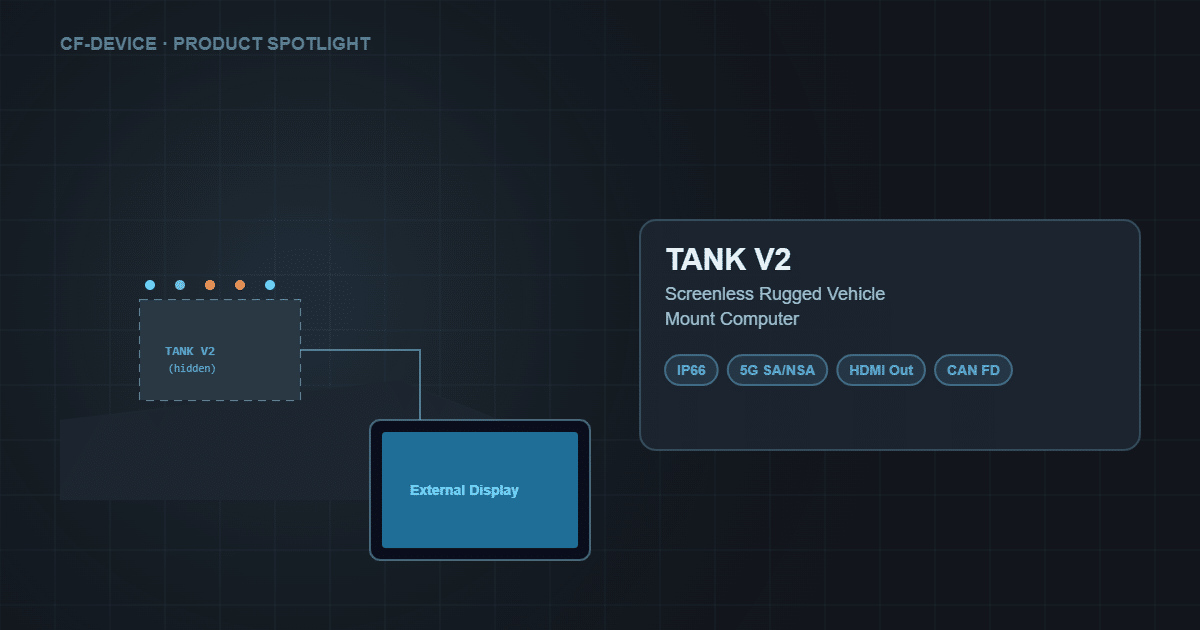
CF-Device’s TANK V2 is a screenless rugged vehicle-mount computer built for deployments where the compute unit and the display need to live in different physical locations — custom dashboards, hidden equipment-bay installs, or vehicles with existing screen infrastructure.
TL;DR
- No built-in display — drives an external 10.1″ (1024×600) or 12.1″ (1024×768) touchscreen over HDMI; 7″ is not supported
- 5G SA/NSA plus 4G/LTE, with GPS/BDS/GLONASS positioning and optional centimeter-level GNSS or inertial navigation
- Four AHD camera inputs at 720p, or two at 1080p, for surround-monitoring even without a screen
- Up to four CAN channels (two classic, two CAN FD), gigabit Ethernet, USB 3.0 Type-C, built-in hardware encryption
- IP65, third-party measured vibration and shock, −30°C to +70°C, 5-36V DC, for hidden or under-dash installation
Why Some Deployments Don’t Want a Built-In Screen
Not every vehicle-computing application wants a screen built into the same housing as the processor. Custom dashboards, hidden installations, and vehicles with existing display infrastructure all need a compute unit that can live separately from whatever screen the operator actually looks at — that’s the specific problem the TANK V2 solves, a deployment pattern relevant to smart warehousing and forklift/AGV fleets where space and mounting constraints are common. Where this form factor sits within the broader category is set out in what is an onboard computer.
In the wider embedded computing category this form has a name: a box PC — a sealed, display-less unit that arrives ready to mount, as distinct from a bare module or a single-board computer that leaves the enclosure, certification and firmware work with the buyer. How the four forms differ, and which one suits a given build, is compared in embedded computer: the four forms and which one goes in a vehicle.
TANK V2: A Screenless Compute Core
Unlike every other model in the CF-Device lineup, the TANK V2 has no built-in display. Instead, it drives an external 10.1″ (1024×600) or 12.1″ (1024×768) touchscreen over HDMI, letting integrators mount the compute unit somewhere protected — behind a dash, inside an equipment bay — while the display goes wherever the operator needs it. The unit is a quad-core Cortex-A55 at 2.0 GHz with a 0.8 TOPS NPU, 2 GB RAM expandable to 8 GB and 16 GB storage expandable to 256 GB, and it runs Android 11.0 or Linux (kernel 5.10) as a dual system, with Qt 5.15.7 listed for custom interfaces.
Modern Connectivity in a Compact Box
5G SA/NSA and 4G/LTE dual-mode connectivity keeps the TANK V2 competitive with screen-equipped models on communication speed, alongside Wi-Fi (2.4G and 5.8G, 802.11 a/b/g/n/ac) and Bluetooth. GPS/BDS/GLONASS positioning is listed, with positioning offered at meter or centimeter level as an option. TANK V2 is also the only model in the range that lists an optional inertial navigation unit and an optional NFC reader.
Interfaces Built for Custom Integration
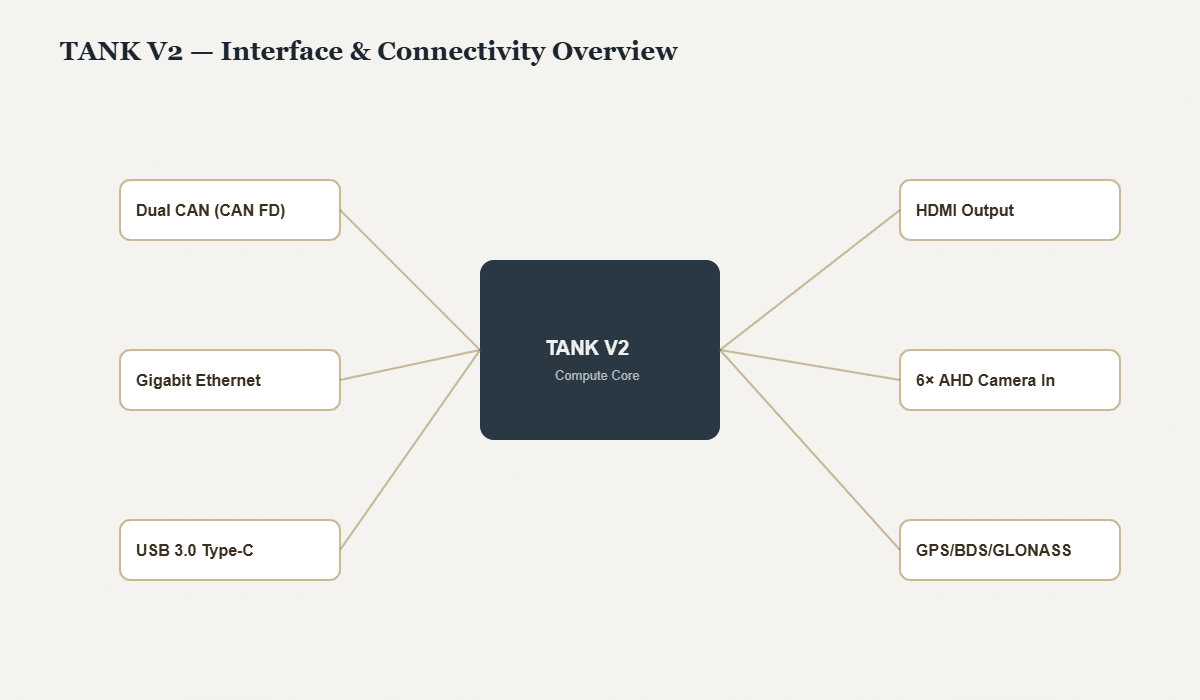
| Interface | Purpose |
|---|---|
| Up to 4 CAN (2 classic, 2 CAN FD) | Vehicle network and implement integration |
| Gigabit Ethernet (M12 X-code) | High-speed data networking |
| USB 3.0 Type-C | Peripheral and storage connectivity |
| HDMI output | Drives the external touchscreen |
| AHD camera inputs: 720p×4 or 1080p×2 | Surround-monitoring setup, CF AVM 360° listed |
| RS232 (1 standard, up to 3), RS485 (1) | Peripherals and sensor buses |
Pin Trade-Offs to Know Before You Order
Several TANK V2 options share lines, and the datasheet lists the costs. The fourth CAN channel and the third RS232 port share a line, so you use one or the other. The second RS232 port and the RS485 port are likewise mutually exclusive. The two analog inputs share pins with OUTPUT1 and the speaker output. Check which of these functions the machine needs before choosing the configuration; the trade-offs between serial ports are covered in RS232 vs RS485. There is no built-in speaker; the unit takes one external speaker.
Security and Reliability Features
Built-in hardware encryption helps protect sensitive fleet and operational data. Five dual-color LED indicators (power, Wi-Fi, GNSS, cellular, CAN) give installers at-a-glance system status without needing a display connected during setup or diagnostics, which matters on a unit with no screen of its own. An external UPS battery is available as an option. Fleet-wide, this same terminal integrates with MDM remote device management for configuration and health monitoring across every deployed unit.
Rugged for Hidden Installation
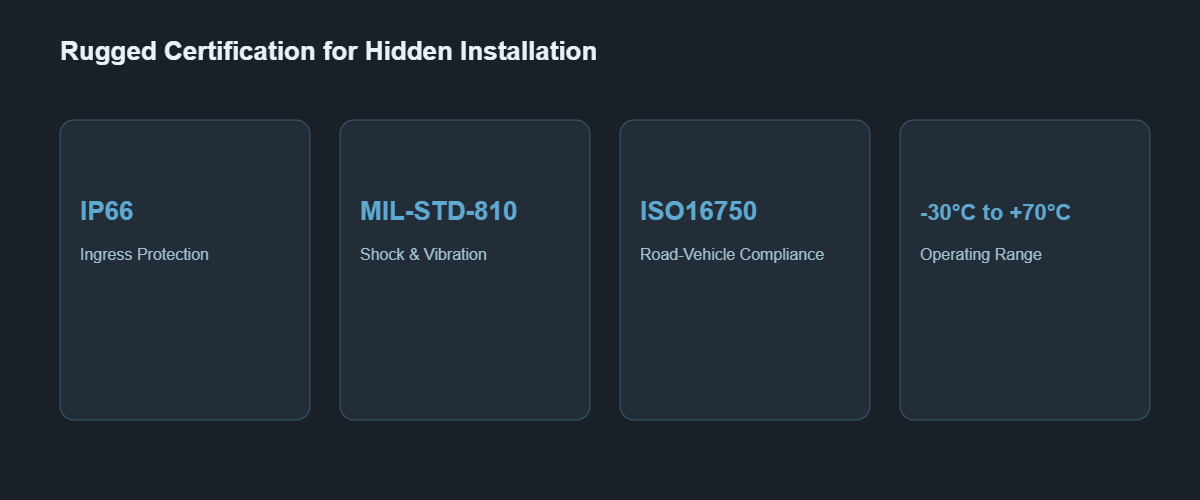
IP65 protection, third-party measured vibration (7.0 Grms) and shock (50 g) results, and a −30°C to +70°C operating range mean the TANK V2 handles the vibration and environmental exposure of an under-dash or equipment-bay mounting position, not just an exposed cab surface. The supply is 5-36V DC with ignition detection. The datasheet does not list a salt-spray result or over/under-voltage and reverse-polarity protection for this model, so ask CF-Device to confirm both if the unit goes into a coastal or electrically harsh site. See our IP65 vs IP67 rating guide for how ingress ratings compare across mounting scenarios.
Harness Group F: A Separate Wiring Family
The TANK V2 measures 203.52 × 126.56 × 55.5 mm and weighs 0.69 kg. It mounts either on the wall with four M5 screws at a 38 × 40 mm spacing, or on a RAM-101U bracket. Its 26-pin connector is harness group F, an independent definition that does not interchange with any VCM model, so a fleet mixing TANK V2 and VCM units needs separate cables and has to check which one is in the vehicle before ordering a harness.
Who It’s For
Specialty vehicle builders, OEM integrators with existing display hardware, and any deployment that needs to physically separate the compute unit from the screen — for space, security, or custom-display reasons — will find the TANK V2 fills a gap the rest of the tablet-format lineup can’t, including screen-equipped models like the VCM M10.
Common Questions
Can TANK V2 drive two external displays at once?
No — it outputs to one external touchscreen via HDMI (10.1″ or 12.1″), though the AHD camera inputs (four at 720p or two at 1080p) can feed surround-view content to that single connected display.
Does removing the screen reduce TANK V2’s rugged rating compared to screen-equipped models?
The TANK V2 is IP65 and operates from −30°C to +70°C regardless of mounting location. Ruggedness figures differ by model across the lineup — some screen-equipped models are IP67 or list a salt-spray result — so compare the datasheets for the site you have in mind.
Why would a fleet choose TANK V2 over a standard tablet-format terminal?
When the install location for the compute unit and the display must be different — hidden behind a dash for security or space reasons, or when a vehicle already has display hardware installed — the TANK V2’s screenless design solves an integration problem tablet-format units can’t.
Can the TANK V2 use a 7-inch external screen?
No. The datasheet lists 10.1″ (1024×600) and 12.1″ (1024×768) external touchscreens over HDMI, and does not support a 7″ display.
A screenless unit is one of several form factors in the range, and the hardware, software and deployment framework common to all of them is set out in our complete guide to rugged vehicle tablets and the rugged vehicle tablet hardware buyer’s guide.
Interested in specs or a quote? Contact our team or view the full TANK V2 product page.