

Smart transportation depends on the vehicle terminal: CF-Device runs DMS and AVM 360° on selected VCM terminals for transit operators, because public and commercial transportation — buses, transit vehicles, ride-hailing and passenger fleets — carry a safety responsibility that goes beyond cargo: the people on board. As transit authorities push for measurable safety outcomes, the vehicle terminal has become the single piece of hardware coordinating driver monitoring, pedestrian awareness, and fleet-wide accountability at once.
TL;DR
- DMS driver monitoring is becoming standard on passenger-carrying vehicles for real-time fatigue/distraction detection
- AVM 360° addresses pedestrian and cyclist safety around buses’ large blind zones
- 4G/5G connectivity gives operators fleet-wide location and schedule-adherence tracking
- Continuous daily duty cycles require rugged IP65–IP67 hardware tested to MIL-STD-810, not consumer tablets; CF-Device’s VCM M10 lists both DMS and AVM 360° support
- On terminals with enough processing headroom, passenger-facing information can run on the same unit without adding a second screen
Smart Transportation: Why Transit Fleets Carry a Different Kind of Risk
A delivery truck’s worst-case incident is cargo damage or a missed window. A transit vehicle’s worst-case incident involves passengers and pedestrians — people boarding at a curb, crossing behind a bus, or riding for hours on a repetitive route. That difference is why transit terminals prioritize passenger fleet safety — monitoring and blind-spot elimination — ahead of the implement control or precision guidance that dominate agricultural or construction deployments. For how this plays out on bus networks specifically, see rugged tablets for public transit and bus fleet management.
Driver Safety as a Core Requirement
DMS driver-monitoring functionality is becoming a standard expectation on passenger-carrying vehicles, catching fatigue and distraction in real time rather than relying solely on driver self-reporting or after-the-fact incident review. In practice a DMS transit vehicle setup is a driver-facing camera plus software running on the in-cab terminal, raising an alert the moment attention drops. On transit routes specifically, fatigue risk compounds differently than on long-haul freight: the danger isn’t one long drive, it’s dozens of short, repetitive stop-start cycles across a shift, where attention lapses accumulate rather than peak once near the end of a route. Where those in-cab alerts sit within a full safety programme is set out in fleet safety monitoring: the four layers.
360° Awareness Around Passenger Vehicles
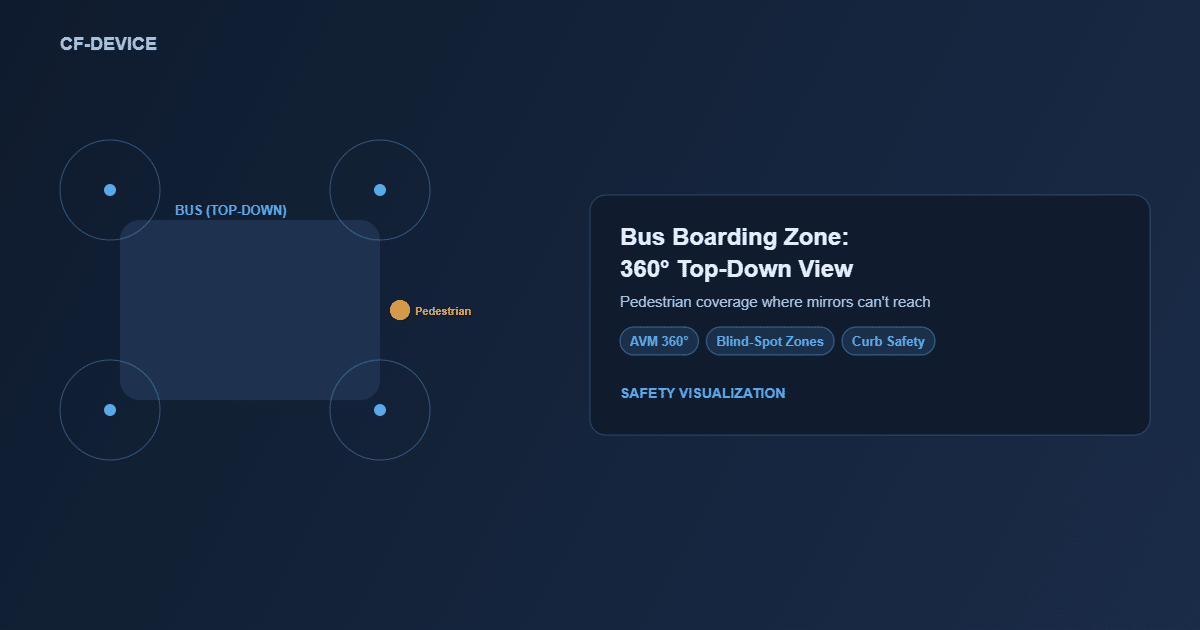
Buses and transit vehicles have some of the largest blind zones of any road vehicle — AVM 360° Surround View directly addresses pedestrian and cyclist safety risks around the vehicle’s sides and rear, a growing regulatory and safety focus in urban transit systems. An AVM 360 bus installation stitches several wide-angle cameras into one top-down view on the driver’s terminal. The highest-risk moments aren’t while the bus is moving at speed — they’re at stops, where pedestrians cross close to the vehicle in the exact zones a driver’s mirrors can’t fully cover. A stitched top-down view during boarding and departure closes that specific gap.
Fleet-Wide Data for Operators
4G/5G connectivity lets transit operators track vehicle location, schedule adherence, and driver behavior across an entire fleet from a central dashboard, supporting both operational efficiency and passenger-safety reporting requirements through the same MDM Remote Device Management layer used to keep every terminal updated and monitored. For a transit authority answering to riders and regulators, this data is also the record that demonstrates schedule performance and safety compliance after the fact — not just a real-time operations tool.
Built for Continuous Duty
Unlike a personal vehicle, transit and passenger fleets run near-continuous daily hours — the terminal needs rugged reliability and a stable operating system (Android or Debian-based Linux, depending on the model) that can run scheduling, ticketing, or passenger-information software without downtime. A terminal that needs a reboot mid-shift isn’t a minor inconvenience on a transit route — it means a driver losing DMS coverage, AVM visibility, or dispatch contact while still carrying passengers.
The Hardware Behind the Safety Software
DMS and AVM 360° are only as reliable as the terminal running them. A transit vehicle operating many hours a day, every day, puts continuous thermal and vibration stress on hardware that a seasonal agricultural or construction deployment never sees — which is why transit-grade terminals need the same IP65–IP67 sealing and MIL-STD-810 testing covered in our hardware durability guide, not a consumer tablet retrofitted into a dashboard mount. Wide-voltage DC input matters here too (the supply range depends on the model) — a transit vehicle’s electrical system cycles on and off dozens of times a day as the vehicle starts and stops along a route, and a terminal without proper voltage protection degrades faster under that cycling than one built for it. The VCM M10 is the model whose datasheet lists DMS, AVM 360° and forward collision warning together.
An Illustrative Deployment Example
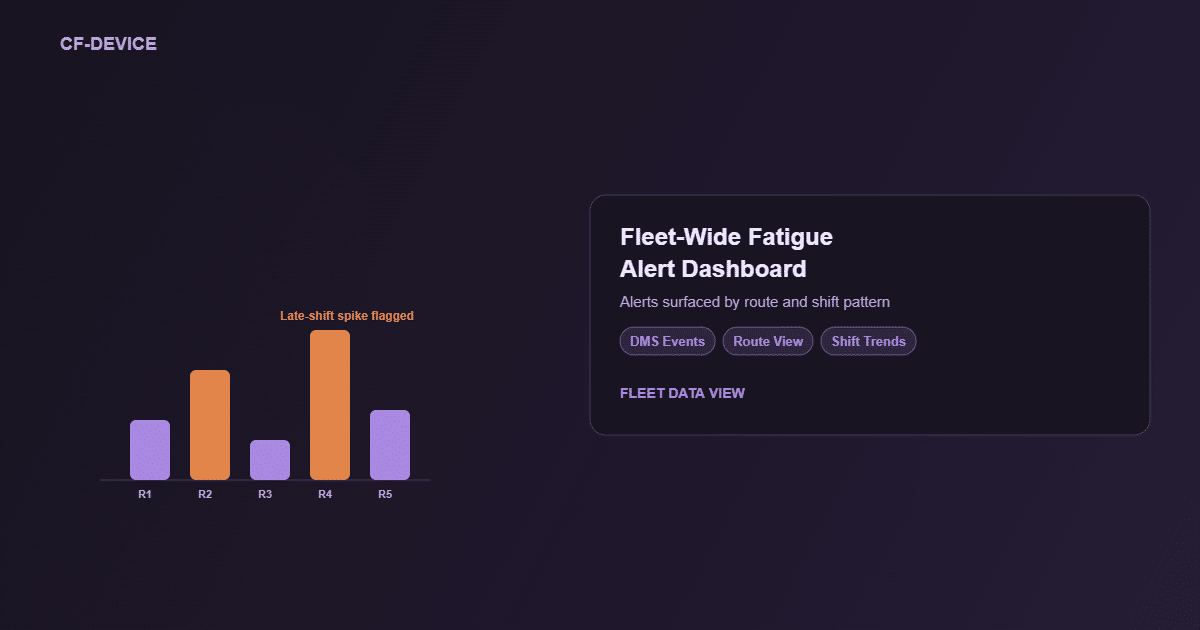
Picture a municipal transit authority running 60 buses across mixed urban and suburban routes, relying on separate dash-cam units for incident review and driver self-reporting for fatigue. After equipping the fleet with terminals running DMS and AVM 360° together, safety staff could see fatigue-alert frequency by route and shift pattern — surfacing that late-evening shifts on one specific route generated disproportionately more alerts, prompting a schedule adjustment before an incident occurred rather than after.
Why This Category Is Growing
As cities and transit authorities push for measurable safety improvements, the vehicle terminal has moved from a dispatch convenience to core safety infrastructure — the same integration approach covered in One Tablet, Four Systems. Regulatory pressure is increasingly pushing DMS and surround-view from “nice to have” to a documented, auditable safety program — one that only works if the underlying hardware runs reliably enough to generate a complete record, not intermittent gaps.
Common Questions
Is DMS required by regulation for transit fleets, or is it optional?
Requirements vary by region and operator, but it’s increasingly expected as a safety-reporting standard even where not strictly mandated by law.
Can AVM 360° and DMS run simultaneously on one terminal?
They are designed to cover in-cab driver safety and exterior perimeter awareness together. How many functions run at once depends on the model and configuration, and the VCM M10 is the model whose datasheet lists both.
What makes a terminal suitable for continuous multi-shift transit duty?
Sustained thermal management, rugged sealing (IP65–IP67 depending on model), and a stable OS platform that doesn’t require frequent reboots are the key differentiators from consumer-grade hardware.
Can the same terminal drive a passenger-facing information display?
On terminals with sufficient processing headroom, yes — though some operators prefer a separate passenger-facing screen to keep the driver’s display uncluttered.
Does a transit-grade terminal need different certification than a construction or agricultural one?
The baseline is the same across CF-Device’s range — sealing from IP65 to IP67 depending on model, tested to MIL-STD-810. What differs for transit is duty-cycle length and thermal load, not the sealing standard itself.
Which CF-Device model supports both DMS and AVM 360° for buses?
According to the spec sheets, the VCM M10 lists both DMS and CF AVM 360° (plus forward collision warning), with up to eight AHD camera inputs. Several other VCM models support AVM 360°; confirm DMS support for a specific model before specifying it.
The same pairing of surround view and driver monitoring applies inside the warehouse, where pedestrian detection and speed governance sit alongside it — set out in our smart warehousing guide.
Interested in specs or a quote? Contact our team to discuss transit fleet deployment.