

IP67 vs MIL-STD-810 is a comparison between two certifications that test entirely different kinds of stress, yet both are printed on nearly every rugged vehicle tablet datasheet. IP67 covers dust and temporary water immersion; MIL-STD-810 covers drop, vibration, shock and temperature. CF-Device publishes both ratings per model rather than as a blanket claim, and a tablet advertising both has been validated against failures a consumer tablet never encounters.
TL;DR
- IP67 certifies dust-tight sealing + temporary submersion (water/dust ingress)
- MIL-STD-810 certifies mechanical stress — vibration, shock, thermal cycling
- The two test different failure modes; a tablet needs both, not one
- CF-Device datasheets list third-party vibration and shock results, and 48-hour salt fog on listed models
- Always request the actual test reports, not just the printed rating
What IP67 Actually Certifies
The IP (Ingress Protection) rating is a two-digit code from the IEC 60529 standard: the first digit measures solid-particle protection (dust, sand, debris), the second measures liquid protection. IP67 means a device is fully dust-tight and can survive temporary submersion up to 1 meter of water for 30 minutes. For a tablet mounted in an open-cab tractor, excavator, or forklift, this matters daily — engine bay dust, monsoon rain through an open cab window, or a pressure-washer pass during equipment cleaning are all IP67 use cases, not edge cases.
CF-Device’s VCM series is rated IP65–IP67 depending on model, meaning even the lower end of the range is fully sealed against dust ingress and protected against water jets from any direction.
For a closer look at how these two ratings differ in real-world dust and water protection, see our comparison guide: IP65 vs IP67: What the Difference Really Means for Rugged Tablets.
What MIL-STD-810 Adds
Where IP67 stops at dust and water, MIL-STD-810 (a US military test standard, widely adopted across industrial electronics) adds mechanical and environmental stress testing: random vibration profiles that simulate an engine idling for hours, shock testing that simulates rough-terrain jolts, and thermal cycling that simulates a device going from a cold morning start-up to a hot afternoon under direct sun.
CF-Device rugged tablets are tested to MIL-STD-810, and the datasheets add measured results from third-party testing: vibration at 7.0 Grms (10–1000 Hz, three axes, eight hours each, unit powered) and shock at 50 g for 18 ms half-sine, five directions three times each. Salt fog matters for coastal, port and marine equipment, where corrosion, not just moisture, degrades connectors and housings over months of use; the 48-hour salt fog result is listed for specific models, covered in the table below.
What Each Standard Tests
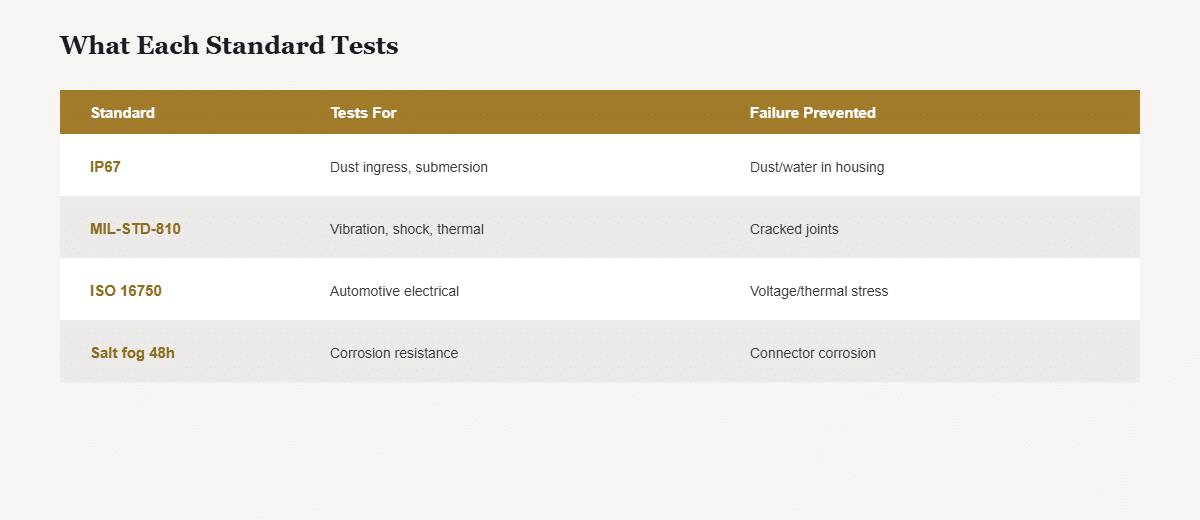
| Standard | Tests for | Real-world failure it prevents |
|---|---|---|
| IP67 | Dust ingress, submersion | Sealed housing lets in dust/water |
| MIL-STD-810 | Vibration, shock, thermal | Cracked joints from engine vibration |
| ISO 16750 | Automotive electrical/environmental | Voltage & thermal stress in vehicles |
| Salt fog (48h) | Corrosion resistance | Connector/housing corrosion at coast |
IP67 vs MIL-STD-810: Why Buyers Need Both
A device can pass IP67 and still fail in the field if it isn’t also vibration-rated — sealed housings can crack at weld points or connector joints under sustained engine vibration even if they never let in a drop of water. Buyers evaluating rugged tablets should ask for both certifications, not just one, and should confirm the operating temperature range (-30°C to +70°C is standard across CF-Device’s VCM line) matches the climate the equipment actually operates in.
This same combination of sealing and shock resistance is exactly what supports use cases like mining and port equipment, where the tablet lives on constantly vibrating machinery in dust, heat, and occasional wash-down conditions.
The Bottom Line
IP67 and MIL-STD-810 aren’t marketing badges — they’re the two tests that separate a rugged vehicle tablet from a consumer tablet in a rugged case. Fleet buyers comparing vendors should request the actual test reports, not just the printed rating, since third-party validation is the only way to confirm a device will survive its intended duty cycle. Where these certifications fit into the full hardware decision is laid out in our rugged vehicle tablet hardware buyer’s guide, and how the same baseline applies whether the terminal is deployed on a bus, a fire apparatus or a utility truck is broken down in our mobile data terminal by sector guide.
How Do the Sealing Ratings Differ Across CF-Device Models?
The ingress rating is set per model, not for the whole range. Check the datasheet of the model you are specifying:
| Model | Sealing | 48-hour salt fog result |
|---|---|---|
| VCM M10 | IP65 | Listed |
| VCM V12 PRO | IP67 | Listed |
| VCM V12-2 | IP67 | Listed |
| VCM V10-2 | IP67 | Listed |
| VCM V7-2 | IP65 standard; IP67 available as a custom option | Listed |
| VCM V7A-2 | IP65 standard; IP67 available as a custom option | Listed |
| VCM S10-2 PRO | IP65 | Listed |
| VCM S10-2 PLUS | IP65 | Listed |
| VCM S10-2 | IP65 | Confirm with CF-Device |
| VCM V12 | IP65 | Confirm with CF-Device |
| VCM V10 PRO | IP65 | Confirm with CF-Device |
| VCM V8 PRO | IP65 | Confirm with CF-Device |
| VCM V7 PRO | IP65 | Confirm with CF-Device |
| VCM S7 | IP65 | Confirm with CF-Device |
| TANK V2 | IP65 | Confirm with CF-Device |
Vibration and shock results are third-party measured and listed for every model above. For coastal or port duty, confirm the salt fog result with CF-Device for any model marked accordingly before you specify it.
Other Names for the Same Question
An IP67 tablet or IP67 rugged tablet is sealed against immersion, while a MIL-STD-810 tablet has been tested for shock and vibration. Both feed into overall rugged tablet durability, and industrial tablet vibration resistance is the part that decides life in a vehicle.
Which Guide Should I Read Next?
This guide belongs to the rugged vehicle tablet hardware guide.
| If your question is… | Read |
|---|---|
| IP65 or IP67 for my environment? | IP65 vs IP67 rating guide |
| Which of the four tablet types do I need? | Rugged industrial tablet: the four types |
| Full hardware specification sequence | Rugged vehicle tablet buyer’s guide, 10-inch hardware hub |
| Where durability matters most | Mining: rugged terminals for the harshest environment |
| The whole category in one guide | Rugged Vehicle Tablet Complete Guide |
Common Questions
Is IP67 always better than IP65 for vehicle tablets?
Not necessarily — IP65 is fully dust-tight and jet-resistant, sufficient for most enclosed-cab road use; IP67 adds submersion protection that matters for open-cab, wash-down, or flood-prone environments.
Does MIL-STD-810 certification guarantee a tablet won’t break?
No — it validates against defined test profiles; real-world duty can exceed them, which is why matching the rating to your actual vibration/temperature conditions matters.
What temperature range should I require?
-30°C to +70°C covers most global climates including cold-start mornings and direct-sun afternoons; confirm against your specific deployment region.
Why does salt fog testing matter if my fleet isn’t marine?
Coastal, port, and even road-salt winter environments cause connector corrosion over months — salt fog validation predicts multi-year durability in those conditions.
Certification tells you what a unit survives; it does not tell you which unit to buy. Matching the rating to the environment — and the environment to one of the four device types — is covered in rugged industrial tablet: which of the four types you actually need.
Interested in specs or a quote? Contact our team to discuss durability requirements for your deployment.