

CF-Device builds the layer everything else depends on, and it is worth stating plainly: fleet management platforms are only as good as the data feeding them — and that data originates at the vehicle terminal. For fleet managers, the terminal is the single point where location, driver behavior, vehicle health, and communication all converge.
TL;DR
- GNSS, CAN-bus diagnostics, DMS, and 4G/5G communication converge on one terminal
- Consolidating hardware cuts three vendor relationships and failure points down to one
- MDM compatibility is what separates a fleet-ready terminal from a one-off installation
- Wide-voltage input, ignition detection, and IP65+ protection let hardware survive years, not one season
What Data Does a Fleet Terminal Collect?
- GNSS tracking: real-time vehicle location for route monitoring and dispatch
- Vehicle diagnostics: CAN-bus integration surfaces engine and system data that flags maintenance needs early
- Driver behavior: DMS monitoring adds a safety layer that pure GPS tracking can’t provide
- Communication: 4G/5G connectivity keeps dispatch and drivers in constant contact, with dual-SIM options for regions with inconsistent coverage
- This same consolidated approach extends to public-sector fleets — see how it applies to municipal waste collection and public works vehicle tracking.
What Hardware Does One Terminal Replace?
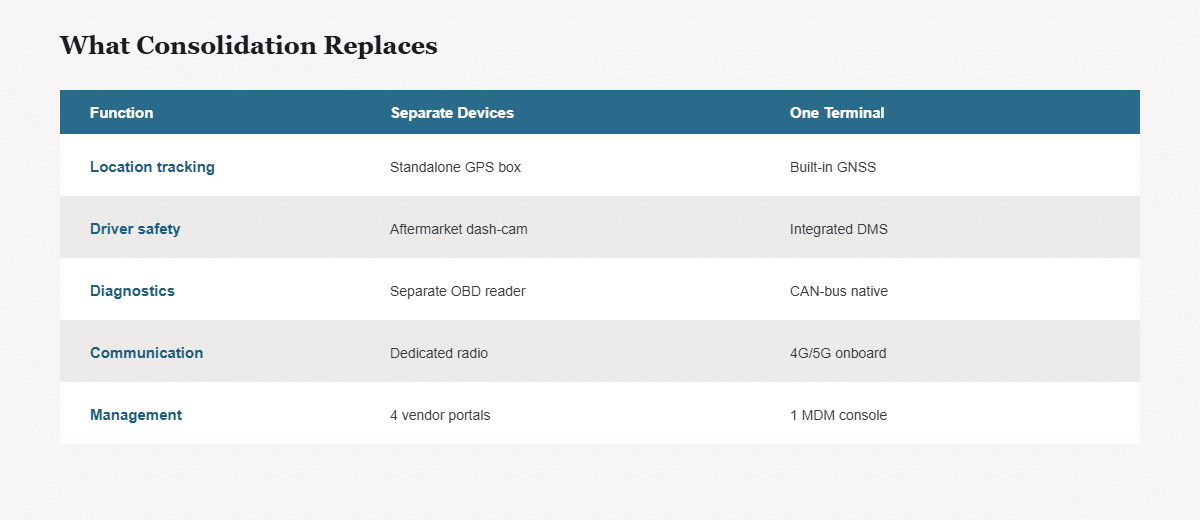
| Function | Separate-device approach | One-terminal approach |
|---|---|---|
| Location tracking | Standalone GPS box | Built-in GNSS |
| Driver safety | Aftermarket dash-cam | Integrated DMS |
| Diagnostics | Separate OBD reader | CAN-bus native |
| Communication | Dedicated radio/modem | 4G/5G onboard |
| Management | 4 vendor portals | 1 MDM console |
Why Consolidate Fleet Hardware Onto One Terminal?
Fleets that run separate hardware for tracking, dash-cam recording, and driver communication end up managing three vendor relationships and three points of failure instead of one. A single rugged vehicle-mount terminal that handles all three functions simplifies both procurement and maintenance — fewer devices to install, power, and service across every vehicle.
How Do You Manage a Fleet of Terminals at Scale?
MDM (Mobile Device Management) compatibility is what separates a fleet-ready terminal from a one-off installation — it lets IT teams push configuration changes, monitor device health, and manage software updates across dozens or hundreds of vehicles from a central console, without a technician visiting each one. For more on how MDM works alongside DMS, AVM, and ISOBUS VT on the same device, see One Tablet, Four Systems.
Can I Use a Consumer Tablet for Fleet Management?
Consumer tablets retrofitted into vehicle mounts fail faster under vibration, temperature swings, and inconsistent power than hardware designed for vehicle installation from the start. Wide-voltage input (5-36V DC), ignition detection, and IP65+ protection are what let a terminal survive years of fleet duty rather than a single season. The hardware side of that decision — which durability and power specs to require — is covered in our rugged vehicle tablet hardware buyer’s guide, and this same terminal role recurs across the full range of deployments in our top use cases for rugged vehicle tablets in 2026. Business owners evaluating hardware for the first time should also see our best tablet for business owners buying guide. For how fleet management sits alongside precision agriculture and business-vehicle deployment as one connected field, see our applications hub.
What Is a Fleet Management System, Exactly?
CF-Device separates this into two layers, because the term is used for both and the distinction decides what you actually buy. A fleet management system is the software — the dashboard where routes, driver hours, fuel, maintenance schedules and compliance records live. A fleet terminal is the hardware in the cab that produces the data those dashboards run on.
Buyers searching for a fleet management system usually find software vendors, then discover the software needs a device in every vehicle that the vendor does not make. CF-Device builds that device layer: 140,000+ terminals shipped annually into 33 countries, rated IP65–IP67, tested to MIL-STD-810, running on 5–36V DC with ignition sense. Which software platforms those terminals run cleanly on is set out in rugged tablets compatible with fleet management platforms.
What Is the Difference Between a Fleet Terminal and a GPS Tracker?
A GPS tracker reports position. A fleet terminal reports position and reads the vehicle, shows the driver something, and takes input back. The practical difference shows up in what each one can tell you when something goes wrong:
| Standalone GPS tracker | Fleet terminal | |
|---|---|---|
| Location | Yes | Yes, GPS/BDS/GLONASS |
| Engine data | No, or via separate OBD dongle | Native CAN bus, J1939 |
| Driver interaction | None — no screen | Dispatch, navigation, job status |
| Driver monitoring | No | Integrated DMS camera |
| Remote management | Firmware only, if any | Full MDM: config, OTA, diagnostics |
| Install | Hidden box, no sightline needed | Mounted in cab, sightline matters |
A tracker is the right answer for trailers, containers and unpowered assets. A terminal is the right answer wherever there is a driver whose work the fleet needs to direct. The tracker-side decision is covered in GPS tracking devices for fleet vehicles and dispatch.
How Do I Choose a Fleet Terminal?
CF-Device works through it in this order, because deciding on price or screen size first is what produces a unit that will not clear a mirror or turns out to be one CAN channel short:
- Power — wide-voltage DC input covering the vehicle’s system, with ignition-sense behaviour defined
- Interfaces — count the CAN channels, serial ports and camera inputs the job actually needs
- Sealing and temperature — IP65 for enclosed cabs, IP67 where washdown or standing water is possible
- Mount and sightline — measured against the cab, with the bracket rated to the same vibration standard as the terminal
- Connectivity — native cellular, dual-SIM where routes cross carrier coverage boundaries
- Management layer — how the fleet updates and audits the units once deployed
Item six is the one fleets discover late: eighty terminals cannot be updated by visiting each cab. Standardising on one platform — one mount, one power specification, one OS image — is what makes remote management possible at all. Specific models compared across road fleets are in the best tablets for truck drivers.
Common Questions
Does consolidating hardware onto one terminal create a single point of failure risk?
It shifts the risk profile rather than eliminating it — but one well-supported rugged terminal with MDM monitoring is typically more reliable and easier to service than three separate lower-grade devices.
Is MDM only useful for very large fleets?
No — even fleets of 10-20 vehicles benefit from remote configuration and health monitoring, avoiding unnecessary technician dispatches.
What’s the risk of using a consumer tablet in a vehicle mount instead of a purpose-built terminal?
Vibration, temperature swings, and inconsistent vehicle power shorten consumer hardware lifespan significantly — wide-voltage input and IP65+ sealing are specifically engineered to prevent this failure mode.
How many vehicles before a fleet needs a formal management platform?
There’s no hard threshold, but manual tracking usually becomes impractical between 20–50 vehicles depending on route complexity.
Can one terminal serve a mixed fleet of trucks, vans and heavy equipment?
One platform can; one screen size usually cannot. CF-Device’s approach is to qualify the platform against the harshest vehicle in the fleet, then fit the appropriate size per cab — 7″ for day cabs and compact machines, 10.1″ as the fleet standard, 12.1″ where multi-camera or implement control is involved. Mount, power specification and management console stay identical across all three.
Which CF-Device models are used for fleet management?
The VCM S10-2 (10.1″) as the common fleet standard, the VCM V10-2 for dual-SIM routes crossing carrier boundaries, the VCM V7-2 (7″) for compact cabs, and TANK V2 where the cab has no panel space and the compute unit must sit separately from the display. All accept 5–36V DC with ignition sense and operate from −30°C to +70°C.
Interested in specs or a quote? Contact our team to discuss terminals for your fleet.