

CF-Device builds the layer most buyers evaluate last, which is why fleet vehicle GPS tracking systems are usually bought backwards. A fleet manager evaluates dashboards, picks the platform with the reports they like, and inherits whatever hardware that vendor happens to ship. Six months later the complaint is always about data quality — gaps in shift records, vehicles that appear stationary when they’re moving, alerts nobody trusts. Those are hardware and network problems, decided by a choice made at the dashboard stage. CF-Device builds the second and third layers of that stack: VCM terminals with multi-constellation GNSS, CAN bus, and local logging with sync-on-reconnect.
TL;DR
- A tracking system has four layers: satellite constellations, in-vehicle hardware, network transport, and the management platform
- Buyers evaluate the top layer (dashboard) and inherit the rest — which is backwards
- Data quality problems almost always originate in the hardware or network layer, not the software
- Local buffering during signal loss is the single most under-specified capability in the category
- CF-Device VCM terminals: GPS/BDS/GLONASS standard, optional cm-level RTK, native CAN bus, IP65–IP67, −30°C to +70°C
The Four Layers, Bottom to Top
Every fleet tracking system is built from the same four layers, whether or not the vendor presents it that way:
- Satellite constellations — GPS, BeiDou, GLONASS. Free, universal, not a differentiator between vendors
- In-vehicle hardware — the receiver, processor, and interfaces that turn satellite signal into usable fleet data
- Network transport — how that data reaches the platform, and what happens when it can’t
- Management platform — reports, alerts, dashboards, integrations
In short: the top layer is what buyers compare, the middle two layers are what determines whether the top layer shows anything useful.
Layer One Is Not a Differentiator
Vendors sometimes market satellite coverage as a feature. It isn’t — the constellations are public infrastructure available to any receiver. What varies is the receiver: how many constellations it listens to simultaneously, and what correction method it supports. A single-constellation receiver struggles in urban canyons and deep pits where fewer satellites are visible; a multi-constellation receiver holds a fix in the same place. CF-Device fits GPS, BeiDou and GLONASS reception as standard across the VCM range for this reason. The accuracy tiers this produces are broken down in our GNSS positioning guide, and which machine class needs which tier in GPS for heavy equipment.
Layer Two Decides What the Other Layers Can Do
The in-vehicle unit sets a ceiling on the whole system. A basic tracker reports position and ignition state — so a platform sitting on top of it can only ever show position and ignition state, no matter how sophisticated its reporting engine is. A CF-Device VCM terminal reading CAN bus reports engine hours, fault codes, fuel data, and implement activity alongside position, which means the same platform can now produce maintenance forecasting and utilisation analysis. The platform didn’t change; the data available to it did. The hardware-selection tradeoff here is covered in fleet GPS tracking hardware: terminals vs aftermarket trackers.
The Layer That Fails Quietly: Network
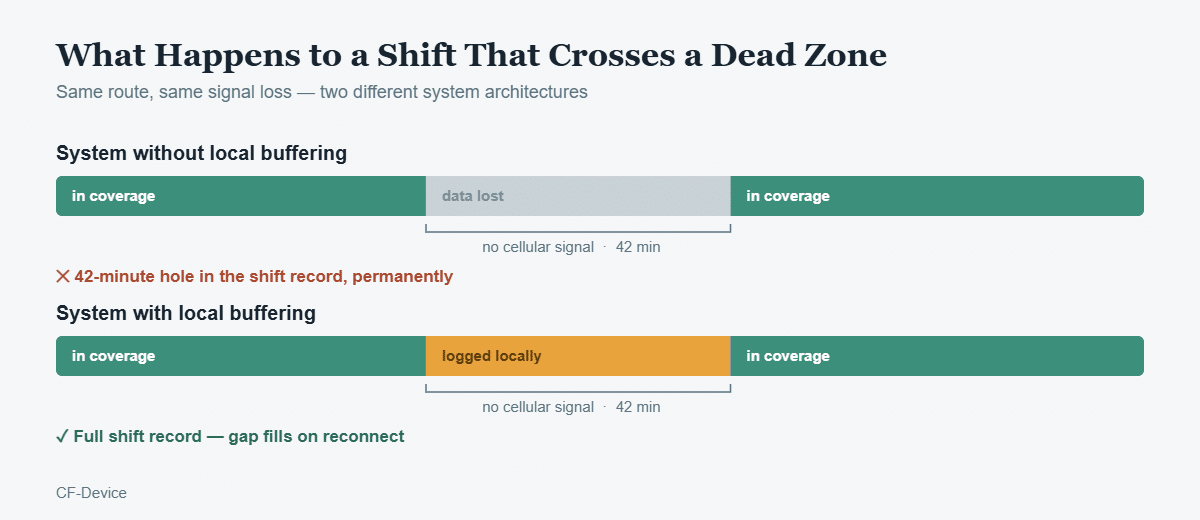
Network is where most tracking deployments quietly lose data, and where almost no procurement document asks a question. Every fleet crosses areas without cellular coverage — tunnels, rural routes, quarry pits, underground loading bays. The question that matters is what the in-vehicle unit does during that window. A system that streams only live data has a permanent hole in the record. A system that logs locally and uploads the backlog on reconnect has a complete record with a delay. Both look identical on a feature comparison sheet; only one produces defensible shift records.
This matters beyond tidiness. Utilisation reports, driver-hours compliance, and billing built on route data all become disputable the moment there are unexplained gaps in the timeline. In mining and quarry operations, where dead zones are the norm rather than the exception, this single capability separates a usable system from a decorative one — a constraint covered in rugged vehicle terminals for mining.
Layer Four: What a Platform Can and Can’t Fix
A good platform makes existing data legible — clean reports, sensible alert thresholds, useful integrations with dispatch or ERP. What it cannot do is invent data the hardware never captured, or repair gaps the network layer dropped. This is why platform-first buying goes wrong: the software demo looks excellent because it’s running on the vendor’s clean demonstration dataset, not on the sparse, gap-ridden feed your actual hardware and routes will produce.
Does GPS positioning itself stop working without cellular signal?
No — positioning and cellular are independent systems. The device still knows exactly where it is from satellite signal alone; the only question is whether it can store that record until transmission is possible again. CF-Device VCM terminals log locally and backfill on reconnect, which is what turns a 40-minute quarry-pit dead zone from a permanent gap into a delayed upload. This is the single capability most often missing from basic trackers, and the reason the same shift produces a defensible record on one system and an unexplained blank on another.
A Deployment Example
A regional aggregates hauler ran 60 trucks on a well-reviewed tracking platform and could never reconcile driver-reported hours against system records. The platform was working correctly. The trucks spent 30-50 minutes per shift inside quarry pits with no cellular signal, and the trackers simply stopped reporting for that period — which the platform rendered as “stationary,” not “unknown.” Replacing the trackers with terminals that buffered locally and backfilled on exit resolved a problem that had been blamed on the software for two years.
Evaluating a System, Bottom-Up
| Layer | Question to ask |
|---|---|
| Receiver | How many constellations, and what accuracy tier? |
| Hardware | Does it read CAN bus, or only position and ignition? |
| Network | What happens to data during signal loss — buffered or lost? |
| Platform | Does it distinguish “no data” from “stationary”? |
| Whole system | Can hardware be replaced without abandoning the platform? |
That last row deserves attention. A system where the platform only accepts one vendor’s hardware means a hardware limitation becomes a full system migration to fix. How location data feeds day-to-day dispatch decisions once these layers are sound is covered in GPS tracking device for fleet vehicles, and the wider operational picture in our fleet management terminal guide.
Where Device Management Fits
Once a fleet passes a few dozen vehicles, a fifth concern appears alongside the four layers: keeping the in-vehicle units themselves configured, updated, and accounted for. A tracking platform monitors vehicles; it doesn’t manage the hardware doing the tracking. CF-Device provides that layer as its own MDM platform, built in-house alongside the terminals — covered in MDM devices: what fleet hardware a platform actually manages.
Common Questions
Can I keep my current tracking platform and change only the hardware?
If the platform accepts standard telematics protocols, yes — this is worth confirming before committing, since closed systems turn a hardware upgrade into a full migration.
How much local storage does a tracking device need for buffering?
Position logs are small; a properly designed unit can hold days of records. The limitation is usually whether the firmware implements buffering at all, not storage capacity.
Is a tracking system worth it below 10 vehicles?
Often yes for routing and utilisation, but the four-layer evaluation matters less at that size — with few vehicles, gaps are noticed and corrected manually rather than compounding into unusable reports.
Which CF-Device models suit fleets crossing frequent dead zones?
Any VCM model logs locally and syncs on reconnect. For fleets where connectivity itself is the weak point, the VCM V10-2 adds dual-SIM dual-channel 4G so a second carrier takes over automatically when the first drops.
Interested in specs or a quote? Contact our team to discuss tracking hardware for your fleet.