

“Can you do OEM?” is one of the most common opening questions CF-Device receives as a rugged hardware manufacturer, and one of the least specific. It can mean printing a logo on a housing, or designing a new board around a different processor. Those are separated by roughly five months of lead time and two orders of magnitude in MOQ — so the useful conversation starts by naming which level you actually need. CF-Device handles all five levels in-house across the VCM range.
TL;DR
- Industrial tablet OEM work spans five distinct levels, from branding to full tooling
- Levels 1–2 (branding, software image) are fast and low-MOQ — most projects only need these
- Level 3 (I/O changes) is where most genuine integration requirements land
- Levels 4–5 (board revision, new housing) require volume to justify the engineering and tooling
- OEM and ODM are different engagements — the difference is who owns the design
- CF-Device runs in-house SMT, assembly, and dual Android 11.0 / Linux 5.10 OS builds, which is what makes all five levels available on one platform
OEM or ODM: Which Are You Actually Asking For?
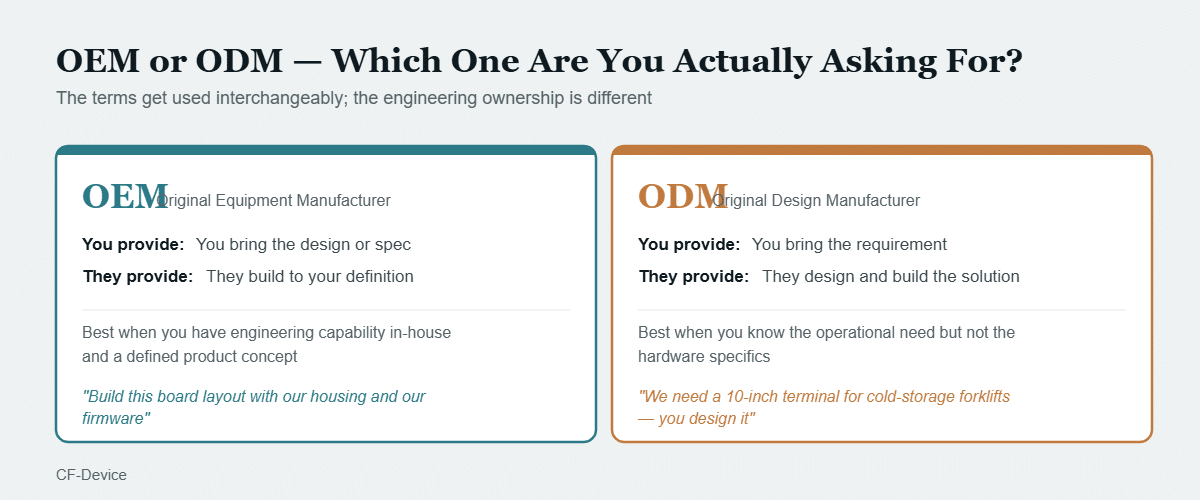
In short: OEM means you own the design and the manufacturer builds it; ODM means the manufacturer designs it to your requirement.
Most enquiries that say “OEM” are actually describing an ODM project — the buyer knows the operational problem (a terminal that survives cold storage, a display that fits a specific cab) but doesn’t have a board layout in hand. That’s not a problem; it just changes who carries the engineering work, and therefore how the project is quoted.
Level 1: Branding
Logo on the housing, custom boot screen, branded packaging and documentation. No engineering change to the product itself, which is why this level carries the lowest MOQ and the shortest lead time of any customisation. For a systems integrator reselling terminals as part of a larger solution, this is often the only level needed — the hardware is already right, it just shouldn’t arrive with someone else’s brand on it.
Level 2: Software Image
The terminal ships with your application pre-installed, a kiosk profile already applied, and the OS configured to your specification — so the installer’s job is mounting and wiring, not software setup. Across a 200-unit rollout this eliminates a meaningful amount of field labour, and it removes the variance that comes from configuring devices individually. CF-Device maintains its own Android and Linux builds, which is what allows an image to be modified rather than merely installed.
This level pairs directly with fleet-wide management: a pre-imaged unit that self-enrols on first power-on is the practical form of what our MDM solution guide describes as zero-touch provisioning, and the OS choice underneath it (Android or embedded Linux) is covered in our dual Android/Linux architecture guide.
Level 3: I/O Configuration
This is where the majority of genuine industrial tablet ODM projects sit. An additional CAN channel, a second RS485 port, a different camera input combination, a specific connector type to match existing vehicle harnesses. The base platform stays the same; the interface set changes to match what the machine actually needs. CF-Device’s standard range already spans 2–4 SocketCAN channels and up to 6 AHD camera inputs, so this level often means selecting the right existing configuration rather than engineering a new one.
It’s worth scoping carefully, because interface requirements are usually driven by the vehicle network rather than by preference — a terminal that needs to read engine data and run an implement interface simultaneously has a hard requirement, not a wish list, as set out in our CAN bus and J1939 guide.
Level 4: Board Revision
A different SoC for more computing headroom, more memory, a specific cellular module for a regional carrier certification, a different GNSS receiver tier. This is real hardware engineering — schematic work, layout, validation testing — and the MOQ reflects that. It’s justified when the requirement genuinely can’t be met by any existing platform configuration, and not before.
Before committing to this level, it’s worth checking whether an existing platform already covers the requirement. Computing headroom in particular is often over-specified — CF-Device’s VCM M10 already carries a 6 TOPS NPU and the V12-2 provides 1T computing, which covers most on-device AI workloads without a board change. The practical ceiling is explained in our NPU and TOPS guide.
Level 5: Tooling and Housing
A new mould for a custom form factor — a non-standard screen size, an integrated mount, a housing designed to fit a specific equipment bay. Tooling is a fixed upfront cost regardless of order quantity, which is why this level requires the highest volume to make economic sense. It also carries the longest timeline, since a new housing has to be re-certified for ingress and shock protection rather than inheriting the existing model’s test results.
That re-certification point is often overlooked in early planning. A custom housing means new IP and MIL-STD testing, on the schedule and budget of the project — the standards involved are described in our IP67 and MIL-STD-810 durability guide.
How to Scope an OEM Enquiry Efficiently
| Tell the manufacturer | Why it matters |
|---|---|
| The operational problem, not just the spec | Often a lower level solves it than the buyer assumed |
| Target annual volume | Determines which levels are economically viable |
| Which vehicle/machine it mounts in | Drives I/O, power, and mounting requirements |
| Required certifications and markets | Regional radio certification can dictate the module choice |
| Your software stack and OS preference | Determines whether Level 2 is enough |
A Project Example
An equipment OEM approached a manufacturer asking for a fully custom terminal — new housing, new board, their own form factor. Scoping the actual requirement revealed the driver was two things: their software needed to be pre-installed and locked down, and the unit needed one more CAN channel than the standard configuration offered. That’s Level 2 plus Level 3 — roughly eight weeks and a moderate MOQ, rather than the six-month, high-volume tooling project they had budgeted for. The custom housing they had assumed necessary turned out to be solvable with a different mounting bracket.
Who You’re Dealing With Matters
None of these five levels is possible with a supplier that doesn’t own its production line and firmware — which is why verifying that upfront saves the most time on an OEM project. The specific checks are set out in rugged tablet manufacturers: how to tell a real maker from a reseller, and the five supplier tiers behind the wider industrial computing category in industrial PC manufacturers: five kinds of supplier.
Can I start with a standard unit and move to OEM later?
Yes, and it’s usually the sensible path — validating a standard configuration in the field first tells you which customisation levels are actually necessary rather than assumed. Because CF-Device’s VCM models share one platform family, mounting standard, and 5–36V DC power specification, moving from a standard unit to a Level 2 or Level 3 configuration later doesn’t require re-qualifying the installation.
Common Questions
What is the minimum order quantity for an OEM industrial tablet?
It depends entirely on the level — branding and software imaging carry low MOQs, while board revisions and new tooling require substantially higher volume to cover fixed engineering and mould costs.
Does a custom housing keep the original model’s IP rating?
No — ingress and shock ratings are specific to a tested enclosure, so a new housing requires new certification testing on its own schedule and budget.
Who owns the design in an ODM project?
Typically the manufacturer retains the design IP while granting the customer exclusivity terms — the specifics should be agreed in writing before engineering work begins.
How long does a typical Level 3 I/O change take?
Commonly six to ten weeks including validation, though it varies with how far the change deviates from existing tested configurations.
Which CF-Device models are available for OEM configuration?
The entire VCM range (7″, 8″, 10.1″, 12.1″) and TANK V2 — all with dual Android/Linux support, 2–4 CAN channels, and IP65–IP67 sealing as the baseline to customise from.
Have an OEM or ODM requirement to scope? Contact our team with your operational requirement and target volume.