

DMS driver monitoring watches the driver, not the road. CF-Device runs DMS on-device on the VCM M10, which carries a 6 TOPS NPU, rather than in the cloud, because most serious fleet incidents don’t happen because a vehicle failed — they happen because a driver’s attention did, seconds before something went wrong. A Driver Monitoring System (DMS) is built to catch that moment, not react after it.
TL;DR
- DMS uses in-cab camera + on-device AI to track eye closure, head position, gaze direction in real time
- Detects fatigue (prolonged eye closure, yawning, nodding) and distraction (phone use, looking away, smoking)
- Predictive, not reactive — intervenes before an incident, unlike a standard dash camera
- Must run on-device (not cloud round-trip) to avoid latency that defeats real-time alerting
- Integrated directly into the rugged vehicle-mount tablet, not a bolt-on camera system
How DMS Driver Monitoring Works
A DMS uses an in-cab camera and on-device AI processing to continuously track driver behavior in real time — eye closure duration, head position, gaze direction, and facial orientation. When the system detects patterns consistent with fatigue (prolonged eye closure, nodding) or distraction (looking away from the road, phone use, smoking), it triggers an immediate audible or visual alert to the driver, and can log or transmit the event to a fleet management platform.
What It Actually Detects
- Fatigue indicators: eye closure duration, blink rate, yawning
- Distraction indicators: phone use, looking away from the road, smoking
- Identity and behavior events: driver identification, seatbelt status (on select configurations)
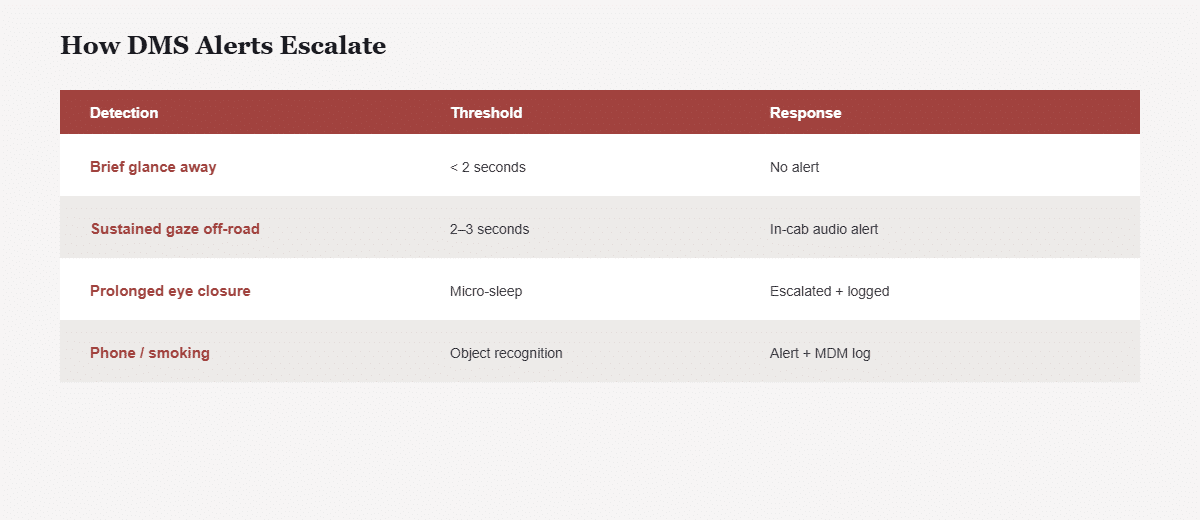
How DMS Alerts Escalate
| Detection | Threshold example | Response |
|---|---|---|
| Brief glance away | < 2 seconds | No alert (normal driving) |
| Sustained gaze off-road | 2–3 seconds | In-cab audio alert |
| Prolonged eye closure | Micro-sleep pattern | Escalated alert + event log |
| Phone/smoking detected | Object recognition | Alert + logged to MDM dashboard |
Calibrating against duration and pattern thresholds is what separates a useful DMS from one that cries wolf — an over-sensitive system trains drivers to ignore it.
Why This Matters More Than a Dash Cam
A standard dash camera records what happened — useful after the fact, but too late to prevent it. DMS is predictive: it intervenes at the moment risk is building, before it becomes an incident. For fleets with insurance requirements, driver-safety KPIs, or duty-of-care obligations, this shifts the safety program from reactive to preventive.
DMS Driver Detection System and Truck Driver Monitoring System
A DMS driver detection system is a camera-based driver monitoring system in three parts: a camera aimed at the driver’s face, an inference engine that classifies what it sees, and an alert output. CF-Device runs the inference on the terminal itself, on the 6 TOPS NPU in the VCM M10, so the detection loop does not wait for a server round trip. Nothing about that architecture is specific to one vehicle type; what changes from a car to a truck is the installation around it.
Truck driver monitoring system deployments differ in three practical ways. Duty cycles are long, so fatigue indicators matter more than distraction alone. Heavy-vehicle cabs run on 12V or 24V electrical systems, so the terminal needs a wide-voltage DC input with ignition sensing (the VCM M10 accepts 5–36V DC) to wake with the engine and shut down cleanly after it. And the cab is a vibration environment, which is why the VCM M10 is tested to MIL-STD-810 and rated IP65 and −30°C to +70°C rather than treated like office hardware. How trucks and trailers fit the wider fleet picture is covered in rugged terminals for logistics and transportation fleets.
Driver Behavior Monitoring System: Camera Data Plus Vehicle Data
A driver behavior monitoring system usually means two data sources read together. The camera answers what the driver is doing: eyes closing, head turned away, a phone in hand. The vehicle answers what the truck is doing: braking, speed, position. A DMS covers the first source. Because CF-Device’s VCM terminals also carry CAN bus and GNSS interfaces, the second source can reach the same device, so an alert can be matched to where and when it happened.
Driver Monitoring System Company: What to Ask a Supplier
When a driver monitoring system company is compared with a hardware maker, the question that separates them is who builds the terminal the DMS runs on. CF-Device does: Shenzhen CF Device Intelligent Technology Co., Ltd. was founded in 2018, ships 140,000+ units a year to 33 countries, and holds ISO 9001:2015 certification (certificate 00121Q310921R0S/4403). In CF-Device’s range, DMS is listed on the VCM M10; for any other model, confirm DMS support with our team before specifying it.
Camera-Based Driver Monitoring System: Four Checks Before You Specify
- Where the inference runs: on the terminal, or in a cloud service that needs a live connection
- Power: a wide-voltage input with ignition sense, matched to your 12V or 24V system
- Camera inputs: how many the terminal accepts — the VCM M10 takes up to eight AHD cameras at 720p or 1080p, so the driver camera does not use up a surround-view channel
- Event handling: whether the terminal logs event clips or continuous footage, and how events reach the fleet platform
Deployment Considerations
DMS processing needs to happen close to the camera — round-tripping video to the cloud for analysis introduces latency that defeats the purpose of a real-time alert. That’s why DMS is best implemented as an integrated function on the vehicle terminal itself, rather than a bolt-on camera system with no local processing power. In-cab alerting is also only the first of four intervention layers a safety programme needs — the review, coaching, and policy layers above it are set out in fleet safety monitoring: the four layers.
A Deployment Example
A regional coach operator running 40 vehicles on multi-shift schedules deploys DMS across the fleet: overnight drivers generate the most fatigue-alert events, surfaced automatically in one dashboard. Rather than reviewing footage after an incident, the safety manager sees fatigue patterns by route and shift, and adjusts scheduling before an incident occurs — the preventive shift DMS is built for.
How CFDevice Supports DMS
CFDevice’s rugged vehicle-mount tablets provide the on-device computing power and camera-input interfaces needed to run DMS functionality directly at the vehicle (DMS is listed on the VCM M10; confirm other models before specifying), without depending on a live network connection for basic alerting to function. DMS is one of four integrated systems — alongside MDM, AVM 360°, and ISOBUS VT — that come together on a single terminal, as covered in One Tablet, Four Systems. Within fleet operations, DMS is one layer of the broader data picture covered in fleet management: one terminal, full operational visibility. It’s especially relevant in public transit and passenger safety deployments, where continuous multi-shift operation raises fatigue risk.
Other Names for the Same System
Searches for dms driver monitoring, dms monitoring, driver monitoring system dms, dms driver monitoring system and driver fatigue monitoring all describe the camera-based system covered above: a driver-facing camera, on-device inference and a graded alert.
Which Guide Should I Read Next?
This guide belongs to the software hub and sits alongside the other systems in One Tablet, Four Systems. Pick the next one by the question you still have open:
| If your question is… | Read |
|---|---|
| What does the camera system outside the cab do? | AVM 360° surround view |
| What compute does on-device AI need? | 6 TOPS NPU explained |
| Passenger fleets | Smart transportation: DMS and AVM |
| Forklifts and warehouses | Forklift safety system |
Common Questions
Does DMS require constant internet connectivity to function?
No — core detection and alerting run on-device via local AI processing; connectivity is only needed to transmit logged events to a fleet management platform, not for the safety alert itself.
Can DMS distinguish between brief, normal eye movement and actual distraction?
Yes — DMS algorithms are calibrated against duration and pattern thresholds (e.g., sustained eye closure vs. a normal blink) to avoid false positives from routine driving behavior.
Is DMS only useful for long-haul trucking?
No — any fleet with duty-of-care obligations or safety KPIs benefits, including public transit, delivery, and utility fleets with shorter but frequent shifts.
Does DMS record video continuously, or only on events?
Configuration-dependent — most deployments log event clips (fatigue/distraction moments) rather than continuous footage, reducing storage and bandwidth while preserving the safety-relevant record.
What is a driver monitoring system, in one sentence?
A driver monitoring system is an in-cab camera and inference system that watches the driver rather than the road, and raises a graded alert when eye closure, head position or phone use crosses a threshold. CF-Device runs DMS on-device on VCM terminals carrying a 6 TOPS NPU, so detection continues through a cellular dead zone rather than waiting on a server.
Interested in specs or a quote? Contact our team to discuss DMS-capable terminals for your fleet.