

A mobile data terminal (MDT) is a vehicle-mounted computer that sends position, machine data and job status to a dispatch system and receives assignments back. CF-Device builds MDTs as the VCM range, and this comparison is deliberately wider than our own catalogue: ten units that transit, logistics, utility and agricultural fleets actually fit, with specifications taken from manufacturer datasheets and distributor listings reviewed in October 2026. Confirm any figure against the current datasheet before ordering, because vendors revise models.
TL;DR
- CF-Device’s VCM terminals are rated IP65–IP67 and operate from −30°C to +70°C, with 5–36V DC input on the VCM S10-2 and V7-2 (9–36V on the V10-2) and native J1939 CAN
- Three different product classes are sold as MDTs: purpose-built vehicle terminals, rugged tablets or convertibles used with a dock, and navigation-led tablets — the class decides power input, mounting and service model
- Zebra’s VC8300 is the strongest fit where a high-voltage forklift supply or a gloved keyboard matters: 10–60 VDC input, IP66 sealing, integrated QWERTY on the 8″ model
- Panasonic, Getac and Durabook lead on battery-powered, fully rugged Windows devices that leave the vehicle with the operator
- Trimble’s TMX-2050 is built around agricultural guidance; Rand McNally’s TND is a trucker navigation tablet rather than a fleet terminal
- Choose on class first, then power, mount and service coverage — unit price last
What Is a Mobile Data Terminal?
An MDT is the interactive end of a fleet’s data network: the driver or operator reads jobs, navigates, fills in forms and acknowledges messages on it, while it reports the vehicle’s position and bus data upstream. That two-way role is what separates it from a hidden GPS box, a distinction set out in fleet tracking hardware: GPS trackers vs vehicle terminals, and the category itself is explained in what a mobile data terminal is and why fleets rely on them.
Which Mobile Data Terminals Are on This List?
- CF-Device VCM S10-2
- Zebra VC8300
- Getac V110
- Panasonic Toughbook G2 (FZ-G2)
- Trimble TMX-2050
- CF-Device VCM V10-2
- Winmate M101 series
- Rand McNally TND Tablet 1050
- Durabook R11
- CF-Device VCM V7-2
Why Does the Product Class Matter More Than the Brand?
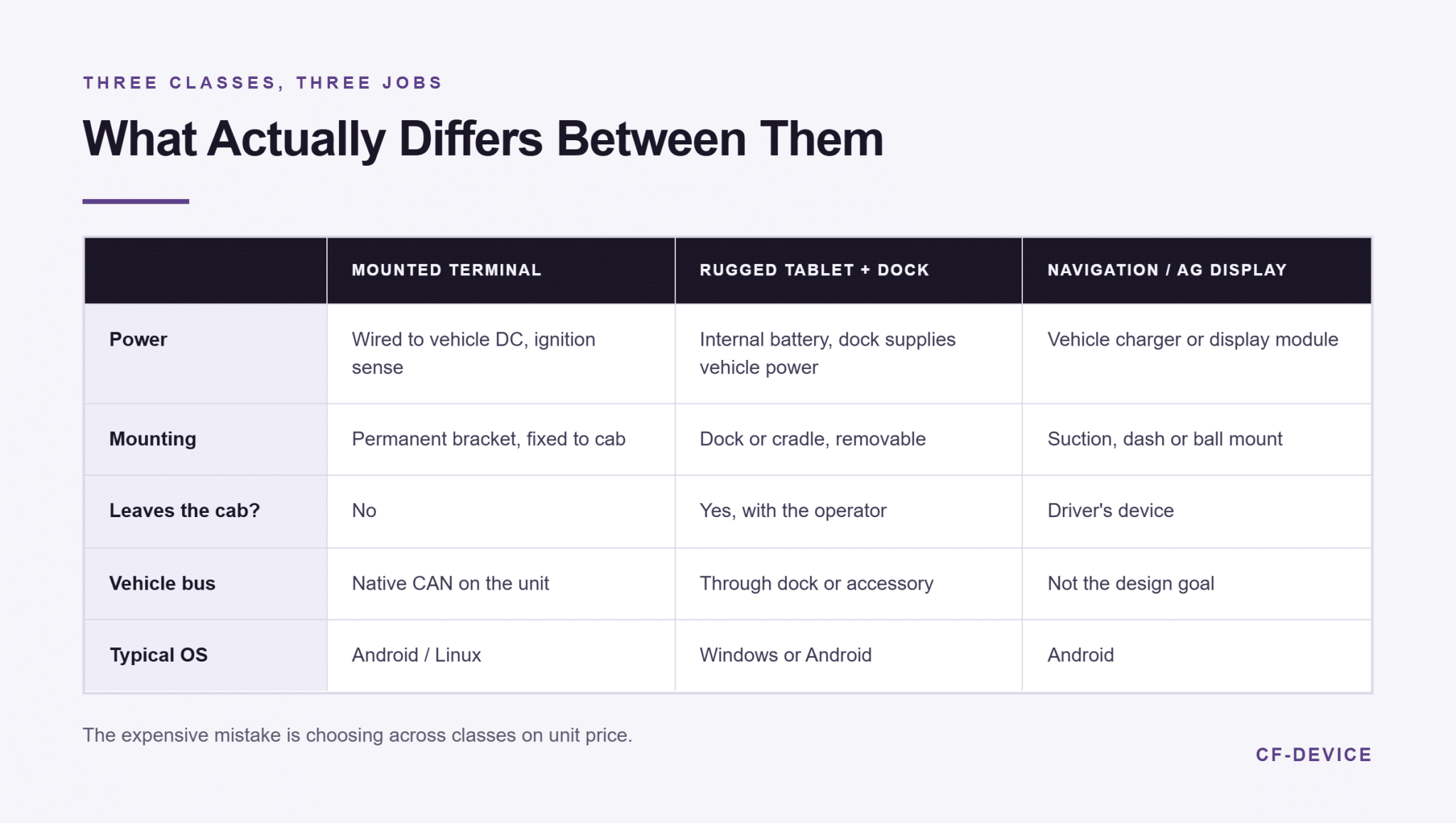
Fleets comparing these ten are comparing three different things. A mounted vehicle terminal is wired to the vehicle’s DC supply, fixed in the cab and reads the vehicle bus directly. A rugged tablet or convertible runs on its own battery, docks in the vehicle and leaves with the operator. A navigation or agricultural display is built around one job — routing a truck, or guiding a tractor. Each is correct for some fleets and wrong for others, and the mistake is almost always choosing across classes on price.
1. CF-Device VCM S10-2
Category: Mounted vehicle terminal · Display: 10.1″, 1024×600, 750 cd/m²
The S10-2 is built around power and bus access rather than screen size. Input is 5–36V DC with ignition detection; one or two CAN channels carry J1939, CANopen and ISO15765; there are two RS232 ports, one RS485 port, and two or four camera inputs. Sealing is IP65, the operating range is −30°C to +70°C, and the 281×181×42 mm housing weighs 1.5 kg with RAM-mount holes reserved on the back.
Where it fits: a fleet standardising on one 10.1″ terminal across mixed vehicles in agriculture, construction and in-cab HMI work. Where it does not: anything the driver carries, or fleets already standardised on AHD cameras, since the S10-2 takes analogue (CVBS) camera inputs.
2. Zebra VC8300
Category: Mounted vehicle computer (warehouse) · Display: 8″ WXGA 1280×720, 1,000 nits
Zebra’s VC8300 spec page lists IP66 sealing, shock and vibration testing to IEC 60721-3-5M3 and MIL-STD-810F, a Qualcomm Snapdragon 660 octa-core processor at 2.2 GHz with 4 GB RAM and 32 GB flash, and an operating system upgradeable to Android 14. Power input is 10–60 VDC, isolated, with a UPS rated for at least 30 minutes over the full operating temperature range. The 8″ model has a capacitive Gorilla Glass touchscreen with an optional heater and a field-replaceable, backlit 67-key keyboard (QWERTY or AZERTY). The operating range is −30°C to +50°C, with freezer and condensing features including heated boards, a heated and vented UPS battery and heated connectors. It measures 276×238×90 mm and weighs 3.7 kg.
What it does well: warehouse and forklift work. The 10–60 VDC range covers higher-voltage electric forklift supplies, a physical keyboard is easier than a touchscreen in heavy gloves, the freezer and condensing features suit cold chain, and the surrounding scanning ecosystem is the deciding factor for fleets already running Zebra handhelds.
Where CF-Device differs: CF-Device’s VCM range is touchscreen-first rather than keyboard-equipped, and its supply range tops out at 36V DC, so higher-voltage forklifts are Zebra’s ground. In return, the VCM range adds native J1939 CAN for reading road and off-highway vehicles, and a wider −30°C to +70°C range for cabs that run hot.
3. Getac V110
Category: Fully rugged convertible · Display: 11.6″ 1920×1080, 800 nits (up to 1,000 on some configurations)
Getac certifies the V110 to MIL-STD-810H, MIL-STD-461G and IP65, with an operating range of −29°C to +63°C, hot-swappable batteries and e-Mark certification for vehicle use. It runs Windows 11 Pro on Intel Core processors, weighs 2.1 kg, and is available with 4G and GPS.
What it does well: field crews who need a full Windows computer that converts between laptop and tablet. Full Windows software compatibility is the real advantage, along with a large sunlight-readable screen.
Where CF-Device differs: the V110 is a battery-powered computer that docks in a vehicle, whereas VCM units take vehicle DC power directly with ignition sense and read the CAN bus natively. Where the application genuinely requires Windows, Getac is the better answer and CF-Device is not.
4. Panasonic Toughbook G2 (FZ-G2)
Category: Fully rugged tablet · Display: 10.1″ WUXGA 1920×1200, up to 1,000 cd/m²
Panasonic’s G2 spec sheet lists MIL-STD-810H, MIL-STD-461G and IP65, a 6-foot (about 183 cm) drop rating, a 10.1″ WUXGA display up to 1,000 nits with direct bonding, five touch modes including rain and glove, and Windows 11 Pro or Red Hat Enterprise Linux. The current Mk3 uses an Intel Core Ultra 5 vPro processor with an integrated NPU, weighs 2.9 lb (about 1.3 kg), quotes up to 14.5 hours of battery life, offers an optional bridge battery for one-minute hot swaps, and adds xPAK expansion options such as a barcode reader, second LAN and serial dongle. Warranty is three years, parts and labor.
What it does well: public-safety and field-service operations that value a long track record, an established service network and modular expansion options.
Where CF-Device differs: it is a handheld first and a vehicle device second, so power protection and bus access depend on the dock and accessories. CF-Device’s VCM units build wide-voltage input and CAN into the terminal itself.
5. Trimble TMX-2050
Category: Agricultural display · Display: 12.1″ Android-based capacitive touchscreen
Trimble documents the TMX-2050 with IP55 sealing, a magnesium housing, an operating range of 0°C to +65°C and a VESA 75 mounting pattern. It integrates a GNSS receiver and one camera input, accepts an optional ISOBUS Universal Terminal and Task Controller, and works with Trimble’s steering systems and FmX+ or Precision-IQ software.
What it does well: machines that already run Trimble autosteer. The integrated guidance, section control and steering ecosystem is the reason to choose it.
Where CF-Device differs: the TMX-2050 is a guidance display tied to one agronomy ecosystem, while VCM terminals are general-purpose: IP65–IP67, −30°C to +70°C and open CAN access for mixed fleets. How ISOBUS terminals work across brands is covered in what ISOBUS VT is and why it matters for mixed fleets.
6. CF-Device VCM V10-2
Category: Mounted vehicle terminal · Display: 10.1″, 1280×800, 750 cd/m² or brighter
The V10-2 adds dual-SIM, dual-channel 4G with dual-card protection to the 10.1″ platform, so a terminal crossing carrier coverage boundaries fails over instead of dropping records. It is sealed to IP67, carries two CAN channels as standard (a third is optional, sharing the RS485 line), supports AHD cameras at 720p or 1080p expandable to four, and runs on 9–36V DC with over-voltage, under-voltage and reverse-polarity protection. It is compatible with CF ISOBUS VT, and the TF card slot supports up to 1 TB.
Where it fits: long-haul and cross-border routes where connectivity continuity matters more than unit price. Where it does not: short-radius urban work on a single carrier, where the S10-2 covers the same job for less.
7. Winmate M101 series
Category: Rugged tablet family with dock · Display: 10.1″ 1920×1200, 800 nits, optically bonded
The M101 line spans several generations and operating systems, from Intel-based Windows models to the M101Q9 with a Qualcomm 6490 and Android 15. Winmate lists IP65 sealing, MIL-STD-810H on current models, an operating range of −20°C to +60°C, hot-swappable batteries and a 19-pin docking connector, with optional barcode, RFID or NFC readers.
What it does well: fleets that want one tablet family across Windows and Android deployments, plus optional data-collection modules such as barcode and RFID.
Where CF-Device differs: the M101 is a battery tablet with a dock, while the VCM range is wired to the vehicle with a 5–36V input, ignition sense and native CAN, and extends the cold limit to −30°C.
8. Rand McNally TND Tablet 1050
Category: Trucker navigation tablet · Display: 10″ Android touchscreen
Rand McNally sells the TND Tablet 1050 as an Android tablet and truck GPS in one. It routes by rig size, weight and cargo, and the company states it carries 33% more truck-specific road data than competing navigators. It has a Corning Gorilla Glass screen, a removable protective guard, a camera for inspection reports and receipts, Wi-Fi, and several mounting options including a powered magnetic mount. Its published specifications focus on navigation and the guard; we did not find an IP or MIL-STD-810 rating listed.
What it does well: owner-operators and small fleets that want truck-specific routing at a consumer price, with a device designed around driver feedback.
Where CF-Device differs: it is a driver’s navigation device, not a fleet terminal: no CAN bus access, no wide-voltage input, and no remote fleet management. Fleets that need those move to a mounted terminal, as set out in the best tablets for truck drivers.
9. Durabook R11
Category: Fully rugged tablet · Display: 11.6″ 1920×1080, up to 1,000 nits with the DynaVue option
Durabook certifies the R11 to MIL-STD-810H and MIL-STD-461F with IP66 sealing and an optional ANSI/UL 121201 Class I Division 2 rating. It operates from −20°C to +60°C, weighs about 1.2 kg at 20 mm thick, runs Windows 11 Pro on a 12th-generation Intel Core processor, offers up to 14 hours of battery life and is dockable. Durabook markets it to utility, public-safety and government users.
What it does well: utility and public-safety crews who want a thin, light Windows tablet with hazardous-location certification available.
Where CF-Device differs: like the other tablets in this class it is battery-first. The VCM range is designed for a permanent cab position with wide-voltage input and CAN built in, and runs Android and Linux rather than Windows.
10. CF-Device VCM V7-2
Category: Mounted vehicle terminal · Display: 7″, 1024×600, 750 cd/m²
The smallest unit in the range carries three CAN channels (two classic and one CAN FD), Gigabit Ethernet over an M12 X-code connector, up to two RS232 ports and one RS485 port, on a 5–36V DC input with ignition detection and over-voltage, under-voltage and reverse-polarity protection. It is IP65 as standard with IP67 available on request, and measures 200×134×32.5 mm at 0.69 kg.
Where it fits: day cabs and compact machines where a larger terminal would block a mirror sightline. Where it does not: multi-camera surround-view work, where the screen area genuinely limits what can be shown.
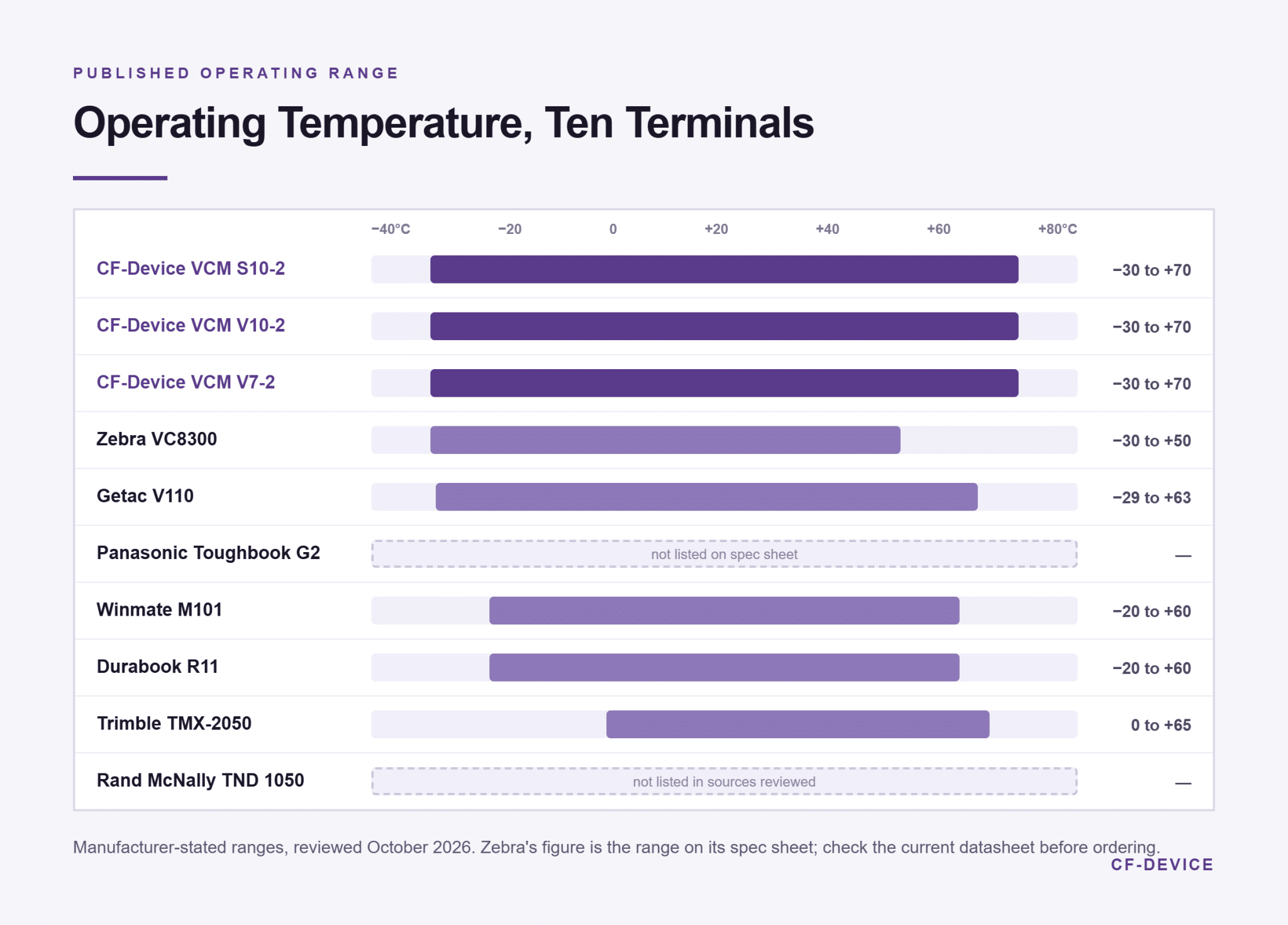
How Do the Ten Compare on Published Specifications?
| Model | Class | Display | IP rating | Operating temperature | Vehicle power |
|---|---|---|---|---|---|
| CF-Device VCM S10-2 | Mounted | 10.1″ | IP65 | −30°C to +70°C | 5–36V DC |
| Zebra VC8300 | Mounted | 8″ | IP66 | −30°C to +50°C | 10–60 VDC |
| Getac V110 | Convertible | 11.6″ | IP65 | −29°C to +63°C | Battery / AC adapter |
| Panasonic Toughbook G2 | Tablet + dock | 10.1″ | IP65 | Not listed on spec sheet | Battery; AC adapter |
| Trimble TMX-2050 | Ag display | 12.1″ | IP55 | 0°C to +65°C | Via Trimble module (see datasheet) |
| CF-Device VCM V10-2 | Mounted | 10.1″ | IP67 | −30°C to +70°C | 9–36V DC |
| Winmate M101 series | Tablet + dock | 10.1″ | IP65 | −20°C to +60°C | Battery, 19-pin dock |
| Rand McNally TND 1050 | Navigation | 10″ | Not listed | Not listed | Vehicle charger |
| Durabook R11 | Tablet + dock | 11.6″ | IP66 | −20°C to +60°C | Battery, dockable |
| CF-Device VCM V7-2 | Mounted | 7″ | IP65 (IP67 on request) | −30°C to +70°C | 5–36V DC |
Figures are as stated by each manufacturer in the sources reviewed; vendors revise models, so treat the table as a starting point and check the current datasheet. The IP-rating distinction behind the second column is explained in IP65 vs IP67.
How Should a Fleet Choose Between These Ten?
- Class — does the device stay wired in the cab, or leave with the operator? Everything below depends on this
- Power — the supply range must cover the vehicle, from 12V and 24V road vehicles to higher-voltage electric equipment
- Interfaces — count the CAN channels, serial ports and camera inputs the job needs; the protocol side is covered in CAN bus and J1939 integration
- Sealing and temperature — match the ratings to where the unit physically sits
- Mount and sightline — measured against the cab, with the bracket rated to the same vibration standard
- Service coverage — where a failed unit is repaired, and how long that takes in your market
- Unit price — last, once the above are fixed
Item six is where established brands have a real edge worth paying for: Zebra, Panasonic, Getac and Durabook typically operate regional service networks, whereas CF-Device handles warranty through RMA logistics with a defined parts-support window per platform. A local depot will usually turn a unit around faster. The full mounted-terminal sequence is in the truck computer in-cab terminal guide and the wider framework in the rugged vehicle tablet hardware buyer’s guide.
Which Class Fits Which Fleet?
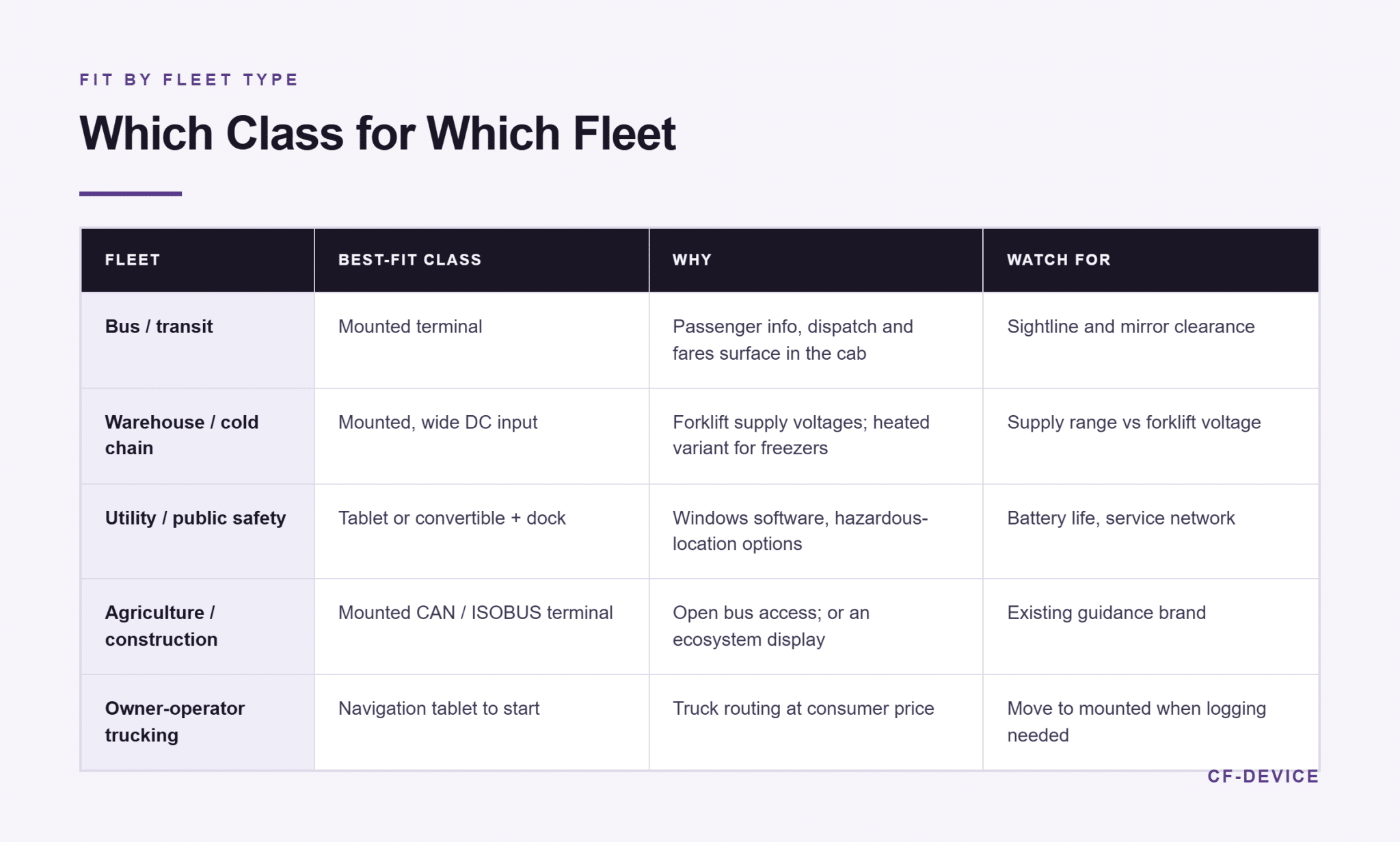
- Bus and transit — a mounted terminal, because passenger information, dispatch and fares all surface in the cab; the sector requirements are compared in mobile data terminals by sector
- Warehouse and cold chain — a mounted terminal with a wide DC input and, for freezers, a heated variant
- Utility and public-safety field crews — a rugged tablet or convertible with a dock, where Windows software and a hazardous-location option matter
- Agriculture and construction — a mounted terminal with CAN and ISOBUS access, or an ecosystem display if the machine already runs one
- Owner-operator trucking — a navigation tablet to start, moving to a mounted terminal once logging and fleet management are needed
Once units are deployed, a fleet of any size needs a way to update and audit them without visiting each vehicle, which is the job of the device layer described in MDM remote device management.
Frequently Asked Questions
Is a rugged tablet in a dock the same as a mobile data terminal?
Functionally it can do the same job, but the engineering differs. A tablet in a dock depends on the dock for vehicle power and bus connections and leaves with the operator; a dedicated MDT is wired into the vehicle and stays there.
Do drivers need a dedicated terminal if they already have phones?
A phone covers navigation. It does not give the fleet an owned record of position, engine data read from the bus, or connectivity that survives the driver’s phone battery dying or leaving the cab.
Which MDT has the widest vehicle power input?
Of the ten listed, Zebra’s VC8300 at 10–60 VDC. CF-Device’s VCM S10-2 and V7-2 accept 5–36V DC, and the V10-2 accepts 9–36V DC.
Which CF-Device models are used as mobile data terminals?
The VCM S10-2 (10.1″) as the general fleet standard, the VCM V10-2 for dual-SIM routes crossing carrier boundaries, and the VCM V7-2 (7″) for compact cabs. All are rated IP65–IP67 and operate from −30°C to +70°C.
Interested in specs or a quote? Contact our team to discuss mobile data terminals for your fleet.