
CF-Device builds the vehicle-mount end of fleet GPS tracking hardware, and the distinction matters: a basic aftermarket GPS tracker tells you where a vehicle is. A rugged vehicle-mount terminal with integrated GNSS does that too — while also running implement control, driver monitoring, and fleet communication from the same unit.
TL;DR
- Aftermarket trackers are cheaper per-unit but add a second device, wiring run, and vendor relationship
- Integrated terminals combine GPS tracking with CAN-bus diagnostics, DMS, and connectivity in one install
- Positioning accuracy ranges from meter-level GPS to centimeter-level RTK depending on application need
- Heavy equipment (excavators, cranes) benefits most from integrated high-precision positioning
- Total cost of ownership, not per-unit price, is the correct comparison basis
Why “Just a GPS Tracker” Often Isn’t the Full Answer
Fleet operators evaluating GPS tracking devices for vehicles often start with the cheapest aftermarket option — a small black-box tracker wired into the vehicle. This works for basic location logging, but it’s a single-purpose device: it doesn’t feed implement control, doesn’t run driver-safety monitoring, and doesn’t display anything to the operator. A rugged vehicle-mount terminal handles GPS tracking as one function among several, on hardware the operator already interacts with — and turns that location data into the kind of dispatch decisions covered in our GPS tracking device for fleet vehicles guide.
Fleet GPS Tracking Hardware: The Full Comparison
| Factor | Aftermarket Tracker | Integrated Terminal |
|---|---|---|
| Per-unit cost | Low | Higher |
| Devices per vehicle | +1 (added device) | 1 (consolidated) |
| Installation | Separate wiring run | Single install with display |
| Positioning tier | Usually meter-level only | Meter-level to cm-level RTK (RTK on selected models) |
| Driver-facing display | None | Built in |
| CAN-bus diagnostics | Rarely | Native CAN bus |
| DMS / safety monitoring | No | Available on selected models |
| Vendor relationships | Separate | One |
Positioning Accuracy Tiers
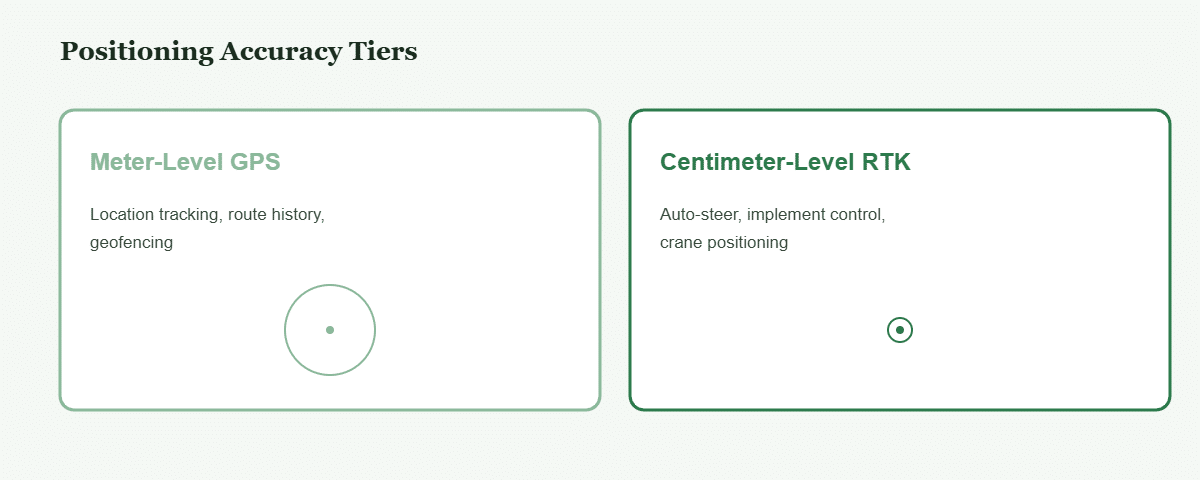
- Meter-level GPS: sufficient for basic location tracking, route history, geofencing
- Centimeter-level RTK GNSS: required for precision-guidance applications like auto-steer and implement positioning, detailed in our GNSS positioning guide
A delivery fleet tracking route adherence needs the first tier. An agricultural operation running auto-steer, or a yard placing containers, needs the second — and no aftermarket tracker provides it. Where this receiver choice sits within the wider system is mapped out in fleet vehicle GPS tracking systems: the four layers behind the dashboard.
Where Heavy Equipment GPS Tracking Differs
Heavy equipment GPS tracking — for excavators, cranes, and mining vehicles — has different requirements than passenger fleet tracking on three axes:
- Connectivity: equipment often operates in remote pits or underground zones with intermittent signal, requiring local logging with sync-on-reconnect rather than live-only reporting
- Precision: positioning frequently feeds into implement control — grading depth, crane placement — not just a dispatch map, as in port and yard operations
- Environment: vibration and dust levels that consumer-grade tracking hardware isn’t certified against
A Deployment Example
Consider a mixed construction fleet of 40 machines: 25 road-going trucks and 15 excavators/loaders. With aftermarket trackers, the operator installs 40 trackers, then still needs separate in-cab displays for the 15 machines running grade-assistance — 55 devices, two vendors, two data platforms. With integrated terminals, the same fleet runs 40 devices on one platform, with the 15 heavy machines using RTK-tier positioning on the same hardware family as the trucks’ meter-tier units — one procurement spec, one MDM console, one support contract.
Integrated vs. Standalone: The Real Tradeoff
An aftermarket tracker is a reasonable choice for a fleet that only needs location history. Once a fleet needs driver safety monitoring, implement control, or fleet-wide device management, an integrated terminal consolidates what would otherwise be 2-3 separate devices — the same consolidation logic covered in our broader fleet management overview. The location and diagnostic data this hardware generates is also exactly what MDM remote-management platforms consume to monitor fleet-wide device health — tracking hardware and device management are two halves of the same data pipeline.
Hardware Requirements Checklist
- Wide-voltage DC input (9-36V or wider) covering both 12V and 24V vehicles
- Ignition-sense wiring so tracking starts/stops with the vehicle
- IP65+ ingress protection for equipment-mounted units
- Local storage for offline logging in low-signal zones
- GNSS module tier matched to the application (standard vs. RTK)
Other Names for the Same Question
Farm equipment gps tracking follows the same split: trackers on trailers and implements, terminals in tractors and sprayers.
Fleet GPS tracking equipment covers both trackers and terminals, and a vehicle GPS terminal is the screen-and-compute version of it.
Which Tracking Guide Should I Read Next?
This guide belongs to the applications hub and the Rugged Vehicle Tablet Complete Guide. Pick the next one by the question you still have open:
| If your question is… | Read |
|---|---|
| Tracker or terminal, asset by asset? | Fleet tracking hardware: GPS trackers vs vehicle terminals |
| Which accuracy tier does heavy equipment need? | GPS for heavy equipment |
| What does the platform behind the hardware do? | Rugged tablets compatible with fleet management platforms |
| I run trucks and need logging too | 10 best tablets for truck drivers, Best tablet for ELD logs |
| Bus, fire or utility fleets | Mobile data terminals by sector |
| All vehicle terminals compared | 10 best mobile data terminals for fleets, hardware buyer's guide |
| Where tracking fits across industries | Top use cases for rugged vehicle tablets |
Common Questions
Is centimeter-level RTK overkill for basic fleet tracking?
Yes, for simple location/route monitoring — RTK-level accuracy matters for precision-guidance applications, not for knowing where a delivery truck currently is.
Can an integrated terminal replace an existing aftermarket tracker without losing historical data?
Typically the historical data stays with the old tracker’s platform; migrating means starting fresh tracking history unless data export/import is supported by both systems.
Does GPS tracking work in areas with no cellular signal?
Positioning itself (GPS/GNSS) works independent of cellular — the terminal can log location locally and sync once connectivity returns, relevant for mining and remote-site operations.
What does dual-constellation (GPS/BDS/GLONASS) support actually add?
More visible satellites at any moment, which improves fix reliability in obstructed environments — urban canyons, tree cover, deep pits — where single-constellation receivers struggle.
How do GPS tracking devices for vehicles differ from a vehicle-mount terminal?
Most GPS tracking devices for vehicles are single-purpose: a sealed box, a SIM, and a position report on an interval. That is enough for a light commercial fleet where a business vehicle tracking device only has to answer “where is it and was it moving.” It stops being enough the moment you need the machine’s own data — engine hours, fault codes, implement state — because a standalone tracker has no CAN bus connection to read it from. This is why GPS agricultural equipment deployments almost always end up on a vehicle-mount terminal rather than a tracker: guidance, implement control and hour logging all need the machine bus, not just a position fix.
Interested in specs or a quote? Contact our team to discuss GPS tracking hardware for your fleet.