

CF-Device’s position on this is unusual for a hardware maker: buying a GPS tracking device for fleet vehicles is easy — every unit on the market can put a dot on a map. The harder, more important question is what happens after that dot appears: does the data actually change what a dispatcher does next, or does it just sit there as a background map nobody checks?
TL;DR
- Raw GPS position data is only useful once it’s turned into a decision — reroute, reassign, follow up
- A dedicated GPS tracking device beats phone-app-only tracking on reliability — no dependency on a driver’s phone battery or app being open
- Real-time fleet tracking matters most for the exceptions (idle time, route deviation, ETA drift), not the routine positions
- Small businesses running just a handful of vehicles benefit from the same tracking logic as large fleets — the scale changes, the need doesn’t
What Actually Happens Between a GPS Ping and a Decision
A GPS tracking device for fleet vehicles is only the first step in this chain. The position itself is just a coordinate — the value comes from what a fleet vehicle gps tracking system does with that coordinate once it arrives: plotting it on a shared dashboard, comparing it against an expected route or schedule, and surfacing the exceptions that actually need a person’s attention. A system that stops at step one (just showing a dot) isn’t doing the job a fleet actually needs done. The four layers that carry a position from satellite to dashboard — and the one most buyers skip — are broken down in fleet vehicle GPS tracking systems: the four layers behind the dashboard.
Dedicated Device vs. Phone-App Tracking
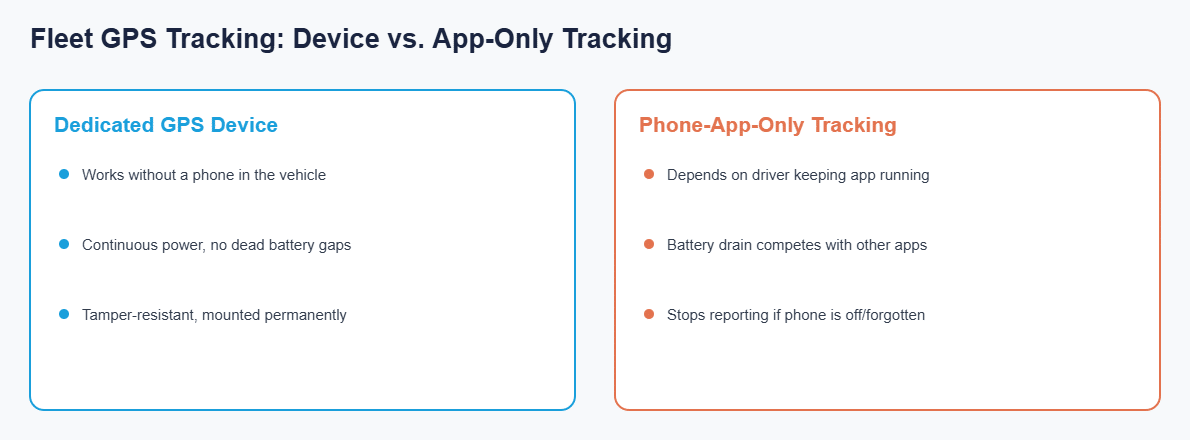
A driver’s personal phone running a tracking app looks like a free solution, but it’s dependent on the driver keeping the app open, the phone charged, and the device actually in the vehicle. A dedicated GPS tracking device mounted permanently in the vehicle removes all three failure points — it reports continuously off the vehicle’s own power, regardless of what the driver’s phone is doing.
What “Real-Time” Actually Needs to Mean
Real time fleet tracking gets marketed as a headline feature, but the update frequency itself matters less than what triggers an alert. A dispatcher doesn’t need to watch a truck’s position tick by every few seconds — they need to know the moment a vehicle sits idle for 20 minutes when it should be moving, or drifts off its expected route, or is running late enough that a customer needs a heads-up call before they ask for one. The exceptions are what a gps fleet management system should be built to surface, not the routine positions in between.
Does a Small Fleet Need This Too?
Vehicle tracking for small business fleets often gets treated as an unnecessary expense reserved for large operations — in practice, the same reliability problems (a driver who’s lost, a vehicle that’s stopped somewhere unexpected, a customer asking “where’s my delivery”) hit a 5-vehicle fleet just as hard as a 500-vehicle one. The difference at small scale isn’t whether tracking is needed, it’s that the setup and monthly overhead need to stay proportionate — which is exactly where a tracking capability built into the same terminal running dispatch and navigation, rather than a separate standalone tracker and subscription, keeps the cost and complexity down.
How This Connects to the Rest of the Vehicle’s Software
Location data is most useful when it isn’t siloed in a standalone tracking device — the same GNSS positioning that feeds a fleet map can also feed MDM remote fleet management, giving a single dashboard both the vehicle’s location and its device health at once. For fleets weighing a dedicated GPS unit against a vehicle-mount terminal that already includes GNSS as one function among several, our Fleet GPS Tracking Hardware guide covers that hardware-level tradeoff directly.
Common Questions
Is phone-app tracking good enough for a small fleet?
It works until the app is closed, the phone dies, or the driver leaves it at home — a dedicated device removes that dependency entirely, even for just a few vehicles.
How often does a GPS tracking device need to report position?
Frequent enough to catch meaningful deviations (typically every 30 seconds to a few minutes) — what matters more is which events trigger an alert, not the raw update rate.
Do I need separate tracking hardware if my vehicles already have a dispatch tablet?
Not necessarily — a vehicle-mount terminal with built-in GNSS can handle tracking and dispatch together, avoiding a second device and subscription.
What should trigger an alert in a fleet tracking system?
Unexpected idle time, route deviation, and ETA drift are the three exceptions worth surfacing — routine, on-schedule positions don’t need active attention.
For trucking fleets the same terminal usually carries the compliance load as well as the tracking load, and the logging requirement changes what has to be specified — set out in the best tablet for ELD logs.
Where the decision is still open between a hidden tracker box and a terminal the operator works with, the split is worked through asset by asset in fleet tracking hardware: GPS trackers vs vehicle terminals.
Interested in specs or a quote? Contact our team to discuss GPS tracking options for your fleet.