
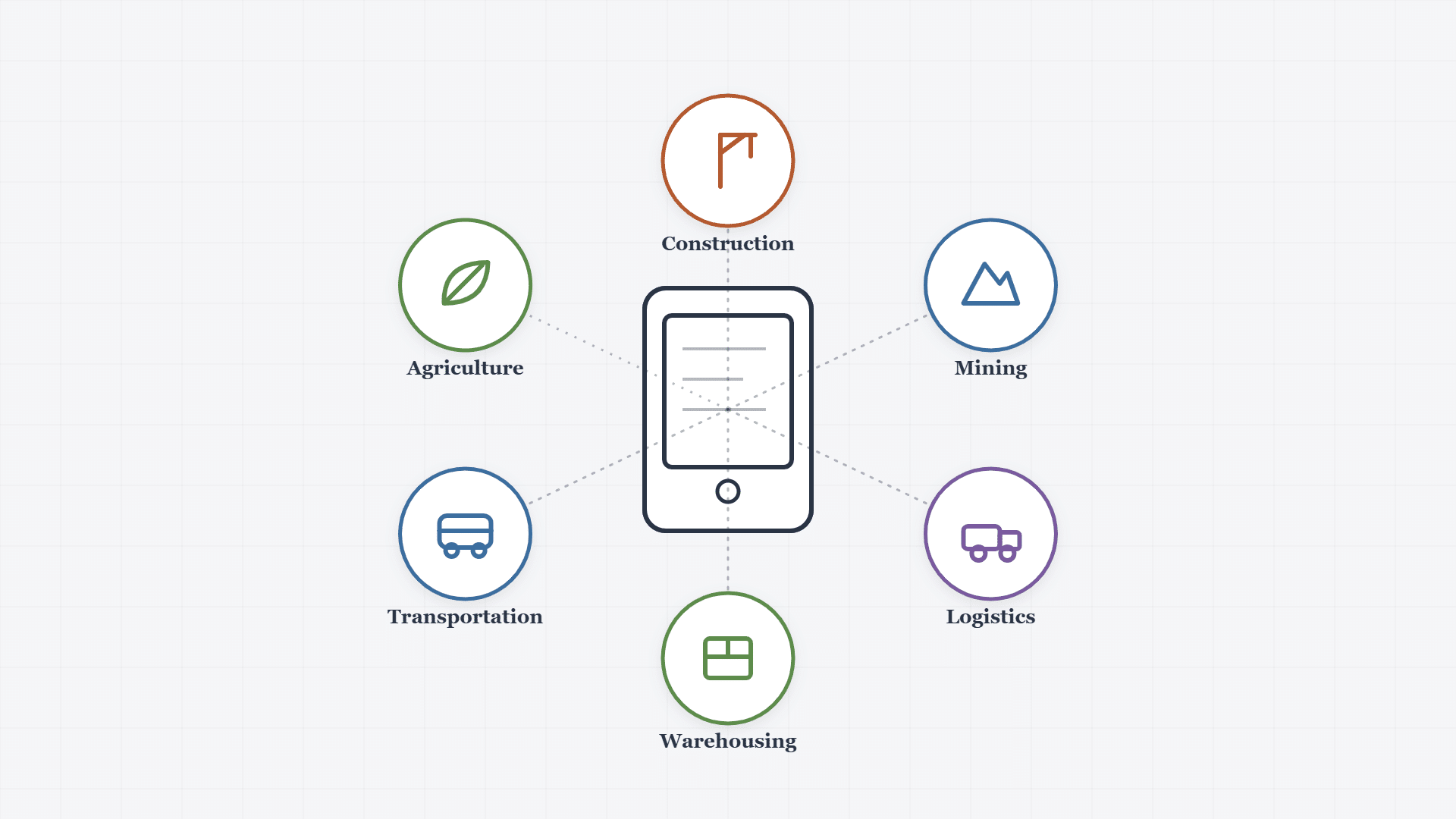
The main rugged vehicle tablet use cases are precision agriculture, construction and earthmoving, mining and ports, logistics and fleet management, warehousing, and public transport. CF-Device ships more than 140,000 rugged vehicle terminals a year into 33 countries, and the hardware does not change dramatically between these jobs. What changes is the software and sensors the same durable, connected platform is paired with. This guide walks through each use case by industry and links to a deeper breakdown of each.
TL;DR
- The same vehicle-grade platform family serves agriculture, construction, mining, logistics, warehousing and transit
- What changes between industries is the software and sensor layer, not the core tablet
- Agriculture is the most varied single-vehicle use case: guidance, variable-rate application and implement control
- Passenger transport prioritises safety software (DMS and AVM); mining prioritises durability
- CF-Device’s VCM range is sealed to IP65–IP67 and tested to MIL-STD-810; supply voltage, temperature range and interfaces are set per model
- Evaluate platform software and sensor support, not “is there a tablet for my industry”
Precision Agriculture
Agriculture is where a rugged tablet does the most varied work in one vehicle, from straight-line guidance in the field to variable-rate spraying that adjusts application by zone. Both rely on the same RTK-guided positioning data, applied to different implements. Related reading: what is ISOBUS VT, what goes on the tractor, GPS accuracy tiers for tractors and the precision agriculture and fleet tracking hub.
Construction and Earthmoving
On a construction site, rugged tablets support real-time grade and depth data for excavators and dozers, and compaction tracking for rollers. See excavator slope grading and depth assistance and road roller compaction and bulldozer blade monitoring. Both reduce rework by replacing operator judgement with sensor-verified data. Construction is also the clearest case of one site needing several hardware specs at once — machine-mounted, supervisor, office and survey — broken down in tablet for the construction industry. For tracking machines and crews, see rugged tablets for construction fleet tracking, and for accuracy by machine type, GPS for heavy equipment.
Mining and Port Operations
Mining and ports push rugged tablets into their harshest conditions: wide temperature swings, dust and heavy vibration. See how tablets support mining fleet operations and port and yard operations, including gantry crane positioning, where high-precision positioning matters as much as ruggedness. The positioning side is covered in precision positioning for port and yard equipment.
Logistics and Fleet Management
For logistics operators the tablet’s role shifts toward connectivity and coordination. Our guides on fleet management, logistics and transportation fleet terminals and cold chain logistics cover how the same hardware supports route tracking, temperature-sensitive cargo and dispatch. Municipal operations are in municipal fleet and waste collection tracking. For the data side of tracking, start with GPS tracking for fleet vehicles.
Smart Warehousing
Inside warehouses and yards, forklifts and AGVs use rugged tablets for navigation and safety. See smart warehousing for forklifts and AGVs, where collision-avoidance software runs alongside standard fleet tracking. Warehouse forklift safety is one of the more layered deployments, combining outward pedestrian detection, machine speed control and inward driver monitoring, compared in the forklift safety system guide.
Passenger and Public Transportation
For passenger-carrying fleets, safety software takes priority. Smart transportation with DMS and 360° AVM covers how driver monitoring and surround view work together in this context, and rugged tablets for public transit and bus fleets covers fleet management. Road transport is the use case with the widest choice of hardware; the models fleets deploy are compared in the best tablets for truck drivers. Across all of these the first hardware question is the same: does the asset need a screen or only a position report? That split is in fleet tracking hardware: GPS trackers vs vehicle terminals.
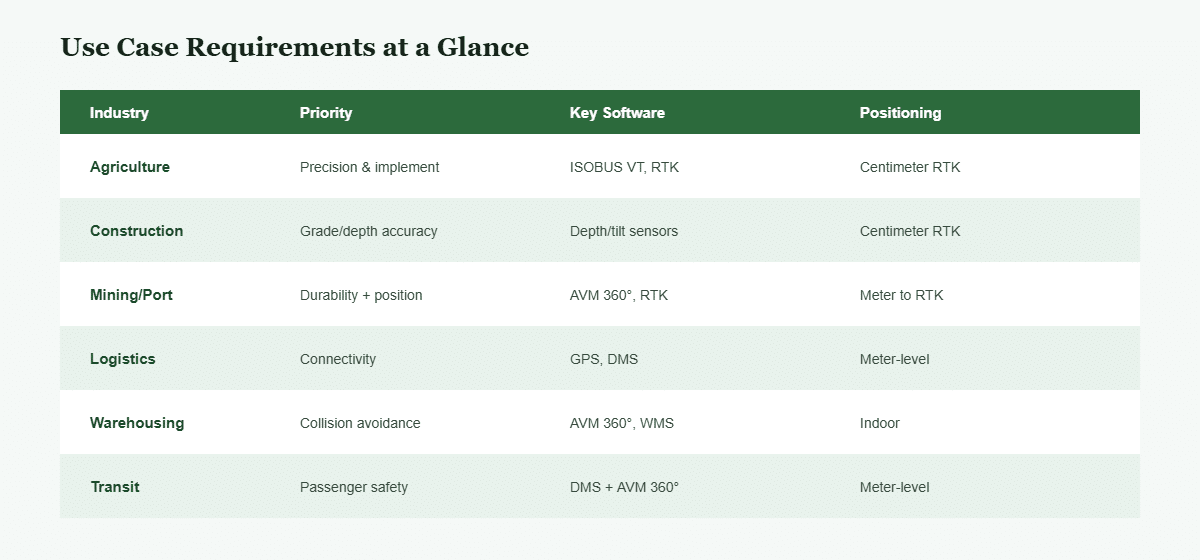
Rugged Vehicle Tablet Use Cases at a Glance
| Industry | Priority | Key software and sensors | Positioning | Guide |
|---|---|---|---|---|
| Agriculture | Precision and implement control | ISOBUS VT, RTK guidance | Centimetre RTK | Agriculture hub |
| Construction | Grade and depth accuracy | Depth and tilt sensors | Centimetre RTK | Construction |
| Mining and port | Durability and positioning | AVM 360°, RTK | Metre to RTK | Mining |
| Logistics | Connectivity | GPS tracking, DMS | Metre-level | Logistics |
| Warehousing | Collision avoidance | AVM 360°, WMS link | Indoor / not applicable | Warehousing |
| Transit | Passenger safety | DMS and AVM 360° | Metre-level | Transit |
Does Each Industry Need a Different Tablet Model?
No. The core hardware requirement — durability, connectivity, display visibility — is shared across all six; what gets matched to the industry is the configuration. CF-Device covers them from one VCM platform family: the VCM V12 series (12.1″) for the largest screen area for ISOBUS implement control and multi-camera surround view (every VCM model supports CF ISOBUS VT or is compatible with it), the VCM V10 and S10-2 series (10.1″) as the general fleet standard, the VCM V7 series (7″) for compact cabs, and the TANK V2 as a screenless compute unit for custom installations. Supply voltage, operating temperature range and operating system versions differ by model, so confirm them on the model page.
One Platform, Many Jobs
What ties these use cases together is that the hardware requirement changes little between industries. What changes is the software layer on top, covered in One Tablet, Four Systems: MDM, DMS, 360° AVM and ISOBUS VT. Buyers evaluating a rugged tablet for a new use case should ask less “does a tablet exist for my industry” and more “does this platform support the software and sensor integrations my fleet needs” — and, before that, whether the company quoting it builds the hardware, as set out in rugged tablet manufacturers: how to tell a real maker from a reseller. Which specific tablet fits each job is a hardware question: see the rugged vehicle tablet hardware buyer’s guide, the mobile device management hub for managing the fleet, and the Rugged Vehicle Tablet Complete Guide for the full map.
Which Rugged Vehicle Tablet Use Case Is the Most Demanding on Hardware?
Mining and port operations push durability hardest: dust, vibration and temperature swings call for IP67 sealing, MIL-STD-810 vibration testing and a wide operating temperature range. Agriculture pushes the widest range of software at once: a single tractor terminal can run RTK guidance, ISOBUS implement control and AVM 360° surround view at the same time. Where on-device AI or many camera inputs are needed, look at the VCM M10, which carries the 6 TOPS NPU and up to eight AHD camera inputs.
Other Names for the Same Question
Fleet owners often ask for a rugged tablet for fleet management in general terms. The answer depends on the use case in the table above, because the tablet that suits a logistics fleet is not the one a mine needs.
Rugged tablets for transportation and logistics and rugged tablets for buses sit in the transport rows of the table above: a bus fleet leans on driver monitoring and surround view, while a logistics fleet leans on connectivity and fleet management. A rugged tablet for taxi dispatch is simpler still, a fixed, vehicle-powered screen that keeps dispatch running all shift. The same rugged tablet for fleet management question applies in every case.
Common Questions
What is a rugged vehicle tablet used for?
Across agriculture, construction, mining, logistics, warehousing and passenger transport. The same durable, connected platform runs different software (guidance, monitoring, tracking, implement control) depending on the job.
How do I choose a tablet if my use case spans two industries?
Specify to the harshest environment and the most demanding software combination in your operation. Hardware qualified for the worst case usually serves the lighter cases too.
How many countries does CF-Device deploy in?
33 countries and regions across six continents, with hardware shipments above 140,000 units in 2023, across all six of the industry use cases described above.
Interested in specs or a quote? Contact our team to discuss the right configuration for your use case.